Written and clinically reviewed by Dr. Mehmood Asghar, BDS, MPhil, PhD. Last reviewed: August 2, 2026. See our editorial standards.
Nano-hydroxyapatite vs. fluoride toothpaste. Learn what the evidence says about cavity prevention, enamel support, sensitivity, and choosing wisely. Choosing a toothpaste can feel more complicated than it should. Fluoride has a long history in cavity prevention, while nano-hydroxyapatite is increasingly marketed as a fluoride-free way to support enamel and reduce sensitivity.
Both ingredients are discussed in relation to enamel health, but they are not interchangeable in every situation. The best choice depends on your cavity risk, sensitivity, dry-mouth symptoms, dental history, age, preferences, and the advice of your dentist.
Quick Answer
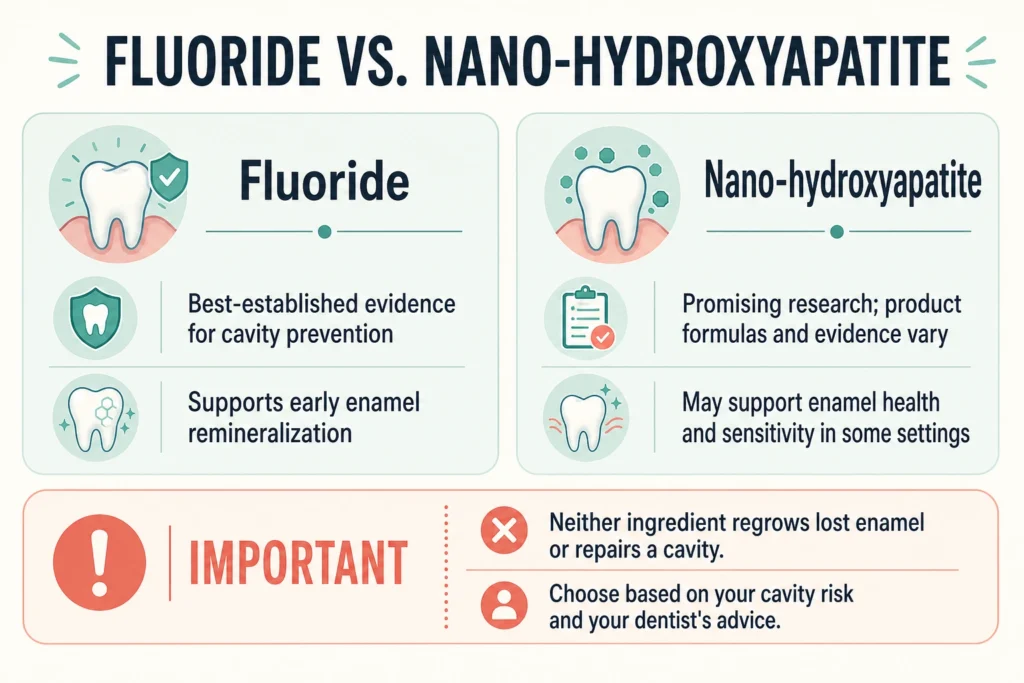
Fluoride remains the most established toothpaste ingredient for preventing cavities and supporting remineralization of early enamel mineral loss. Nano-hydroxyapatite is a promising ingredient used in some toothpastes, and research suggests it may support enamel health and sensitivity in certain settings. However, products and studies vary, so it should not be presented as a universal replacement for fluoride for every person.
For a practical guide to daily enamel care and the limits of remineralization, read How to Remineralize Teeth: What Helps—and What Cannot Be Reversed.
Nano-Hydroxyapatite vs. Fluoride: Why This Comparison Matters
People usually search for fluoride versus nano-hydroxyapatite because they want a simple answer: “Which one is better for my teeth?”
The more useful question is: “Which option makes sense for my risk and my goals?”
Someone with repeated cavities, dry mouth, exposed roots, or a high-sugar diet may need a different prevention plan from someone whose main concern is mild sensitivity. A person who prefers a fluoride-free toothpaste may also benefit from a discussion that looks at the whole picture rather than relying on marketing language.
Neither ingredient can regrow a chipped tooth, repair a formed cavity, or reverse significant enamel erosion. Toothpaste is one part of prevention—not a substitute for an examination when there is pain, a visible hole, persistent sensitivity, or a changing tooth surface.
For a clearer explanation of the difference between remineralizing weakened enamel and replacing enamel that has been physically lost, read Can Enamel Grow Back?
What Is Fluoride?
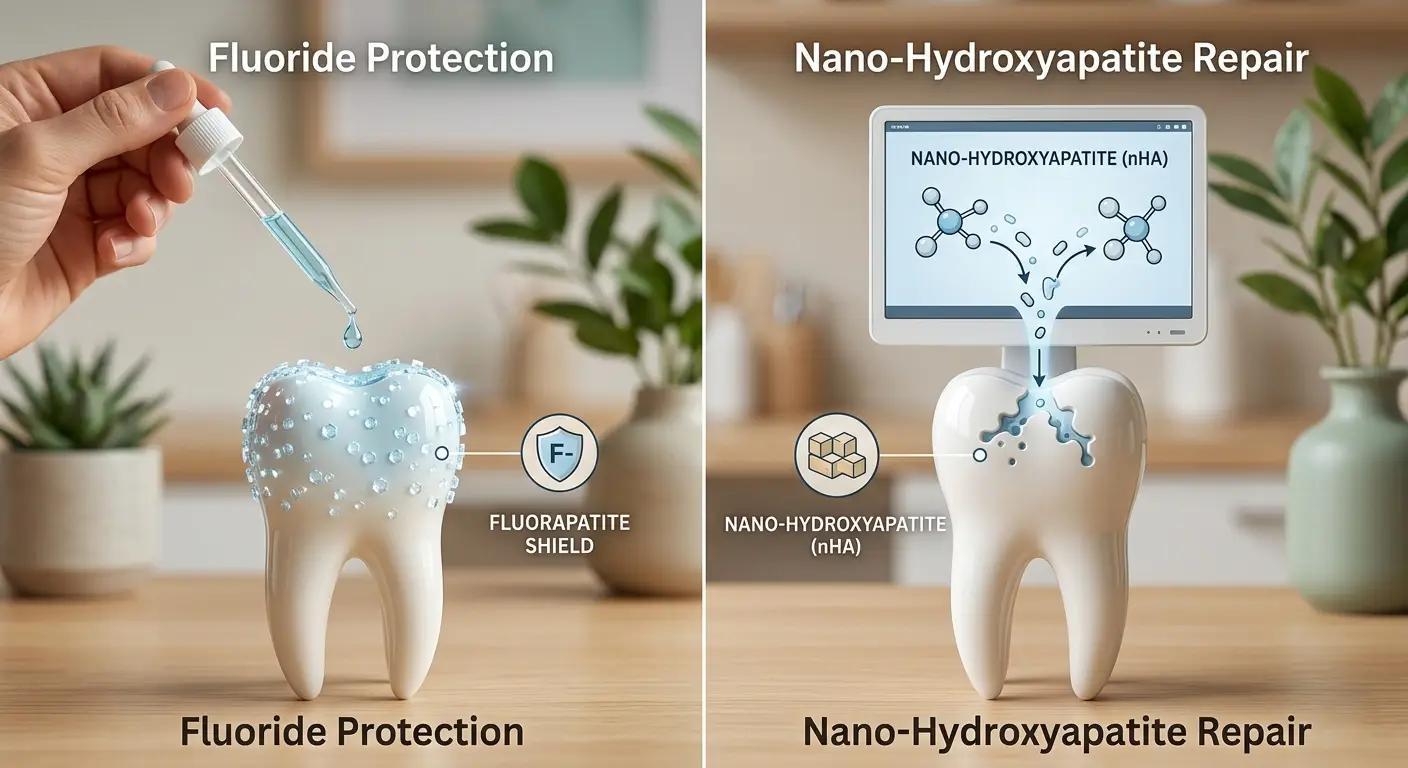
Fluoride is a mineral used in many toothpastes, mouth rinses, varnishes, and other dental products. It helps make enamel more resistant to acid and supports the replacement of minerals in areas of early enamel mineral loss.
The American Dental Association explains that fluoride toothpaste helps prevent tooth decay and supports remineralization in the early stages of decay. The National Institute of Dental and Craniofacial Research also describes fluoride as helping strengthen enamel and reverse early decay by replenishing lost minerals.
What Fluoride Is Well Established For
Fluoride has the strongest long-term evidence base for:
- Reducing the risk of cavities.
- Supporting remineralization in the earliest stage of tooth decay.
- Strengthening enamel against future acid attacks.
- Helping people with increased cavity risk as part of a dentist-directed prevention plan.
This does not mean every person needs the same fluoride product or concentration. A dentist may recommend a more tailored approach for people with dry mouth, frequent cavities, orthodontic appliances, exposed roots, or other risk factors.
Who May Need a Personalized Fluoride Plan?
A dental professional may want to discuss fluoride options more closely if you:
- Have had multiple cavities or fillings in recent years.
- Experience persistent dry mouth.
- Have reflux, frequent vomiting, or regular acid exposure.
- Wear braces or retainers that make cleaning more difficult.
- Have exposed root surfaces.
- Are caring for a child who may swallow toothpaste.
Do not change a child’s toothpaste routine or use high-fluoride products without age-appropriate advice from a dentist or pediatric clinician.
What Is Nano-Hydroxyapatite?
Hydroxyapatite is a calcium-phosphate mineral related to the mineral found naturally in teeth and bone. Nano-hydroxyapatite refers to very small particles of this material used in some oral-care products.
In toothpaste, nano-hydroxyapatite is often promoted for enamel support, sensitivity, and a fluoride-free oral-care routine. The idea is that the material may interact with the tooth surface and contribute to mineral deposition in areas of early mineral loss.
That is biologically plausible, but a plausible mechanism is not the same as a guaranteed clinical result for every product or every person.
Nano-Hydroxyapatite vs. Fluoride: What Research Suggests
Clinical research on hydroxyapatite-based products is growing. A 2024 systematic review and meta-analysis found expanding evidence for hydroxyapatite-containing oral-care products in caries prevention.
However, it is important to read this evidence carefully. Studies use different formulations, concentrations, comparison products, study lengths, and outcomes. Some reviews also include authors with industry affiliations, which does not automatically invalidate the findings but is a reason to avoid overly confident marketing claims.
Earlier evidence reviews found that, in some settings, nano-hydroxyapatite and fluoride had similar remineralization potential, while the overall certainty of evidence was low and several studies had a high risk of bias or manufacturer involvement. This systematic review explains those limitations.
What Research Does Not Yet Prove
Current research does not justify saying that every nano-hydroxyapatite toothpaste:
- Works better than fluoride toothpaste.
- Is equally effective for every person and every level of cavity risk.
- Can regrow lost enamel.
- Can repair an established cavity.
- Makes dental checkups unnecessary.
- Is automatically the right choice simply because it is fluoride-free.
Product labels can sound more certain than the research actually is. Look for clear claims, avoid miracle language, and ask a dentist if you have a history of decay or other risk factors.
Nano-Hydroxyapatite vs. Fluoride: A Practical Comparison
| Question | Fluoride | Nano-Hydroxyapatite |
|---|---|---|
| Is it well established for cavity prevention? | Yes. It has a long record of evidence and is widely used in cavity-prevention toothpaste. | Research is promising, but formulas and study quality vary. |
| Can it support early remineralization? | Yes, especially in the earliest stage of mineral loss. | It may support early mineral deposition, but outcomes vary between products and studies. |
| Can it regrow lost enamel or repair a cavity? | No. | No. |
| Is it useful for everyone in the same way? | No. Risk level, age, and dental history matter. | No. Product type, risk level, and evidence limitations matter. |
| Is it a substitute for dental care? | No. | No. |
| Should you choose based only on online claims? | No. | No. |
What About Sensitivity?
Tooth sensitivity can happen for many reasons, including exposed dentin, gum recession, enamel wear, cracked teeth, cavities, aggressive brushing, or recent dental treatment.
Some toothpastes are formulated to help reduce sensitivity. Nano-hydroxyapatite may be included in products marketed for this purpose, while other products use ingredients such as potassium salts or stannous fluoride.
Sensitivity is not a diagnosis. If it is new, severe, localized to one tooth, worsening, or associated with pain when biting, arrange a dental assessment rather than changing toothpaste repeatedly.
Can You Use Fluoride and Nano-Hydroxyapatite Together?
Some products contain both ingredients. This does not automatically mean they are better than every fluoride-only or nano-hydroxyapatite-only product.
A systematic review found promising findings for early white-spot lesions but concluded that the number and type of studies were too limited to recommend broad use on that basis alone.
In practical terms, do not assume that “more active ingredients” always means better protection. Choose an approach that is appropriate for your cavity risk, is comfortable to use consistently, and fits advice from your dentist.
How to Think About Your Choice

Consider fluoride toothpaste first if you want the most established evidence base for cavity prevention or if your dentist has identified a higher risk of decay.
Consider discussing nano-hydroxyapatite toothpaste if you prefer a fluoride-free option, are interested in the ingredient for sensitivity or enamel-support reasons, or have questions about a particular product. This conversation is especially useful if you have a history of cavities, dry mouth, exposed roots, or recent dental treatment.
A good dental prevention plan also includes gentle brushing, cleaning between teeth, reducing frequent sugary and acidic exposures, drinking water, and attending regular dental checkups.
Questions to Ask Your Dentist
- Based on my cavity history, am I considered low, moderate, or high risk?
- Is my sensitivity likely to be from enamel wear, exposed dentin, a cavity, or another cause?
- Would fluoride toothpaste be appropriate for me?
- If I prefer a fluoride-free toothpaste, what should I realistically expect from it?
- Do I need a professional fluoride treatment, prescription product, or another preventive measure?
- Are dry mouth, reflux, diet, or tooth grinding contributing to my risk?
Frequently Asked Questions
Is nano-hydroxyapatite safer than fluoride?
They are different ingredients, and “safer” depends on the person, the product, how it is used, and the clinical question. Fluoride toothpaste has established safety and effectiveness when used as directed. If you have concerns about fluoride, a child’s toothpaste use, or a specific product, discuss them with a dentist or pediatric clinician.
Is nano-hydroxyapatite better than fluoride?
There is not one answer that applies to everyone. Fluoride has the stronger long-term evidence base for cavity prevention. Nano-hydroxyapatite is promising, but evidence differs between products and studies. “Better” depends on your dental risk and goals.
Can nano-hydroxyapatite replace fluoride toothpaste?
Some people choose fluoride-free toothpaste, but this should not be treated as a universal recommendation. People at higher risk of cavities should discuss their prevention plan with a dentist before changing an established fluoride routine.
Does nano-hydroxyapatite regrow enamel?
No. It does not regrow enamel that has been lost through a cavity, chip, or significant erosion. At most, oral-care products may support early mineral changes on a tooth surface that is still structurally intact.
Can I switch toothpaste if I have sensitive teeth?
You can discuss toothpaste options with a dentist, but do not assume sensitivity is minor. Persistent or one-sided sensitivity, pain when biting, visible tooth damage, or swelling should be assessed professionally.
Explore more evidence-based dental guidance in The Calm Dentist Guides and Blogs.

Dr. Mehmood Asghar is a Dentist and an Assistant Professor of Dental Materials, with nearly a decade of clinical experience. He holds a Ph.D. in Dental Biomaterials from Universiti Malaya and a Bachelor of Dental Surgery (BDS) from NUST. As a dedicated researcher with over 25 peer-reviewed publications and more than 310 citations in international journals, Dr. Asghar bridges the gap between clinical dentistry and advanced biomaterials research to provide patients with evidence-based, practical dental advice.
Discover more from The Calm Dentist Blog
Subscribe to get the latest posts sent to your email.