Bite Feels Off? Phantom Bite Syndrome, Dental Anxiety, and What to Do
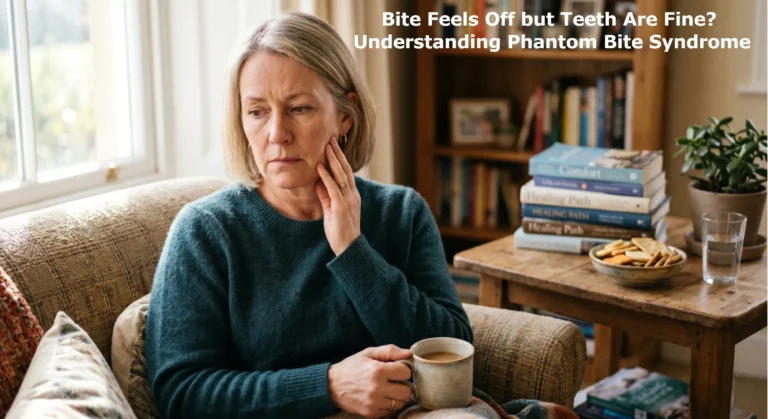
If your bite feels off, it can be surprisingly distressing. You may feel that one tooth touches too soon, your teeth do not meet properly, your jaw cannot find a comfortable position, or something is “wrong” even after your dentist says the bite looks fine.
This feeling can be confusing, especially when no obvious dental problem is found.
The important point is this:
The sensation is real — but the cause is not always a visible bite problem.
Sometimes a bite feels off because of a high filling, crown, tooth movement, jaw muscle tension, clenching, following a dental bone graft procedure, or a true dental issue. In other cases, the problem may be related to dental anxiety, bite hyperawareness, or a condition sometimes called phantom bite syndrome or occlusal dysesthesia.
This guide explains the difference in calm, practical language.
Quick Answer: Why Does My Bite Feel Off?
If your bite feels off, the cause may be a high filling, crown, recent dental work, clenching, jaw muscle tension, TMJ-related discomfort, or tooth sensitivity. These causes should be checked by a dentist, especially if the feeling started suddenly after treatment or one tooth feels like it hits first.
However, if your bite still feels wrong even after careful dental checks show no clear problem, the sensation may be linked to bite hyperawareness, dental anxiety, or phantom bite syndrome, also called occlusal dysesthesia.
The feeling is real, but repeated bite adjustments are not always the answer. If no clear high spot or dental problem is found, repeatedly grinding or adjusting the teeth can sometimes increase bite awareness and remove healthy tooth structure unnecessarily.
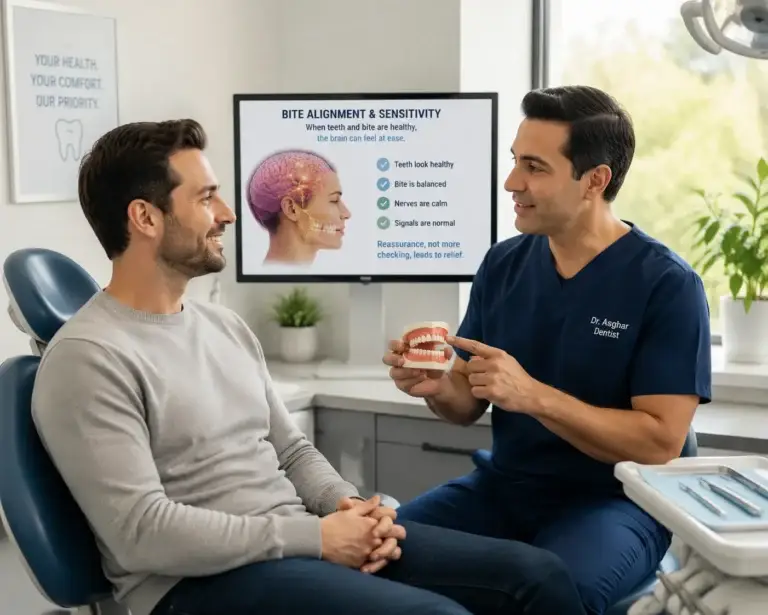
Best first step: ask your dentist for a focused bite, tooth, gum, jaw muscle, and TMJ evaluation. If everything looks stable, avoid repeatedly tapping, clenching, or testing your bite, as this can make the sensation feel stronger.
Table of Contents
- Quick Answer: Why Does My Bite Feel Off?
- What Does “My Bite Feels Off” Usually Mean?
- Symptoms of Phantom Bite Syndrome
- Common Reasons Your Bite May Feel Off
- When It May Be a Real Dental Bite Problem
- Real Bite Problem vs Phantom Bite Syndrome
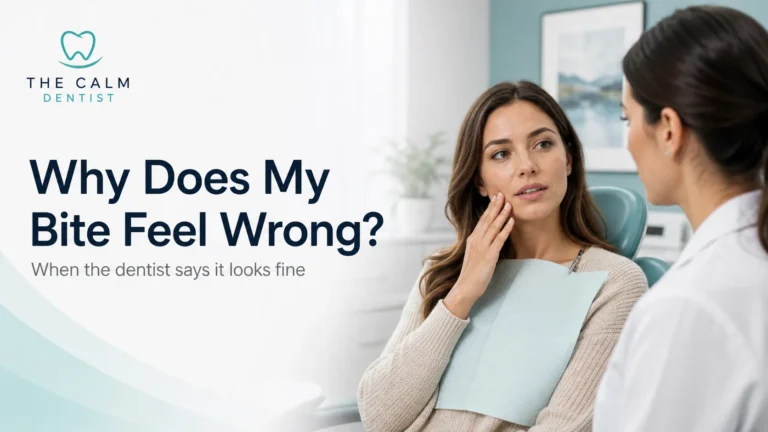
- When the Bite Looks Fine but Still Feels Wrong
- What Is Phantom Bite Syndrome?
- Why Repeated Bite Adjustments Can Be Risky
- The Bite-Anxiety Cycle
- What Not To Do If Your Bite Feels Off
- What To Do First
- Treatment Options for Phantom Bite Syndrome and Bite Discomfort
- Dental Splints, Mouthguards, and Night Guards
- Dental Products and Home Devices: What Helps and What To Avoid
- Sedation Options for Anxious Patients With Bite Concerns
- How To Find a Dentist Who Treats Bite Problems or Phantom Bite Syndrome
- Can Online Consultations Help?
- Cost of Bite Adjustment, Splints, and Specialist Care
- When To Contact a Dentist Urgently
- FAQs About a Bite That Feels Off
- Suggested Reading
- Final Thoughts
What Does “My Bite Feels Off” Usually Mean?
Patients describe this feeling in many ways:
- “My teeth do not fit together anymore.”
- “One side touches before the other.”
- “My bite feels high.”
- “My teeth feel weird.”
- “My jaw cannot find a comfortable position.”
- “My dentist says everything looks fine, but it still feels wrong.”
- “I keep checking my bite all day.”
- “I cannot stop noticing how my teeth touch.”
These symptoms can happen after dental treatment, during periods of stress, or without an obvious trigger.
Symptoms of Phantom Bite Syndrome
Phantom bite syndrome does not look the same in every patient. The most common symptom is a persistent feeling that the bite is uncomfortable, uneven, or wrong, even when the dentist cannot find a clear dental cause that explains the severity of the sensation.
Possible symptoms include:
- a constant feeling that one tooth is too high
- a feeling that the jaw cannot close comfortably
- repeated awareness of how the teeth touch
- a sense that the bite changes throughout the day
- discomfort despite normal-looking dental checks
- difficulty relaxing the jaw
- repeated urge to tap, clench, or slide the teeth together
- ongoing worry that the bite has been damaged
- feeling temporarily reassured after a dental visit, then worried again later
These symptoms can overlap with clenching, jaw muscle tension, TMJ-related discomfort, dental anxiety, and health anxiety. That is why a careful dental evaluation is important before assuming the cause.
Common Reasons Your Bite May Feel Off
A bite that feels wrong does not always have one single cause. The feeling can come from the teeth, jaw muscles, jaw joints, nerves, or the attention system.
1. A high filling or crown
This is one of the most common dental causes.
If a filling, crown, onlay, bridge, or implant crown is slightly high, one tooth may hit before the others. This can make the bite feel uneven and may cause tenderness when chewing.
A high filling or crown is more likely if the feeling started soon after dental treatment.
2. Recent dental treatment
After a dental procedure, your mouth may feel different for a short time. This can happen after:
- a filling
- a crown
- orthodontic movement
- a dental implant crown
- tooth extraction
- bite adjustment
- deep cleaning
- temporary restoration
Your tongue and jaw are very sensitive to small changes. Even a minor change can feel large at first.
3. Jaw muscle tension
Your bite is not controlled only by your teeth. Your jaw muscles guide how your teeth meet.
If the jaw muscles are tense, tired, or overactive, the bite may feel strange even if the teeth themselves are not the main problem.
This can happen with stress, clenching, grinding, poor sleep, long dental appointments, or repeated checking of the bite.
4. Clenching or grinding
Clenching and grinding can make teeth feel tender, heavy, high, or uncomfortable.
You may notice:
- jaw tiredness
- morning soreness
- headaches
- tooth sensitivity
- facial muscle tightness
- a feeling that the bite changes during the day
5. TMJ-related discomfort
The temporomandibular joint, often called the TMJ, helps your jaw open, close, and move side to side.
TMJ or jaw muscle problems can cause:
- jaw pain
- clicking or popping
- stiffness
- difficulty opening
- locking
- headaches
- ear-area discomfort
- a feeling that the teeth do not meet normally
If your jaw muscles or joints are irritated, your bite may feel unstable even when the tooth surfaces are not the main issue.
You can read more about temporomandibular disorders from the National Institute of Dental and Craniofacial Research and the American Dental Association’s MouthHealthy TMJ guide.
6. Dental anxiety and bite hyperawareness
When you are anxious about your teeth, your brain may start monitoring normal tooth contact more closely.
This is called hyperawareness.
The more you check your bite, the more noticeable it becomes. This can create a loop where normal sensations begin to feel abnormal or threatening.
For a deeper explanation, read: Dental Anxiety and Hyperawareness: Why Your Bite Feels Off.
7. Phantom bite syndrome or occlusal dysesthesia
Phantom bite syndrome, also called occlusal dysesthesia, describes a persistent feeling that the bite is wrong despite no matching dental explanation being found.
This does not mean the patient is imagining it.
It means the sensation is real, but the cause may involve the nervous system, attention, jaw muscle activity, anxiety, or altered sensory processing rather than a simple high spot that can be adjusted away.
You can also read our dedicated guide: Phantom Bite Syndrome: Why Your Bite Feels Off.
When It May Be a Real Dental Bite Problem
A real bite problem should always be considered first, especially if symptoms started after dental work.
You may need a dental review if:
- the bite changed suddenly after a filling or crown
- one tooth hits first
- chewing causes pain on one specific tooth
- a tooth feels bruised or tender
- the pain is reproducible when biting
- a crown or filling feels too high
- a tooth feels loose
- there is swelling, pus, or gum infection
- there was recent trauma
- you cannot chew normally
In these cases, your dentist may check the bite, restoration height, tooth vitality, gum condition, cracks, or signs of infection.
When the Bite Looks Fine but Still Feels Wrong
This is where many patients become frustrated.
You may have had:
- bite paper checks
- X-rays
- dental examination
- multiple adjustments
- several opinions
Yet the feeling remains.
When this happens, the question changes from:
“Which tooth is high?”
to:
“Why does my nervous system keep detecting the bite as wrong?”
This distinction matters because the wrong treatment approach can make things worse.
What Is Phantom Bite Syndrome?
Phantom bite syndrome is a term used when a person has a persistent feeling of an uncomfortable or incorrect bite, but the dentist cannot identify a matching bite abnormality that explains the severity of the symptoms.
It is also called:
- occlusal dysesthesia
- occlusal discomfort syndrome
- persistent uncomfortable bite sensation
Patients may feel:
- one tooth is too high
- the jaw cannot close comfortably
- the bite keeps changing
- the teeth do not meet evenly
- there is constant awareness of tooth contact
Phantom bite syndrome can be emotionally exhausting because the patient feels something is wrong, but repeated dental treatment may not solve it.
For more background, you may review this article on phantom bite syndrome and this narrative review on occlusal dysesthesia.
Why Repeated Bite Adjustments Can Be Risky
If there is a clear high filling or restoration, a careful minor adjustment may help.
But if multiple dentists cannot find a clear bite problem, repeated bite grinding or adjustment can become risky.
Repeated bite adjustments may:
- remove healthy enamel
- change the bite unnecessarily
- increase your attention to tooth contact
- create new bite sensations
- make you feel you need “just one more adjustment”
- fail to solve the real cause if the issue is sensory or anxiety-driven
This does not mean bite adjustment is always wrong.
It means adjustment should be conservative, evidence-based, and linked to a clear clinical finding.
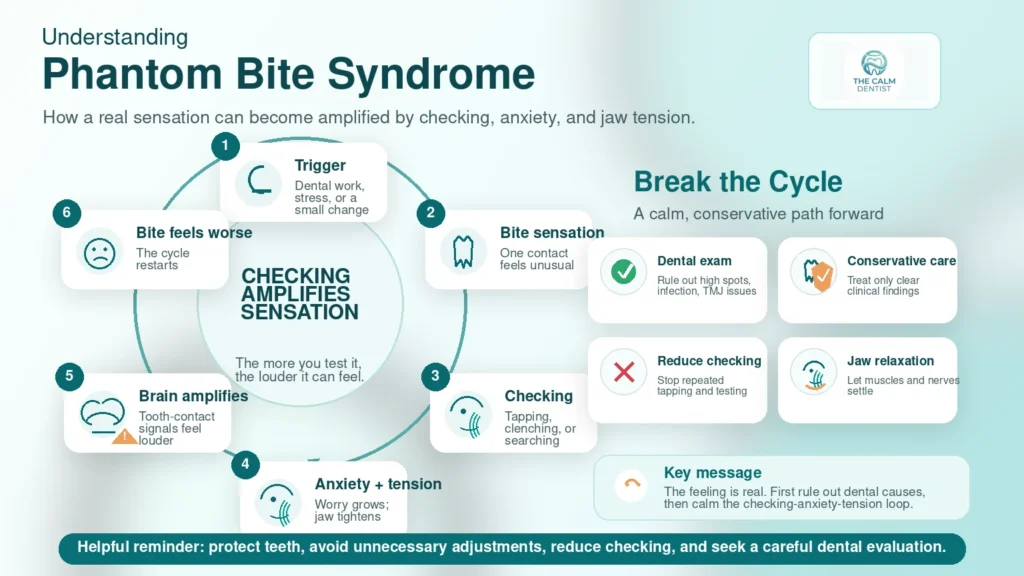
The Bite-Anxiety Cycle
A bite that feels off can trigger a cycle:
Bite feels strange
↓
You check it repeatedly
↓
Jaw muscles become tense
↓
Teeth feel more noticeable
↓
Anxiety increases
↓
The bite feels even more wrong
This cycle can become self-reinforcing.
The more you test your bite by tapping, sliding, clenching, or searching for the “perfect” contact, the more sensitive your brain may become to normal tooth sensations.
What Not To Do If Your Bite Feels Off
If your bite feels wrong, try to avoid these behaviors:
- Do not repeatedly tap your teeth together to test the bite.
- Do not clench to “find” the correct position.
- Do not constantly slide your jaw side to side.
- Do not press on teeth with your tongue.
- Do not compare your bite every few minutes.
- Do not ask for repeated irreversible adjustments unless there is a clear clinical reason.
- Do not search online for hours if it increases your anxiety.
- Do not assume the problem is “all in your head.”
The goal is not to ignore symptoms. The goal is to stop feeding the checking cycle while still getting appropriate dental evaluation.
What To Do First
A calm, stepwise approach is best.
Step 1: Ask for a focused dental check
Your dentist should check for:
- high filling or crown
- tooth tenderness
- cracked tooth
- gum inflammation
- infection
- tooth mobility
- bite contacts
- jaw muscle tenderness
- signs of clenching or grinding
- TMJ symptoms
Step 2: Explain the pattern clearly
When you contact your dentist, describe:
- when the feeling started
- whether it began after dental treatment
- which tooth or side feels wrong
- whether pain is improving or worsening
- whether chewing hurts
- whether you are clenching or checking the bite
- whether stress or anxiety makes it worse
Step 3: Avoid constant bite testing
This is difficult but important.
Try to reduce tapping, sliding, clenching, and checking. These behaviors can keep the brain focused on the bite.
Step 4: Relax the jaw muscles
Use gentle strategies:
- keep lips together, teeth apart
- place the tongue lightly on the palate
- avoid chewing gum
- avoid very hard foods temporarily
- use warm compresses if advised
- take breaks from jaw clenching
- practice slow nasal breathing
Step 5: Consider jaw or orofacial pain evaluation
If symptoms include jaw pain, clicking, locking, headaches, muscle tenderness, or long-term bite discomfort, your dentist may recommend review by a dentist with experience in TMJ disorders or orofacial pain.
Step 6: Consider anxiety and hyperawareness support
If you are constantly monitoring your teeth, cannot stop checking your bite, or feel trapped in worry, anxiety-focused strategies may help.
This does not mean the symptoms are fake.
It means the attention and threat system may be amplifying the sensation.
Treatment Options for Phantom Bite Syndrome and Bite Discomfort
Treatment depends on the cause. The safest approach is usually conservative and stepwise.
| Possible Cause | Possible Approach |
|---|---|
| High filling or crown | Careful, conservative bite adjustment if one contact is clearly high. |
| Recent dental treatment | Short observation period, review appointment, and minor adjustment only if clearly needed. |
| Clenching or grinding | Night guard, habit awareness, jaw relaxation, and stress management. |
| Jaw muscle tension | Soft diet temporarily, warm compresses if advised, jaw relaxation, TMJ assessment, or physiotherapy. |
| TMJ-related symptoms | Conservative TMJ care, jaw exercises, professional evaluation, and avoiding unnecessary bite changes. |
| Dental anxiety or bite hyperawareness | Reassurance, reduced checking, anxiety-management strategies, and sometimes mental health support. |
| Phantom bite syndrome | Conservative, multidisciplinary care. Avoid irreversible treatment unless there is a clear clinical finding. |
| Tooth infection, crack, or gum problem | Dental diagnosis and treatment based on the exact cause. |
There is no single product or procedure that fixes every bite-feels-off case. The key is matching the treatment to the correct cause.
Dental Splints, Mouthguards, and Night Guards
Some patients with bite discomfort also clench or grind their teeth. In these cases, a dentist may recommend a dental splint, mouthguard, or night guard.
A custom dental splint may help by:
- reducing tooth wear from grinding
- protecting restorations
- reducing overload on certain teeth
- helping some jaw muscles relax
- providing a controlled bite surface during sleep
However, a splint is not always the answer. In some patients with strong bite hyperawareness, a new appliance can become another object of checking and worry.
Ask your dentist:
- What problem is the splint meant to solve?
- Is it for grinding, TMJ symptoms, tooth protection, or bite stabilization?
- How many hours should I wear it?
- How will we know if it is helping?
- When should it be reviewed or adjusted?
A custom appliance made by your dentist is usually more controlled than guessing with an over-the-counter guard, especially if your bite already feels unstable.
Dental Products and Home Devices: What Helps and What To Avoid
Many patients search for products or devices to check or fix their bite at home. Be careful.
Helpful home measures may include:
- a soft diet for a short period if chewing is uncomfortable
- warm compresses for jaw muscle tightness if advised
- avoiding chewing gum
- reducing caffeine if it worsens clenching or anxiety
- using prescribed or dentist-recommended rinses when relevant
- using a dentist-made night guard if prescribed
Avoid trying to adjust or diagnose your bite at home with:
- DIY bite filing
- online “bite correction” gadgets
- unverified alignment devices
- constant use of bite-checking paper without professional interpretation
- repeated self-testing by clenching, tapping, or sliding the jaw
Your bite involves teeth, jaw joints, muscles, and nerves. It should not be adjusted without professional evaluation.
Sedation Options for Anxious Patients With Bite Concerns
Some patients with bite concerns also feel anxious during dental visits. Sedation can help certain patients tolerate necessary dental care, but it does not diagnose the bite problem by itself.
Common anxiety-support options may include:
- calm, slow appointments with clear explanations
- breaks during treatment
- local anesthesia when needed
- nitrous oxide sedation, if available and suitable
- oral sedation, if appropriate and prescribed by a qualified dentist
- referral to a dentist experienced with anxious patients
If your main problem is bite hyperawareness or phantom bite syndrome, sedation may make dental visits easier, but it should not lead to unnecessary irreversible bite adjustments.
Before accepting treatment, ask:
- What exact dental problem are we treating?
- Is this treatment reversible or irreversible?
- What are the risks of adjusting the bite again?
- What happens if the symptoms are anxiety- or muscle-related?
How To Find a Dentist Who Treats Bite Problems or Phantom Bite Syndrome
If you are searching for a dentist who treats phantom bite syndrome, bite misalignment, or complex bite discomfort, look for someone who takes a conservative and diagnostic approach.
Search terms that may help include:
- dentist for bite problems near me
- occlusion dentist near me
- TMJ dentist near me
- orofacial pain specialist near me
- dentist for phantom bite syndrome
- dentist for occlusal dysesthesia
- anxiety-friendly dentist near me
When reviewing a clinic, look for signs that they:
- listen carefully to symptoms
- check teeth, restorations, jaw muscles, and TMJ
- avoid rushing into irreversible bite changes
- explain the diagnosis clearly
- understand clenching, jaw tension, and anxiety-related symptoms
- offer conservative options before major treatment
Be cautious if the first recommendation is major irreversible bite reconstruction without a clear diagnosis, especially if several dentists have already found no obvious bite problem.
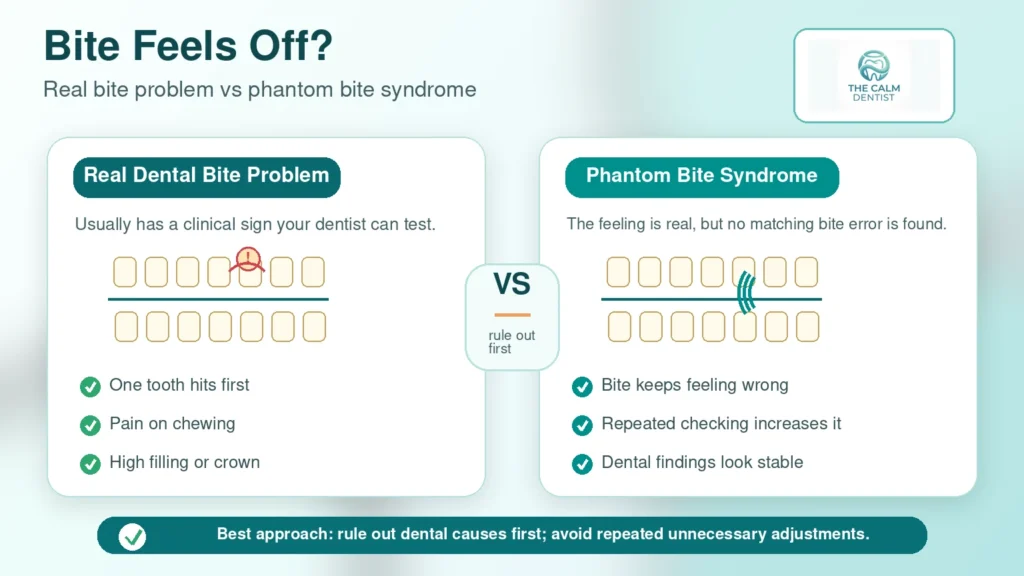
Real Bite Problem vs Phantom Bite Syndrome
One of the most important questions is whether the bite feels off because of a true dental problem or because the nervous system is interpreting normal bite sensations as abnormal. These two situations can feel very similar to the patient, but they need different approaches.
A real bite problem usually has a detectable dental cause. For example, one filling may be too high, a crown may hit early, a tooth may be cracked, or there may be inflammation around a tooth. In these cases, the dentist can usually find a clinical sign that matches the patient’s symptoms.
Phantom bite syndrome, also called occlusal dysesthesia, is different. The patient feels that the bite is wrong, but careful dental examination does not find a clear bite abnormality that explains the severity or persistence of the feeling. The sensation is still real, but the source may involve bite hyperawareness, jaw muscle tension, stress, anxiety, or altered sensory processing.
| Feature | Real Bite Problem | Phantom Bite Syndrome / Bite Hyperawareness |
|---|---|---|
| Main issue | A physical dental problem is usually present. | The bite feels wrong despite no clear matching dental problem. |
| Common trigger | Recent filling, crown, bridge, implant crown, tooth movement, trauma, cracked tooth, or infection. | Dental treatment, stress, anxiety, repeated bite checking, jaw tension, or sometimes no clear trigger. |
| How it feels | One tooth may hit first, feel high, or hurt when chewing. | The whole bite may feel uncomfortable, unstable, uneven, or impossible to settle. |
| Dental findings | The dentist may find a high restoration, tooth tenderness, crack, mobility, gum problem, or infection. | Dental checks may look normal or show only minor findings that do not explain the intensity of symptoms. |
| Pain pattern | Often localized to one tooth or one restoration. | Often difficult to localize, changes location, or becomes more noticeable with attention and checking. |
| Effect of bite adjustment | A careful minor adjustment may help if a clear high spot is found. | Repeated adjustments may not help and can sometimes worsen bite awareness. |
| Best first step | Focused dental examination to identify and correct the specific cause. | Rule out dental disease first, then focus on conservative care, reducing checking, jaw relaxation, and managing hyperawareness. |
A useful way to think about it is this:
If the dentist can find a clear problem that matches the symptoms, treat the problem conservatively.
If repeated examinations do not show a clear problem, avoid chasing the feeling with repeated irreversible bite adjustments.
This distinction protects your teeth. A real high filling may need a small correction, but phantom bite syndrome usually needs a broader, calmer approach that considers the teeth, jaw muscles, TMJ, anxiety, and the brain’s sensitivity to tooth contact.
If you are unsure which category you fall into, ask your dentist these questions:
- Can you identify one specific tooth or restoration that is hitting too early?
- Is there pain on biting that points to one tooth?
- Are there signs of a crack, infection, gum inflammation, or tooth mobility?
- Are my jaw muscles or TMJ tender?
- Would another adjustment remove healthy tooth structure?
- Is it safer to monitor, use conservative care, or seek an orofacial pain/TMJ opinion?
The goal is not to dismiss your symptoms. The goal is to choose the safest explanation and the least harmful treatment path.
Can Online Consultations Help?
An online dental consultation can sometimes help you organize your symptoms, understand possible causes, and decide what type of in-person evaluation you need.
Online consultation may be useful for:
- discussing your symptom pattern
- reviewing the timeline after a filling or crown
- understanding whether symptoms sound urgent
- preparing questions for your dentist
- deciding whether to seek a TMJ or orofacial pain opinion
However, an online consultation cannot fully check bite contacts, tooth cracks, tooth vitality, gum infection, jaw movement, or restoration height. If your symptoms are severe, worsening, or linked to swelling, pus, fever, trauma, or biting pain, you need an in-person dental assessment.
Cost of Bite Adjustment, Splints, and Specialist Care
The cost of care depends on what is causing the bite discomfort and where you are treated.
Possible cost factors include:
- consultation fee
- X-rays or CBCT scans, if needed
- minor bite adjustment
- replacement or correction of a high filling or crown
- custom night guard or splint
- TMJ or orofacial pain consultation
- physiotherapy or muscle-related care
- anxiety-support or sedation options
If affordability is a concern, ask the clinic:
- Can we start with diagnosis before treatment?
- What is the least invasive option?
- Is the proposed treatment reversible?
- Are there staged treatment options?
- Is a custom splint necessary now, or should we monitor first?
- What costs are expected before treatment begins?
A careful diagnosis can prevent unnecessary treatment costs, especially when repeated bite adjustments have not helped.
When To Contact a Dentist Urgently
Contact a dentist promptly if you have:
- severe toothache
- pain on biting one specific tooth
- swelling
- pus
- fever
- a gum boil
- a loose tooth
- recent dental trauma
- jaw locking
- difficulty opening your mouth
- difficulty eating
- symptoms that are rapidly worsening
If you have swelling that affects breathing, swallowing, the floor of the mouth, or the neck, seek urgent medical or dental care.
FAQs About a Bite That Feels Off
Why does my bite feel off but my dentist says it is fine?
Your bite may feel off because of jaw muscle tension, clenching, dental anxiety, hyperawareness, TMJ-related discomfort, or phantom bite syndrome. It is also possible that a subtle dental issue needs a focused review. If repeated checks show no clear bite problem, repeated adjustments may not be the best solution.
What are the symptoms of phantom bite syndrome?
Symptoms may include a persistent feeling that the bite is wrong, one tooth feels too high, the jaw cannot close comfortably, the bite keeps changing, or the teeth feel constantly noticeable despite normal dental findings.
Can anxiety make my teeth feel weird?
Yes. Anxiety can increase body monitoring and make normal tooth contact feel unusually noticeable. This is sometimes called hyperawareness. The sensation is real, but anxiety can amplify it.
What is phantom bite syndrome?
Phantom bite syndrome, also called occlusal dysesthesia, is a persistent feeling that the bite is wrong even when dentists cannot find a matching structural bite problem.
Can a high filling make my bite feel off?
Yes. A high filling or crown can make one tooth hit before the others. This may cause tenderness, chewing discomfort, or a feeling that the bite is uneven. A dentist can check this.
Should I keep getting my bite adjusted?
Only if there is a clear clinical reason. If no objective bite problem is found, repeated adjustments can remove healthy enamel and may worsen bite awareness.
Can clenching make my bite feel wrong?
Yes. Clenching can make teeth, jaw muscles, and the jaw joint feel strained. This can create the sensation that the bite is high, heavy, or unstable.
Can a mouthguard help if my bite feels off?
A mouthguard or splint may help if clenching, grinding, or tooth overload is contributing to the symptoms. However, it should be recommended after a proper dental assessment, especially if your bite already feels unstable.
Are there dental products that help with bite discomfort?
Some supportive measures, such as a dentist-made night guard, soft diet, warm compresses, and avoiding gum chewing, may help depending on the cause. Avoid DIY bite correction devices or self-adjustment.
How long does it take to get used to a new filling or crown?
Some patients adjust within a few days. If the bite feels high, painful, or does not improve, contact your dentist. A small adjustment may be needed if one area is hitting too strongly.
Can I have an online consultation for bite discomfort?
An online consultation may help you understand possible causes and prepare for an in-person visit. However, bite contacts, tooth cracks, gum infection, and jaw movement usually require in-person examination.
When should I get urgent dental help?
Seek prompt dental care if you have swelling, fever, pus, severe toothache, a loose tooth, trauma, jaw locking, or pain that is rapidly worsening.
Suggested Reading
On The Calm Dentist Blog
- Phantom Bite Syndrome: Why Your Bite Feels Off
- Dental Anxiety and Hyperawareness: Why Your Bite Feels Off
- Dental Bone Graft Guide: Healing, Recovery, Warning Signs, and Implant Timeline
External Resources
- National Institute of Dental and Craniofacial Research: Temporomandibular Disorders
- American Dental Association MouthHealthy: TMJ
- Phantom Bite Syndrome: Clinical Review
- Occlusal Dysesthesia: Narrative Review
Final Thoughts
A bite that feels off can be deeply frustrating, especially when the teeth look normal.
The goal is not to dismiss the feeling. The goal is to understand it properly.
Sometimes the answer is a simple dental adjustment. Sometimes the answer is jaw muscle care. Sometimes the key is reducing the checking cycle and calming the nervous system.
A careful, conservative approach protects your teeth while helping you move toward comfort again.
Medical Disclaimer
This article is for general educational purposes only and does not replace personalized advice from your dentist, oral surgeon, physician, or orofacial pain specialist. If your symptoms are severe, worsening, or associated with swelling, fever, pus, trauma, jaw locking, or difficulty eating, seek professional care.
About the Author
Dr. Mehmood Asghar, BDS, MPhil, PhD, writes The Calm Dentist Blog to help patients understand dental problems in clear, reassuring language. His approach combines dental science, patient education, and anxiety-sensitive communication.
“`
Dr. Mehmood Asghar is a Dentist and an Assistant Professor of Dental Materials, with nearly a decade of clinical experience. He holds a Ph.D. in Dental Biomaterials from Universiti Malaya and a Bachelor of Dental Surgery (BDS) from NUST. As a dedicated researcher with over 25 peer-reviewed publications and more than 310 citations in international journals, Dr. Asghar bridges the gap between clinical dentistry and advanced biomaterials research to provide patients with evidence-based, practical dental advice.