By Dr. Mehmood Asghar, BDS, MPhil, PhD
The Calm Dentist
Quick Answer
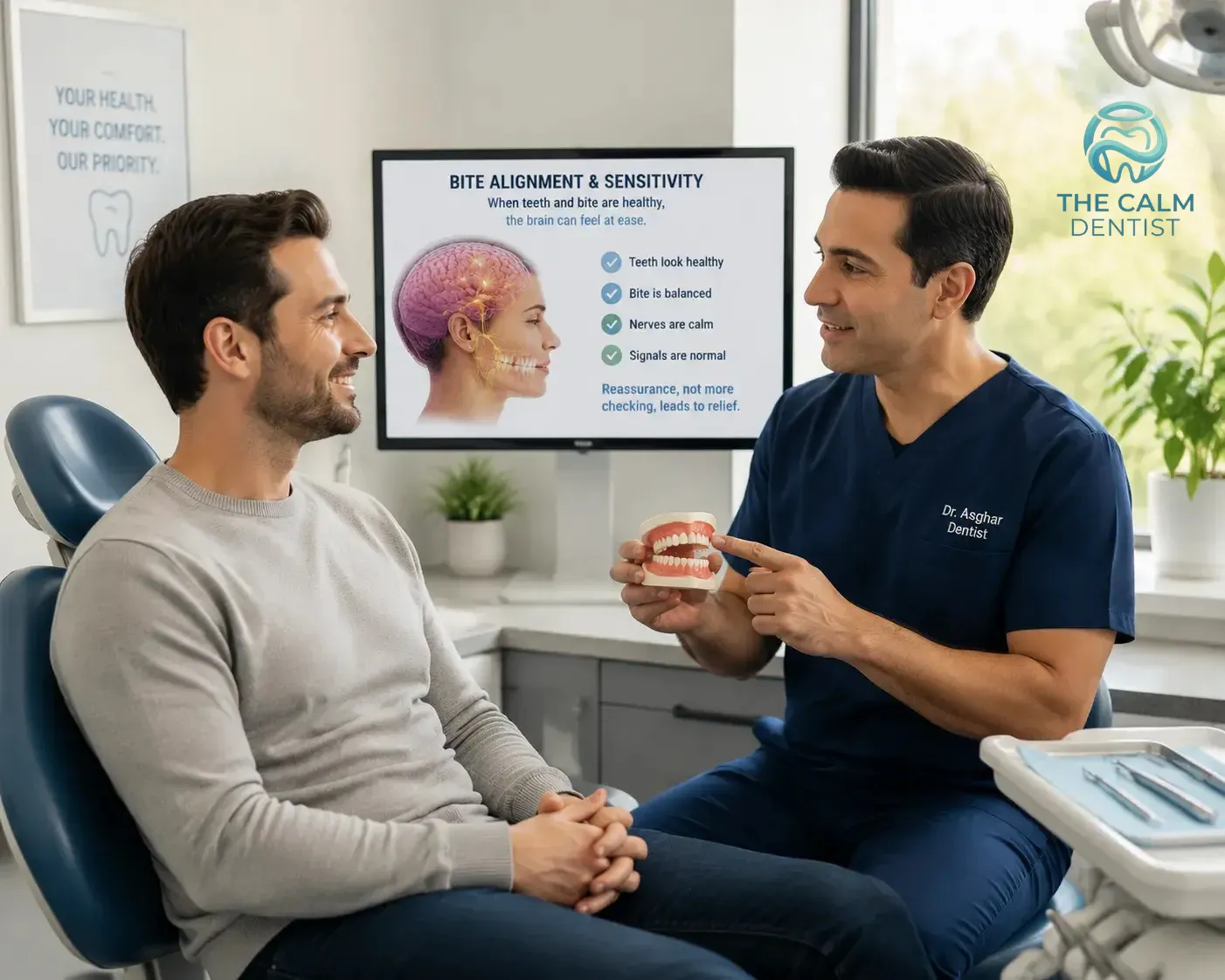
Can dental anxiety make your bite feel wrong? Yes. Dental anxiety can make your bite feel wrong by increasing your awareness of normal tooth contact, encouraging repeated bite checking, and increasing jaw muscle tension or clenching.
This does not mean the feeling is fake. It means the nervous system, jaw muscles, and attention system may be making normal bite sensations feel stronger, stranger, or more uncomfortable.
However, a real dental problem should always be ruled out first, especially if the feeling started after a filling, crown, bite adjustment, injury, tooth pain, swelling, or infection.
For the full overview of real bite problems, dental anxiety, bite hyperawareness, and phantom bite syndrome, read the main guide: Bite Feels Off? Phantom Bite Syndrome, Dental Anxiety, and What to Do.
What Does Bite Hyperawareness Mean?
Bite hyperawareness means you become unusually focused on how your teeth touch.
You may notice things that normally stay in the background, such as:
- one tooth touching before another
- the feeling of your teeth resting together
- small changes in jaw position
- pressure on one side
- tiny differences after a filling or crown
- the urge to tap, clench, or slide your teeth together
- a feeling that your jaw cannot find a comfortable place
The more you check the bite, the more noticeable it can become.
This can feel frightening because the bite is something you cannot easily “turn off.” Every swallow, chew, or jaw movement may remind you of it.
Can Anxiety Really Make Teeth Feel Weird?
Yes. Anxiety can increase body monitoring. When the brain is anxious, it can scan the body for signs of danger. For some people, that attention lands on the teeth, bite, jaw, tongue, throat, breathing, or heartbeat.
In dentistry, this can show up as:
- constant awareness of tooth contact
- repeated checking of the bite
- jaw clenching
- tooth tapping
- tongue pressing against teeth
- fear that dental work has changed the bite
- worry that the teeth will never feel normal again
The sensation is real. But the cause may not always be a visible bite problem.
A useful way to think about it is this:
Anxiety can turn up the “volume” on normal body sensations.
When that happens, a normal tooth contact may feel too strong, too high, or too strange.
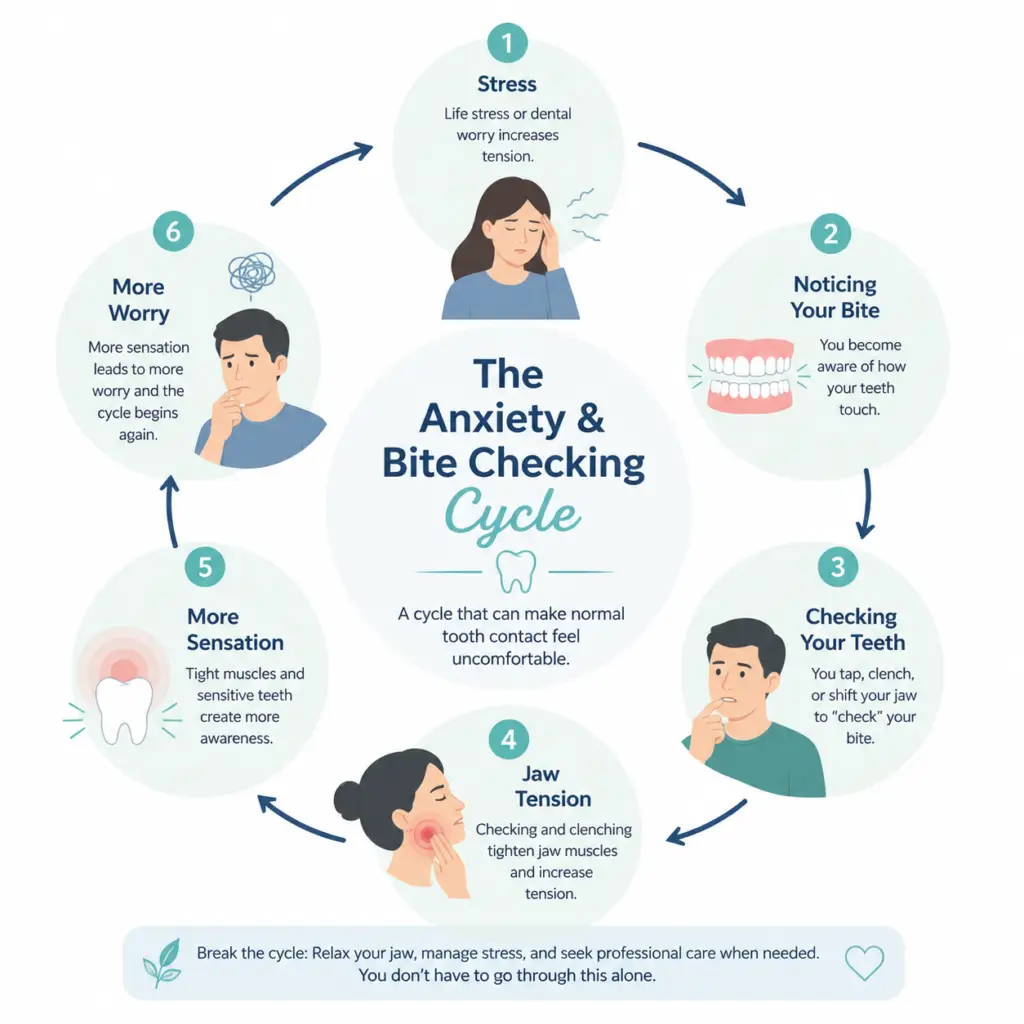
The Bite-Anxiety Cycle
A bite that feels wrong can start a cycle:
- You notice your bite.
- You check it by tapping or clenching.
- The jaw muscles become tense.
- Teeth and muscles feel more noticeable.
- Anxiety increases.
- The bite feels even more wrong.
- You check again.
This cycle can continue for days, weeks, or longer if it is not interrupted.
The goal is not to ignore symptoms. The goal is to avoid feeding the checking cycle while still getting a proper dental evaluation.
How Clenching and Grinding Can Make the Bite Feel Wrong
Dental anxiety often goes together with clenching or grinding.
Clenching can make the teeth, jaw muscles, and jaw joints feel overloaded. This can create the feeling that the bite is heavy, high, uneven, or unstable.
According to Mayo Clinic’s bruxism guide, awake bruxism may be linked with emotions such as anxiety, stress, anger, frustration, or tension. Bruxism can also cause symptoms such as tooth pain, sensitivity, tired jaw muscles, jaw pain, facial pain, and headaches.
This matters because a patient may think:
“My bite must be wrong.”
But sometimes the issue is:
“My jaw muscles and teeth are tense from clenching.”
That difference changes the treatment approach.
Dental Anxiety vs Real Bite Problem
Dental anxiety can make a bite feel wrong, but not every wrong-bite feeling is anxiety. A dentist should first check for real dental causes.
| Situation | More likely explanation |
|---|---|
| One tooth started hitting first after a new filling | Possible high filling |
| A crown feels too tall when chewing | Possible high crown |
| Pain happens on one tooth when biting | Tooth inflammation, crack, or bite overload |
| Jaw feels tired or sore in the morning | Clenching, grinding, or jaw muscle tension |
| Bite feels wrong but changes location | Bite hyperawareness, jaw tension, or sensory focus |
| Several dentists find no clear bite issue | Possible bite hyperawareness or phantom bite syndrome |
| Swelling, pus, fever, or severe pain is present | Possible infection or urgent dental problem |
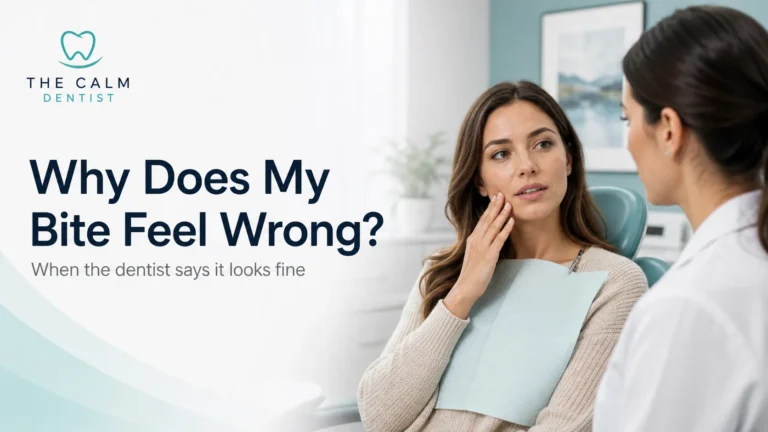
If your dentist says the bite looks fine but the feeling continues, you may also find this focused guide helpful: Why Does My Bite Feel Wrong Even After the Dentist Says It Is Fine?.
When It Might Not Be Anxiety
You should not assume anxiety is the cause until important dental problems are ruled out.
See a dentist if you have:
- pain on biting one specific tooth
- a filling or crown that feels too high
- tooth sensitivity that is worsening
- swelling
- pus
- bad taste
- fever
- a loose tooth
- recent dental trauma
- jaw locking
- difficulty chewing
- symptoms that are getting worse instead of better
Anxiety may amplify symptoms, but infection, cracks, high restorations, gum problems, and jaw disorders still need proper diagnosis.
What To Do First If Anxiety Is Making Your Bite Feel Wrong
1. Get a focused dental check
Ask your dentist to check:
- recent fillings or crowns
- bite contacts
- cracked teeth
- tooth tenderness
- gum inflammation
- jaw muscle tenderness
- signs of clenching or grinding
- TMJ symptoms
2. Stop repeatedly testing the bite
Try to reduce:
- tapping teeth together
- sliding the jaw side to side
- clenching to “find” the bite
- pressing teeth with the tongue
- checking in the mirror repeatedly
- comparing left and right tooth contact all day
This is difficult at first, but it is important. Repeated checking can train the brain to keep noticing the bite.
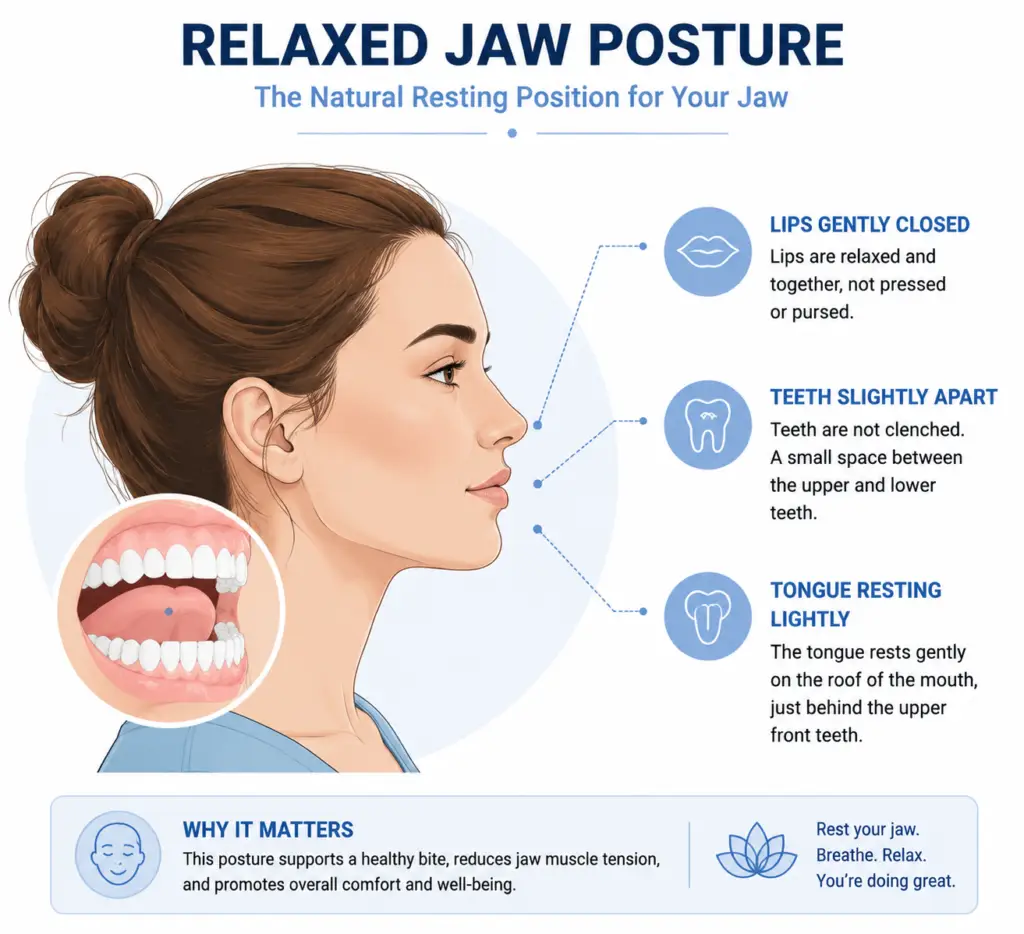
3. Relax the jaw
A simple resting position is:
Lips together, teeth apart, tongue relaxed.
Your teeth do not need to touch when you are resting.
4. Reduce jaw overload
For a short time, you may benefit from:
- avoiding chewing gum
- avoiding very hard foods
- taking breaks during stressful work
- noticing when you clench
- using warm compresses if advised
- improving sleep routine
- reducing caffeine if it worsens clenching or anxiety
5. Ask about support for anxiety or clenching
Mayo Clinic notes that bruxism treatment may include stress or anxiety management and behavior change strategies when stress or anxiety is contributing to grinding or clenching (Mayo Clinic).
This does not mean your symptoms are imaginary. It means the nervous system and jaw muscles may need support too.
What Not To Do
If your bite feels wrong and anxiety is making you hyperaware, avoid:
- repeatedly asking for bite adjustments without a clear high spot
- filing or adjusting your own teeth
- pressing on teeth with your tongue
- tapping your teeth all day
- searching online for hours if it increases panic
- assuming every sensation means dental damage
- rushing into crowns, braces, aligners, or full-mouth bite changes without a clear diagnosis
A careful bite adjustment can help when there is a true high filling or crown. But repeated irreversible treatment can be risky when the main issue is hyperawareness.
Can Dental Anxiety Cause Phantom Bite Syndrome?
Dental anxiety does not automatically mean someone has phantom bite syndrome.
However, anxiety, repeated checking, clenching, jaw tension, and hyperawareness may contribute to a persistent wrong-bite feeling in some patients.
Phantom bite syndrome, also called occlusal dysesthesia, is usually considered when the bite feels persistently wrong even though dental checks do not find a clear bite abnormality that explains the symptoms.
If you want the broader explanation, read the main guide: Bite Feels Off? Phantom Bite Syndrome, Dental Anxiety, and What to Do.
FAQs
Can dental anxiety make my teeth feel too high?
Yes. Anxiety can make you more aware of normal tooth contact. If you are also clenching, the teeth and jaw muscles may feel sore, heavy, or high.
Can stress make my bite feel different?
Yes. Stress can increase clenching, grinding, jaw tension, and body monitoring. These can make the bite feel different even when the teeth have not moved.
Should I ask my dentist to adjust my bite again?
Only if there is a clear clinical reason, such as a high filling or crown. If no clear bite problem is found, repeated adjustments may remove healthy enamel and may not solve the sensation.
How do I stop checking my bite?
Start by noticing the checking habit without reacting to it. Keep your lips together and teeth apart at rest. Avoid tapping, sliding, and clenching. If anxiety feels difficult to manage, consider support from a qualified mental health professional.
When should I see a dentist urgently?
Seek prompt care if you have severe toothache, swelling, pus, fever, trauma, a loose tooth, jaw locking, or pain that is getting worse.
Can Anxiety Make My Bite Feel Wrong? Final Thoughts
Dental anxiety can make your bite feel wrong by increasing awareness, clenching, jaw muscle tension, and repeated checking. But the feeling should still be taken seriously.
The safest approach is simple:
Rule out real dental problems first.
Avoid repeated bite testing.
Protect your teeth from unnecessary adjustment.
Address clenching, stress, sleep, and anxiety when they are part of the pattern.
Your bite feeling wrong does not mean you are imagining it. It means the teeth, jaw muscles, nerves, and attention system may all need to be considered together.
Medical Disclaimer
This article is for general educational purposes only and does not replace diagnosis or treatment by a qualified dentist, physician, or mental health professional. If your symptoms are severe, worsening, or associated with swelling, fever, pus, trauma, jaw locking, numbness, or difficulty eating, seek professional care.

Dr. Mehmood Asghar is a Dentist and an Assistant Professor of Dental Materials, with nearly a decade of clinical experience. He holds a Ph.D. in Dental Biomaterials from Universiti Malaya and a Bachelor of Dental Surgery (BDS) from NUST. As a dedicated researcher with over 25 peer-reviewed publications and more than 310 citations in international journals, Dr. Asghar bridges the gap between clinical dentistry and advanced biomaterials research to provide patients with evidence-based, practical dental advice.