
Bone Graft Falling Out? White Stuff After Surgery – Is It Normal?
Quick Answer
If you notice a few small, white, sand-like particles after a dental bone graft, this can be normal surface graft material coming out, especially during early healing. However, a large amount of graft material coming out, wound opening, worsening pain, swelling, pus, fever, bad smell, or persistent bad taste should be checked by your dentist or oral surgeon. White or yellowish material may be normal healing tissue, graft material, or a membrane, but it should not be associated with worsening symptoms. If symptoms are getting worse instead of better, contact your dentist.
Dental Bone graft falling out? A small amount of gritty, sand-like material can be normal after a dental bone graft, especially in the first few days. However, large amounts of graft material, worsening pain, swelling, pus, fever, or a bad smell should be checked by your dentist or oral surgeon.
For a complete overview of dental bone graft healing, normal symptoms, warning signs, white material, graft particles, and implant timing, read our Dental Bone Graft Guide
Before you read about dental bone grafts, here is a quick video explaining dental implants and why some dental implant patients require a bone graft before getting tooth implants.
Let’s discuss the topic in detail!
You have just returned home from your dental surgery. You are resting, following your post-op instructions, and carefully monitoring your healing. But suddenly, you run your tongue along your gums and feel something gritty. Or worse, you look in the mirror and spot an alarming white film in the back of your mouth. Panic instantly sets in.
If you are frantically searching the internet because you suspect your bone graft is failing, take a deep breath. Experiencing sand in the mouth after dental surgery or spotting unfamiliar textures is incredibly common. In fact, most of what you are experiencing is likely a normal part of the healing process. Let’s break down exactly what is happening in your mouth, what is normal, and when you actually need to call your oral surgeon.
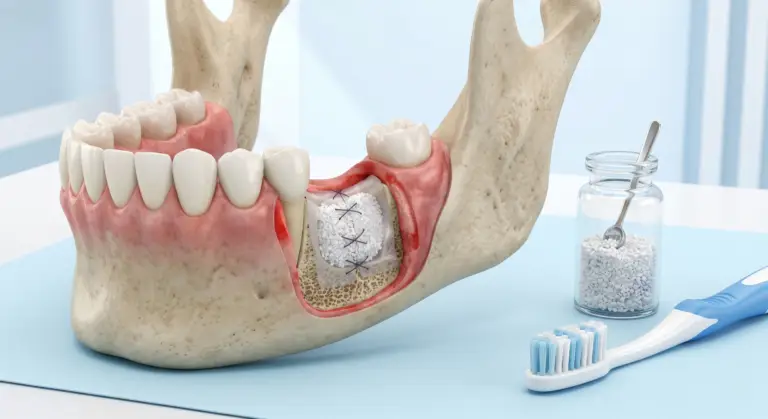
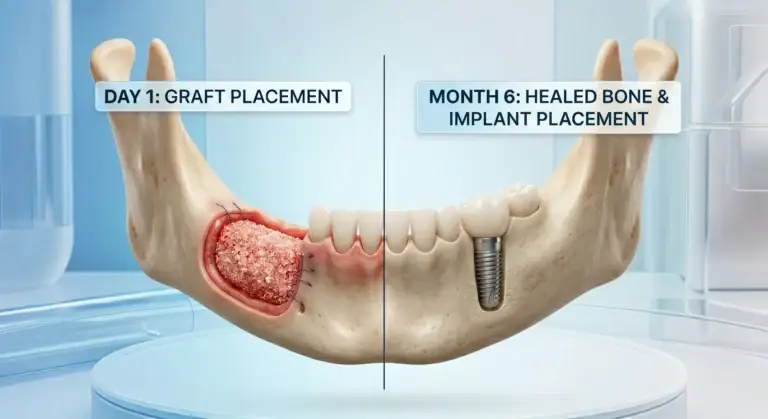
*AI-generated image medically verified by Dr. Mehmood Asghar
Is My Dental Bone Graft Falling Out? Understanding the “Sand” in Your Mouth
One of the most common panicked questions dental offices receive is from patients worried about bone graft particles falling out. To understand why this happens, you have to understand what a dental bone graft actually is.
According to John Hopkins Medicine, A bone graft is a surgical procedure that transplants healthy bone tissue (or synthetic materials) to repair, replace, or rebuild diseased, damaged, or insufficient bone
The Gritty Truth: Why Bone Grafts Feel Like Sand
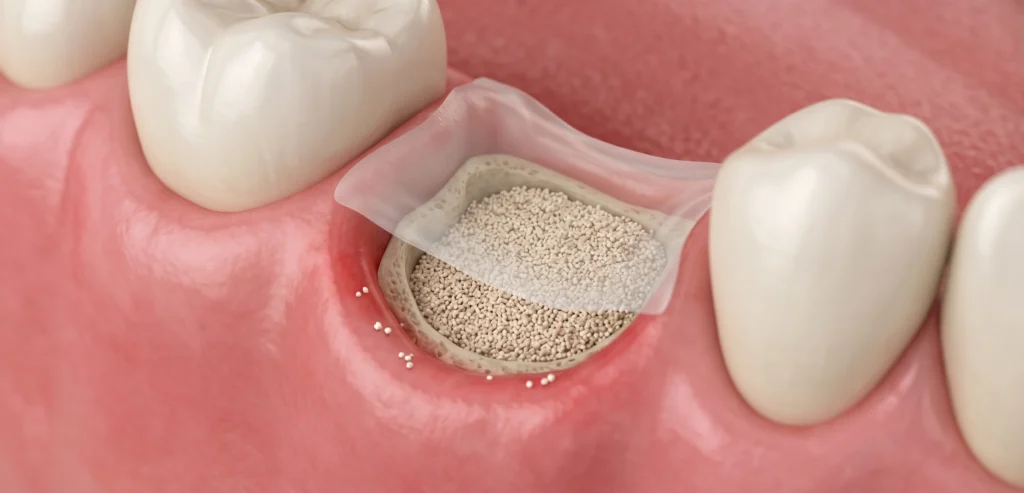
If you are wondering, “why does my bone graft feel like sand?”, the answer lies in the material itself. Dental bone grafts are rarely solid blocks of bone. Instead, dentists usually use particulate grafts—tiny granules of bone material (which can be human, animal, or synthetic) that look and feel exactly like coarse grains of sand.
These granules are packed into the empty socket after a tooth extraction. They act as a microscopic scaffold, encouraging your body’s own natural bone cells to migrate into the area, attach to the granules, and eventually grow new, solid bone. Because the material is granular, feeling a rough, sandy texture in your mouth is entirely expected.
The Logic of “Over-Packing” and Desirable Exfoliation
When a surgeon places a graft, they know that the mouth is a dynamic, wet environment. To compensate for the natural loss of material, dentists purposefully “over-pack” the extraction site. They will often place a small collagen membrane over the top of the packed granules and stitch the gums closed, but the gums don’t always close entirely over the hole.
Because the site is over-packed, it is incredibly normal for the excess particles near the surface to naturally exfoliate or wash out into your mouth over the first few days. Finding a few gritty specks on your tongue is not one of the bone graft falling out symptoms you need to lose sleep over; it is simply the excess material making its exit.
Why Losing a Few Grains is Not a Failure
You might worry that losing any amount of the graft means your surgery was a waste of time. Fortunately, the dental bone graft success rate is exceptionally high. A recent research study published in the Journal or Functional Biomaterials showed that the success rate of bone grafts for dental implants was over 97.8%
Your body only needs a certain amount of that scaffolding to successfully regenerate bone. Losing the top layer of granules will not compromise the foundation that is securely embedded deep within the socket, protected by a forming blood clot. Seeing minor particle loss does not disrupt the actual healing signs after bone graft placement, such as decreasing swelling and subsiding pain.
Identifying the “White Stuff”: Granulation vs. Infection
Aside from the gritty sand, the visual appearance of a healing extraction site can be highly unsettling. Many patients look at the surgical site and immediately worry, asking, “is it normal to see bone after extraction?” In most cases, what you are seeing isn’t actually your jawbone. It is usually the healing membrane, the graft material itself, or a highly misunderstood tissue.
How to Recognize Healthy Granulation Tissue
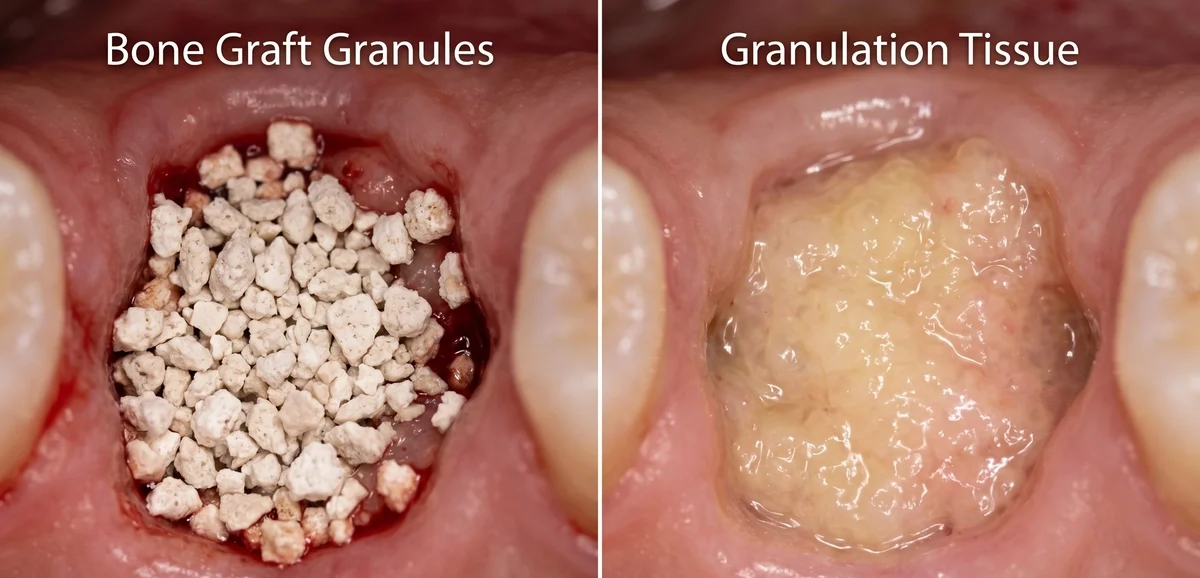
When patients report seeing white stuff in the extraction hole, they are almost always looking at granulation tissue. As your body heals, it produces a matrix of collagen and white blood cells to protect the open wound and begin rebuilding tissue. In the wet environment of the mouth, a healing scab doesn’t turn dark red or brown like it does on your arm. Instead, it turns a milky white, pale yellow, or grayish color.
Understanding granulation tissue vs pus is crucial for your peace of mind. Healthy granulation tissue forms a soft, gummy-looking film over the extraction site. It might look a bit unpleasant, but it is a primary indicator that your body is effectively sealing the wound. It should not be wiped away, poked, or vigorously rinsed out.
Is the “White Stuff” in My Socket a Bone Graft or Granulation Tissue?
Spotting “white stuff” in your extraction site is one of the most common post-surgical anxieties, as reflected by the high volume of queries for terms like “bone graft particles coming out” and “granulation tissue”. Generally, granulation tissue is a soft, fleshy, cream-colored scaffold your body builds to repair the socket, whereas bone graft material appears as tiny, hard, white grains resembling sand. While it is perfectly normal for a few gritty particles to escape or for a fuzzy layer of tissue to form, you should remain calm unless the “white stuff” is accompanied by a foul taste, pus, or the intense, throbbing pain characteristic of a dry socket
Collagen Membrane Fell Out: What Should I Do?
If your collagen membrane falls out, stay calm; this is a common occurrence that often appears in searches alongside “bone graft particles coming out” or “white stuff” in the socket. These membranes act as a temporary leather-like barrier to protect the graft site, and while they are designed to last weeks, losing one prematurely after the first few days doesn’t always compromise the healing process if the underlying material has stabilized.
However, you should monitor for intense throbbing pain, pus, or a foul taste, as these symptoms—rather than the loss of the membrane itself—could indicate an issue. Your primary goal is to protect the granulation tissue, that creamy-white healing scaffold, so avoid poking the area or rinsing vigorously to ensure the remaining graft remains undisturbed.
Red Flags: When the White Stuff is a Cause for Concern
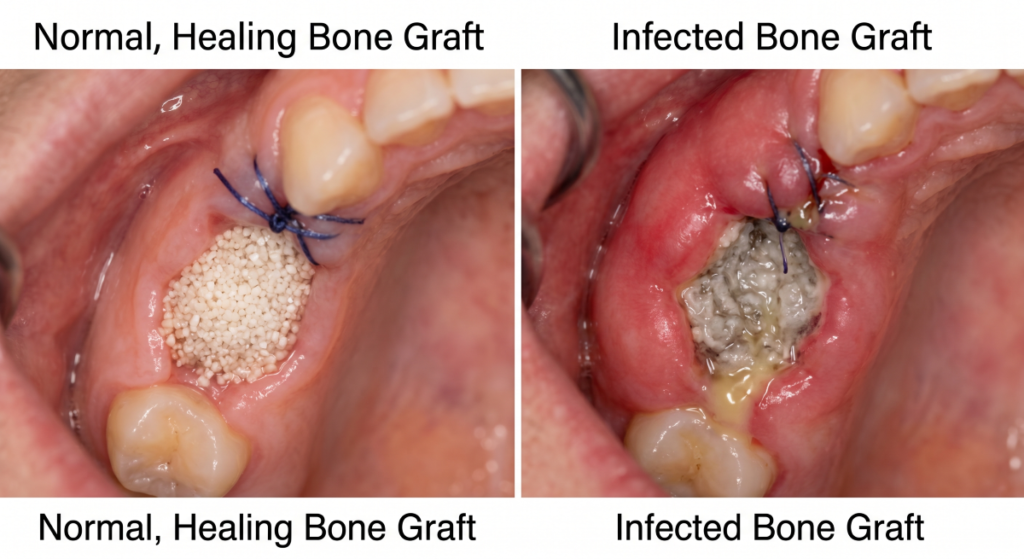
While white or yellowish tissue is usually normal, there are times when it indicates a problem. Pus, unlike granulation tissue, is an active sign of infection. How can you tell the difference?
- Consistency: Granulation tissue is relatively stationary and acts like a soft scab. Pus is a fluid that oozes.
- Odor and Taste: Pus is typically accompanied by a foul, bitter taste in your mouth and noticeably bad breath that doesn’t improve.
- Pain: While soreness is normal, an infection will cause a sudden, throbbing increase in pain several days after the surgery, often accompanied by returning swelling or a fever.
- Managing the First 72 Hours: The Calm Recovery Guide
How you manage your mouth in the first three days dictates the success of your recovery and minimizes the chances of dislodging your graft or developing a painful dry socket
The “No-Rinse” Protocol and Blood Clot Protection
The most critical element of your recovery is the blood clot that forms over the bone graft. This clot acts as a biological lid, holding the deeper graft particles in place and protecting the exposed nerves.
To protect this clot and prevent excess bone graft particles falling out:
- Do not spit forcefully: Let saliva naturally drool out of your mouth into the sink if you need to clear it.
- Avoid straws entirely: The suction created by a straw is the number one cause of dislodged blood clots.
- Implement the “No-Rinse” protocol: For the first 24 hours, do not rinse your mouth at all. After 24 to 48 hours, you can begin using warm salt water, but do not swish vigorously. Instead, gently roll the water around your mouth by tilting your head side to side, and let it passively fall out into the sink.
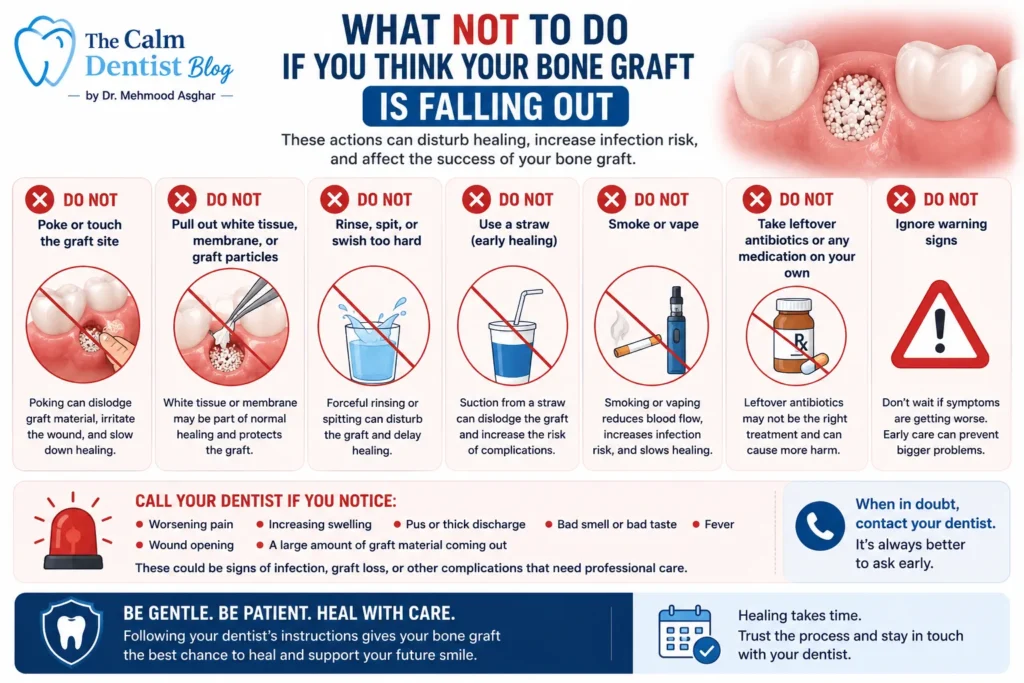
What Not To Do If You Think Your Bone Graft Is Falling Out
If you think your dental bone graft is falling out, it is natural to feel worried and want to check the area repeatedly. However, touching, rinsing, or disturbing the graft site can slow healing and may increase the risk of irritation, bleeding, graft movement, or infection.
Here is what you should avoid:
- Do not poke the graft site with your tongue, finger, cotton bud, toothpick, or any object.
- Do not try to pull out white tissue, membranes, or graft particles. White material may be part of normal healing, a collagen membrane, or graft material placed by your dentist.
- Do not rinse aggressively or spit forcefully, especially during the early healing period. Strong rinsing or spitting may disturb the clot or grafted area.
- Do not use a straw unless your dentist has told you it is safe. Suction can disturb early healing.
- Do not smoke or vape during early healing. Smoking can reduce blood supply and increase the risk of delayed healing or graft problems.
- Do not chew hard, crunchy, sharp, or spicy foods directly over the graft site.
- Do not start leftover antibiotics or any medication without dental advice. The wrong medicine or dose may not treat the real problem and can cause harm.
- Do not ignore worsening symptoms such as increasing pain, swelling, pus, fever, bad smell, bad taste, wound opening, or a large amount of graft material coming out.
Instead, keep the area as undisturbed as possible and follow your dentist’s aftercare instructions. If you notice a few tiny gritty particles but your pain and swelling are improving, it may not be an emergency. But if symptoms are getting worse or you are unsure, contact your dentist or oral surgeon for advice.
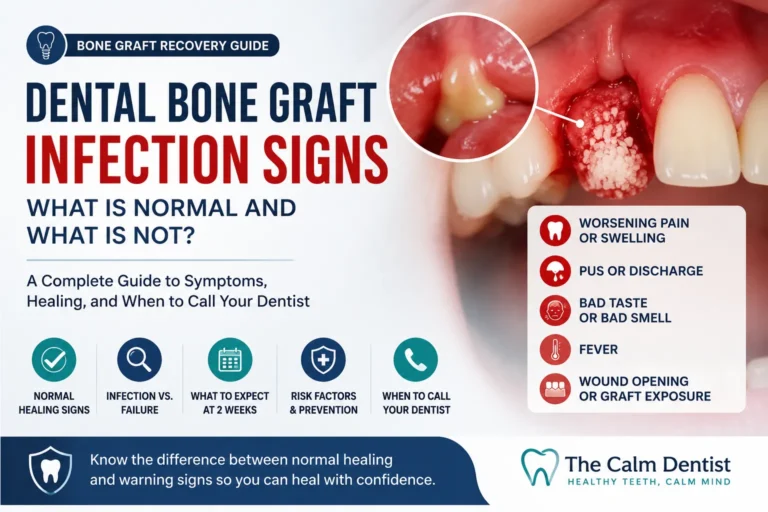
If your main concern is infection, pus, fever, bad smell, or worsening swelling, read our detailed guide on dental bone graft infection signs.
When to Call Your Dentist: Signs of Real Complications
While gritty textures and white healing tissue are completely normal, certain symptoms warrant a call to your oral surgeon. Dental surgeries, particularly upper molar extractions and complex endodontic treatments, carry specific risks. For instance, patients researching apicoectomy vs root canal retreat success often learn that while these procedures save teeth, any adjacent bone grafting or surgical trauma requires careful monitoring.
You should contact your dentist immediately if you experience any of the following:
- Sinus Communication: If you had an upper tooth extracted, the roots often sit very close to the sinus cavity. If you experience liquid coming out of your nose after extraction when you drink, or if you hear a strange sinus whistling after a tooth pull when you breathe or speak, you may have a sinus perforation. This requires immediate attention to ensure it heals properly without infection.
- Prolonged Numbness: It is normal to be numb for a few hours after local anesthesia. However, if you are experiencing profound numbness in your lip, chin, or tongue days after the procedure, you might be dealing with nerve damage after dental work recovery. While often temporary, your surgeon needs to evaluate it.
- Severe, Unmanageable Pain: Pain that suddenly worsens on day 3 or 4, especially if it radiates to your ear or eye, is a classic sign of dry socket or infection.
- Continuous Bleeding: Oozing is normal for the first day, but active, dark red bleeding that fills your mouth and doesn’t stop after applying firm pressure with gauze for 45 minutes is a red flag.
Bone Graft Falling Out – FAQs
Q: Why does it feel like sand is in my mouth after surgery?
A: This is normal. Bone grafts are composed of thousands of particles. Surface grains often exfoliate as the site heals to prevent them from being trapped in your gum tissue.
Q: Can a bone graft fail if I lose some particles?
A: No. Success rates for bone grafts remain over 90% even with minor exfoliation.
Q: What if I see a white, stringy material?
A: This is often a collagen membrane or sponge used to stabilize the graft. It is common for this to come off after a few days.
Q: Is the white stuff in my socket an infection?
A: If it is not painful and doesn’t smell bad, it is likely granulation tissue—the “bandage” your body creates to heal the area.
Dr. Mehmood Asghar is a Dentist and an Assistant Professor of Dental Materials, with nearly a decade of clinical experience. He holds a Ph.D. in Dental Biomaterials from Universiti Malaya and a Bachelor of Dental Surgery (BDS) from NUST. As a dedicated researcher with over 25 peer-reviewed publications and more than 310 citations in international journals, Dr. Asghar bridges the gap between clinical dentistry and advanced biomaterials research to provide patients with evidence-based, practical dental advice.

2 Comments