

People often ask, ‘Why are dental implants so expensive?’ The quoted amount may cover a treatment plan, not just the implant fixture. This guide explains what may be included, why estimates differ, and what to check before comparing quotes.
Quick answer: Dental implants can cost more than a crown on an existing tooth because treatment may include planning and imaging, surgery, the implant fixture, an abutment, a custom crown or other restoration, lab work, and follow-up. A bone graft, sinus lift, sedation, or temporary tooth may add to the total when clinically appropriate. There is no single reliable price for every location or treatment plan, so ask for a written, itemized estimate showing what is included and what may be billed separately.
Why Can a Dental Implant Estimate Seem So High?
A dental implant is not simply a visible artificial tooth. It is a treatment process designed to replace a missing tooth root and then support a restoration.
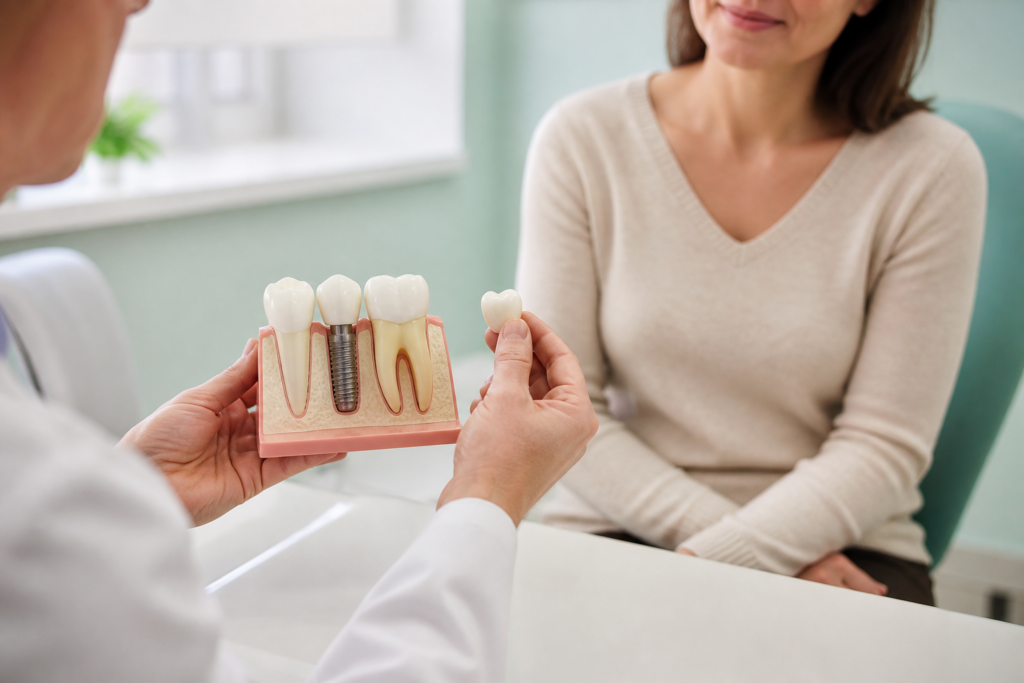
The final visible tooth is only one part of the plan. According to Cleveland Clinic’s overview of dental implants, an implant treatment commonly involves three main components:
- The implant fixture, which is placed in the jawbone.
- The abutment, a connector between the implant and the visible tooth.
- The restoration, such as a crown, bridge, or implant-supported denture.
This is one reason it can be misleading to compare an implant estimate with the price of a single filling or a standard crown on an existing tooth. Implant treatment may involve surgical, restorative, laboratory, and review stages.
What May Be Included in a Dental Implant Treatment Plan?
Every treatment plan is different. A dentist or specialist should explain which stages apply to you and which are optional, separate, or not needed.
Consultation, Examination, and 3D Imaging
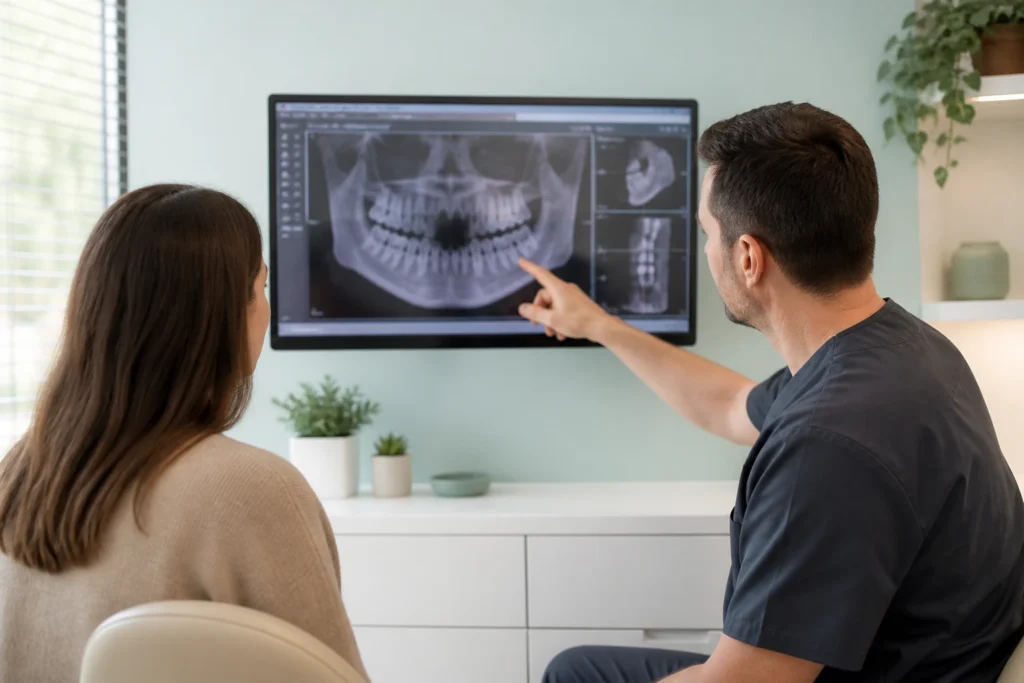
Before treatment, your dentist needs to assess the missing-tooth area, your gums, surrounding teeth, bite, and available bone. This may involve X-rays or three-dimensional imaging, depending on the case.
Planning matters because implants must be positioned with the final restoration, neighboring teeth, nerves, sinus anatomy, and chewing forces in mind. A lower price is not automatically a problem, but a meaningful comparison requires knowing whether two estimates include the same planning and diagnostic work.
Surgical Placement of the Implant
The surgical stage may include the implant fixture, sterile equipment, local anesthetic, dentist, time, and the surgical planning required to place the implant appropriately.
Some cases are straightforward. Others are more complex because of the location of the missing tooth, the amount of bone available, the position of nearby teeth, or the need to avoid sensitive anatomical structures.
Healing, Follow-Up, and Temporary Teeth
After placement, the implant needs time to integrate with the jawbone. This healing process is called osseointegration. The timetable varies, and your dentist decides when it is appropriate to move to the next stage.
A temporary tooth may be useful in some situations, particularly in visible areas of the mouth. Follow-up appointments can also be part of the plan. Ask whether these visits are included in the original estimate.
The Abutment, Crown, and Laboratory Work
Many patients are surprised to learn that the implant fixture and final crown may not be included in the same quoted figure.
The abutment connects the implant to the crown. The crown is then designed and fabricated to fit your bite, neighboring teeth, and appearance. The laboratory work involved in creating a custom restoration can be an important part of the overall treatment cost.
A useful question is:
Does this estimate include the implant fixture, abutment, and final crown—or are these quoted separately?
What Can Increase the Total Cost?
Bone Grafting or Sinus-Lift Planning
An implant needs sufficient bone for support. If bone has reduced after tooth loss, gum disease, trauma, or other factors, a dentist may discuss bone grafting or a sinus lift before or alongside implant treatment.
These procedures are not required for everyone. They should never be assumed from the appearance of the gums alone. For an explanation of the procedure itself, see why a dental bone graft may be recommended.
If you have already had a graft, read How Long After a Bone Graft Can You Get a Dental Implant? to understand how dentist assess readiness for implant planning.
For upper-jaw treatment near the sinus, Sinus Lift Under Local Anesthesia explains why the procedure may be recommended and what patients may experience.
Tooth Location, Bone Quality, and Surgical Complexity
Replacing a missing front tooth is not necessarily the same as replacing a back tooth. The available bone, cosmetic expectations, bite forces, gum shape, and nearby anatomy may all affect planning.
That does not mean a more expensive estimate is always better. It means the clinical reasons behind the treatment plan should be clearly explained.
Sedation, Temporary Restorations, and Extra Appointments
Some patients choose or require additional support, such as sedation, temporary restorations, or more frequent review appointments. These may be included, offered as optional extras, or billed separately.
If treatment makes you anxious, it is reasonable to ask what support options are available before agreeing to a plan. Do not feel pressured to make a decision before you understand what the estimate covers.
Materials and Custom Laboratory Work
Different implant systems, abutment designs, crown materials, and laboratories may be used. The right choice depends on the clinical situation, not on a simple “premium versus cheap” label.
A future material-comparison article can help you explore titanium and zirconia in more detail. For now, the key point is that the implant fixture, the connecting component, and the visible restoration are not all the same thing.
Why Do Two Dental Implant Estimates Differ?
Two estimates can look very different even when both are for “one dental implant.”
| Ask about | Why it matters |
|---|---|
| What is included? | One quote may include the crown and another may list it separately. |
| Is 3D imaging included? | Planning and imaging arrangements can differ. |
| Are grafting or sinus procedures included? | These may be recommended only if your dentist finds they are needed. |
| Is a temporary tooth included? | This can matter especially in a visible area of the mouth. |
| Who performs each stage? | Surgery and the final restoration may be provided by one dentist or by different dentists. |
| What follow-up care is included? | Review arrangements and fees can vary between practices. |
The goal is not to “haggle” over a medical procedure. The goal is to understand the treatment plan well enough to compare like with like and make an informed decision.
Does Dental Insurance Cover Implants?
Dental insurance cover varies widely. Some policies may contribute to parts of treatment, while others may have exclusions, waiting periods, annual limits, or different rules for implants, crowns, grafting, and sedation.
Before treatment begins, ask your insurer:
- Does my policy cover any part of implant treatment?
- Are there waiting periods or annual maximums?
- Does the policy treat the implant, abutment, crown, imaging, and grafting differently?
- Does pre-authorization apply?
- Which documents do you need from my dentist?
Do not rely on a verbal estimate of insurance cover. Ask for written confirmation where possible.

Is the Cheapest Implant Option Always the Best Value?
Affordability matters. It is completely reasonable to ask about payment options, staged treatment, alternatives, or a second opinion.
But the lowest advertised price does not always show the full treatment pathway. A low starting price may not include imaging, grafting, sedation, the final crown, follow-up care, or other necessary parts of treatment.
Instead of asking only, “What is the cheapest implant?”, try asking:
What is the most appropriate option for my situation, what does the written estimate include, and what could change the final cost?
For some people, an implant may be the right option. For others, a bridge, denture, delayed treatment plan, or another approach may be more suitable. Your dentist should explain the advantages, limitations, and maintenance needs of the options available to you.
If you are exploring lower-cost routes, the National Institute of Dental and Craniofacial Research suggests contacting dental schools directly to ask whether they offer clinic services. Availability, supervision, treatment scope, and eligibility differ by institution.
Questions to Ask Before You Accept an Implant Estimate
Take these questions to your consultation:
- Does this estimate include the implant, abutment, and final crown?
- Does it include imaging, surgical planning, and follow-up appointments?
- Could bone grafting, a sinus lift, or sedation change the treatment plan?
- Is a temporary tooth included if I need one?
- Who will perform the surgical and restorative stages?
- Which costs are fixed, and which may change after assessment?
- What alternatives are suitable in my case?
- What should I confirm with my insurer before treatment starts?
The Bottom Line
Dental implants can be expensive because they may involve a carefully planned sequence of clinical and laboratory stages—not simply the placement of one visible tooth.
A high estimate is not automatically unreasonable, and a low estimate is not automatically poor care. What matters is whether you understand the plan, know what is included, and have had an opportunity to ask questions before deciding.
If bone grafting is part of your plan, you may also find Dental Bone Graft Healing Stages useful. It explains the difference between early gum healing and the later bone-healing phase.
Frequently Asked Questions
Why are dental implants so expensive compared with a crown?
A crown on an existing tooth does not usually require surgical placement into the jawbone. Implant treatment may involve planning, surgery, healing, an implant fixture, an abutment, a custom crown, laboratory work, and follow-up care.
Does a dental implant quote usually include the crown?
Not always. Some estimates include the implant, abutment, and crown together, while others list them separately. Ask for an itemized written estimate.
Can bone grafting increase the total cost of an implant?
It can, if your dentist determines that grafting is needed to create or maintain suitable bone support. Not everyone needs a graft, and readiness should be assessed clinically and, where appropriate, with imaging.
Does insurance cover dental implants?
It depends on the policy. Insurance may have exclusions, waiting periods, annual limits, or separate rules for the implant, crown, grafting, and related treatment.
Why can two dental implant estimates be different?
The estimates may include different components, imaging, temporary restorations, laboratory work, follow-up arrangements, sedation options, or treatment for bone-related issues. Compare what is included, not just the total figure.
Is it reasonable to ask for a written itemized estimate?
Yes. A written estimate helps you understand the treatment stages, ask informed questions, compare options appropriately, and check possible insurance benefits.

Dr. Mehmood Asghar is a Dentist and an Assistant Professor of Dental Materials, with nearly a decade of clinical experience. He holds a Ph.D. in Dental Biomaterials from Universiti Malaya and a Bachelor of Dental Surgery (BDS) from NUST. As a dedicated researcher with over 25 peer-reviewed publications and more than 310 citations in international journals, Dr. Asghar bridges the gap between clinical dentistry and advanced biomaterials research to provide patients with evidence-based, practical dental advice.
Discover more from The Calm Dentist Blog
Subscribe to get the latest posts sent to your email.