Written and clinically reviewed by Dr. Mehmood Asghar, BDS, MPhil, PhD. Last reviewed: September 17, 2026. See our editorial standards.
Quick answer: can enamel grow back?
No—enamel that has been physically lost cannot naturally grow back. But early mineral loss is different: if the enamel surface is still intact, minerals can sometimes be restored through remineralization before a cavity forms.
This is why “repairing enamel” can mean two different things. Fluoride, saliva and suitable dental products may strengthen an early weakened area; they cannot recreate a missing layer, fill a hole or replace a chip.
Which enamel change are you dealing with?
| Situation | What is happening | Can it be repaired? |
|---|---|---|
| Early demineralization | Minerals have been lost, but the surface has not formed a cavity. It may look chalky or white. | It may be strengthened through remineralization and control of the cause. A dentist should confirm the stage. |
| Erosion or wear | The enamel surface has thinned or been physically worn away by acids, grinding or abrasion. | Lost enamel does not regrow. Care can protect what remains, reduce the cause and manage sensitivity or appearance. |
| Structural loss | There is a chip, hole, cavitated decay or other missing tooth structure. | It cannot regrow naturally. A dentist may recommend bonding, a filling, a veneer, a crown or another treatment depending on severity. |
Do not try to decide the stage from colour or sensitivity alone. White spots, transparency and sensitivity can have several causes. A dental examination can show whether the surface is intact and whether the change is active.
For a practical guide to fluoride, saliva, diet and product claims, read How to Remineralize Teeth: What Helps—and What Cannot Be Reversed.
On this page
- Why enamel cannot regrow
- Early mineral loss versus lost enamel
- What remineralization means
- Toothpaste and enamel-repair claims
- Erosion, whitening and wear
- What you can do and how dentists help
- When to see a dentist
- Frequently asked questions
Why can’t tooth enamel grow back?
Enamel is the highly mineralized outer covering of your teeth. It protects the softer dentin and pulp underneath and is the hardest tissue in the human body.
During tooth development, enamel is produced by specialized cells called ameloblasts.
Once enamel formation is complete and a tooth erupts into the mouth, those enamel-forming cells are no longer available to repair the tooth in the way living tissues can repair themselves.
That makes enamel very different from tissues such as skin and bone.
If you cut your skin, living cells can participate in healing. Bone can also remodel and repair itself under the right conditions.
Mature enamel does not have living cells or its own blood supply, so it does not have the biological machinery needed to regrow a missing piece of enamel.
This basic limitation of mature enamel is described by sources including the Cleveland Clinic and the National Institute of Dental and Craniofacial Research (NIDCR).
Lost enamel and early mineral loss are not the same thing
This is the distinction that matters most.
Seeing a white area, experiencing sensitivity, or noticing a small change in a tooth does not automatically mean that part of your enamel has permanently disappeared.
There are two very different processes to understand.
Physical Loss of Enamel
Physical loss means some of the tooth structure is actually missing.
Examples include:
- A chipped tooth
- Significant enamel erosion
- Advanced tooth wear
- A cavity that has created a physical defect or hole
- Tooth structure lost through trauma
Once enamel has been physically removed, the body cannot produce new natural enamel to replace it.
Depending on the amount of damage, a dentist may recommend monitoring, bonding, a filling, a veneer, a crown, or another treatment.
Early Mineral Loss
Early mineral loss, or demineralization, is different.
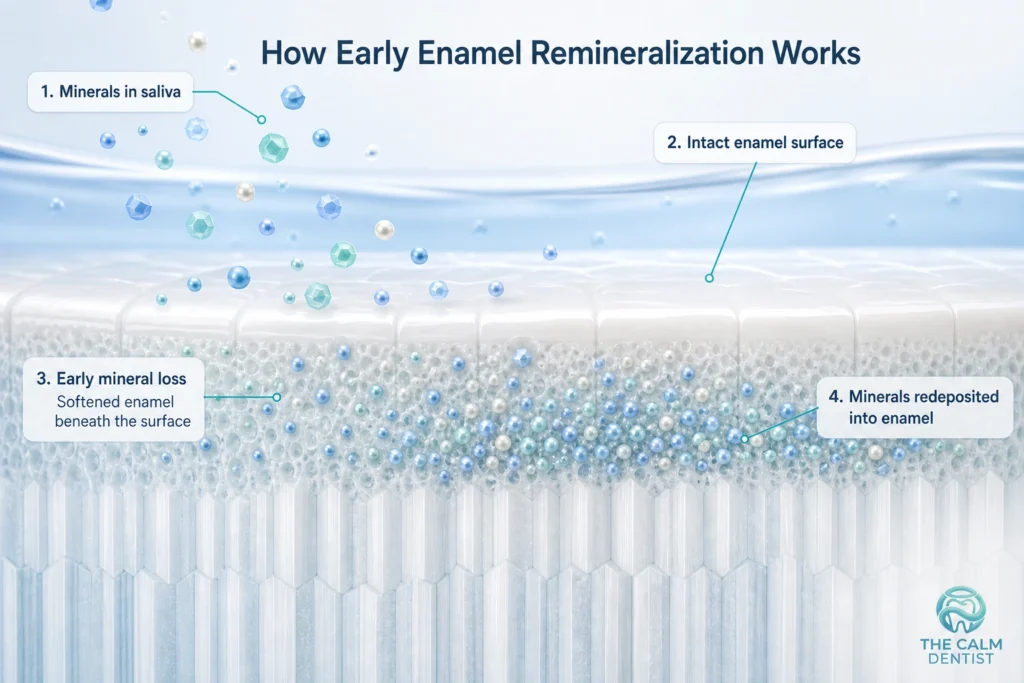
Acids can remove minerals from enamel before the tooth develops a physical cavity. At this stage, the enamel structure may still be present even though its mineral content has changed.
An early lesion may sometimes look chalky, dull, or white, although not every white spot on a tooth is tooth decay.
If the surface has not become cavitated, minerals may be redeposited into the affected enamel. This is remineralization.
NIDCR explains that fluoride can help replace minerals lost from enamel and help stop or reverse the earliest stages of tooth decay before a cavity forms.
| Tooth change | Surface intact? | Can remineralization help? |
|---|---|---|
| Early mineral loss or a white-spot lesion | Usually | Often |
| Established cavity | No | Cannot replace missing structure |
| Chip or fracture | No | No |
| Advanced acid erosion | Enamel physically reduced | Cannot regrow lost enamel |
What does remineralization actually mean?
Remineralization does not mean growing a new layer of enamel.
Instead, it means restoring minerals to enamel that is still physically present.
Saliva naturally contains calcium and phosphate. Fluoride can also help make the tooth surface more resistant to acid and support the remineralization of early areas of mineral loss.
Think of it less as replacing a missing wall and more as reinforcing a wall that is still standing.
This distinction matters because the word “rebuild” is sometimes used loosely in toothpaste advertising.
If you would like a detailed explanation of the habits, fluoride use, diet considerations, and other factors involved in this process, see our separate guide: How to Remineralize Teeth: What Helps—and What Cannot Be Reversed.
That guide focuses specifically on how to support remineralization. This article focuses on the separate question of whether lost enamel can actually grow back.
Can toothpaste regrow enamel?
No toothpaste currently available can make your body grow new natural enamel where enamel has been physically lost.
Some toothpastes can, however, help protect and strengthen enamel that is still present.
Fluoride toothpaste has a well-established role in preventing cavities and supporting remineralization of early mineral loss.
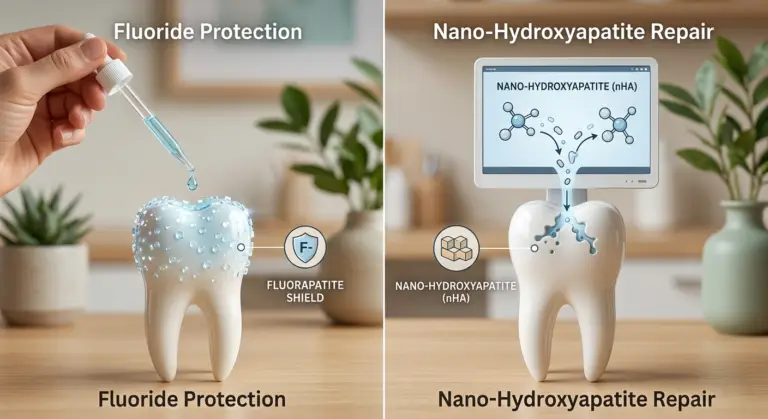
Nano-hydroxyapatite is another ingredient used in some toothpastes. Research suggests that it may support mineral deposition and may help with sensitivity in some circumstances, although formulations and the strength of clinical evidence vary.
Neither ingredient should be understood as growing a completely new layer of natural enamel to replace tooth structure that is missing.
If you are deciding between these ingredients, see our evidence-based comparison: Nano-Hydroxyapatite vs. Fluoride: Which Is Better?.
What About Products That Claim to “Rebuild Enamel”?
Words such as repair, restore, rebuild, and regenerate can be confusing when they appear on dental products.
In many cases, “repair” refers to strengthening or remineralizing the enamel surface rather than replacing missing enamel with newly formed natural enamel.
That does not mean the product has no benefit. Supporting remineralization can be very useful.
It simply means that the claim needs to be interpreted correctly.
At present, an over-the-counter toothpaste, mouthwash, supplement, oil, or home remedy cannot biologically regrow mature enamel that has been physically lost.
Be cautious with products that promise to “grow back” cavities, chips, or severely eroded enamel.
Can enamel grow back after acid erosion?
It depends on what stage the process has reached.
Very early mineral changes may be strengthened if the enamel structure is still present and the source of acid exposure is addressed.
Once erosion has physically removed enamel and changed the shape or thickness of the tooth, however, the missing enamel cannot naturally grow back.
Possible sources of repeated acid exposure include acidic drinks and foods, frequent vomiting, and acid reflux.
If your teeth appear increasingly thin, smooth, rounded, yellow, or transparent around the edges, it is worth discussing this with a dentist. These changes have several possible causes, and an examination is more reliable than trying to diagnose enamel loss from appearance alone.
Can Enamel Grow Back After Whitening?
Whitening does not make your teeth produce new enamel.
When peroxide-based whitening products are used appropriately, temporary tooth sensitivity and gum irritation are among the most commonly reported side effects. The American Dental Association notes that these effects are usually temporary.
If your teeth feel sensitive after whitening, that does not automatically mean that your enamel has been permanently removed.
However, whitening products should be used according to their instructions, and excessive or inappropriate use should be avoided.
If sensitivity is severe, persists, or occurs even when you are not whitening your teeth, a dental examination can help identify whether something else is contributing.
What can you do if your enamel is wearing away?
You do not need an elaborate routine.
The most useful first step is identifying why the change is happening.
For example, enamel may be affected by acid exposure, tooth grinding, aggressive brushing, dry mouth, decay, or a combination of factors. Treating the cause is often more important than repeatedly changing toothpastes.
For everyday protection:
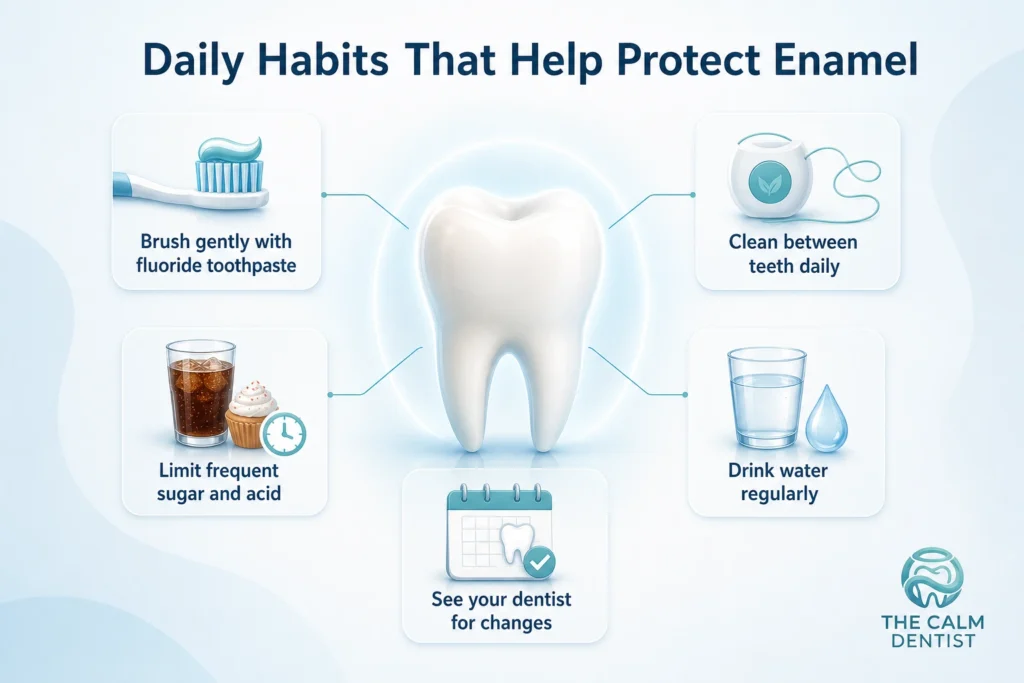
- Brush gently twice a day with fluoride toothpaste unless your dentist has recommended something different.
- Clean between your teeth regularly.
- Limit frequent exposure to sugary and acidic drinks or snacks.
- Drink water regularly and address persistent dry mouth.
- Avoid brushing aggressively, particularly immediately after significant acid exposure.
- Ask a dentist about persistent sensitivity or visible changes rather than relying only on photographs or online comparisons.
For a more detailed prevention and remineralization routine, use our complete guide to remineralizing teeth.
Can Dentists Replace Lost Enamel?
Dentists cannot make mature enamel biologically grow back either.
What dentistry can do is protect or restore a tooth when enough structure has been lost to cause symptoms, affect appearance, increase fracture risk, or expose the underlying dentin.
Depending on the situation, treatment might involve:
- Fluoride or other preventive treatment for early disease
- Dental bonding
- A filling
- A veneer
- An onlay or crown
- Treatment for an underlying cause such as tooth grinding or acid exposure
Not every area of enamel wear needs restorative treatment.
In mild or stable cases, monitoring the area and controlling the cause may be more appropriate. The right approach depends on what is causing the change and how much tooth structure has actually been affected.
Is Scientists’ Work on Regrowing Enamel Changing the Answer?
There is encouraging research in this area, but it is important to separate experimental science from treatments currently available at a dental office.
Researchers are studying biomimetic materials designed to imitate parts of the natural process by which enamel forms.
For example, a 2025 study published in Nature Communications described a protein-based biomimetic material designed to guide enamel-like mineral formation.
Research like this is scientifically exciting and may eventually contribute to new treatments for damaged enamel.
It does not, however, mean that patients can currently visit a dentist and have naturally lost enamel routinely regenerated.
For now, preventing further damage, identifying problems early, and supporting remineralization when the enamel surface is still intact remain the most reliable approaches.
When should you see a dentist?
A small change in a tooth does not necessarily mean something serious is happening.
Still, arranging a dental assessment is sensible if you notice:
- Sensitivity that persists or is becoming more noticeable
- New white, brown, or dark areas on a tooth
- Increasing transparency or thinning
- A chip, crack, or rough edge
- A visible hole or suspected cavity
- Changes in the shape or length of your teeth
- Repeated cavities
- Pain when biting
A dentist can determine whether you are dealing with early mineral loss, erosion, wear, decay, a developmental enamel change, or something else.
Seek urgent dental or medical care if dental symptoms are accompanied by severe or rapidly worsening pain, significant facial swelling, fever, or difficulty swallowing or breathing.
Frequently asked questions
Can enamel grow back on its own?
No. Once mature enamel has been physically lost, your body cannot naturally produce new enamel to replace it.
Early mineral loss is different. If the enamel surface has not developed a cavity, remineralization may strengthen the affected area.
Can a dentist tell whether enamel loss is reversible?
A dentist can usually distinguish early, non-cavitated mineral loss from enamel that has been physically lost through erosion, wear, a chip, or a cavity.
This may involve examining the surface, checking symptoms and risk factors, and using dental radiographs when appropriate. Appearance alone is not always reliable.
Can a cavity grow enamel back?
A cavity that has formed a physical hole cannot grow new enamel and close itself.
Very early tooth decay before cavitation may sometimes be arrested or reversed through remineralization. Once tooth structure has broken down and a cavity has formed, professional assessment is needed.
Can toothpaste rebuild damaged enamel?
Toothpaste can help strengthen enamel that is still present, particularly during early mineral loss.
It cannot recreate a missing piece of natural enamel caused by a chip, cavity, significant wear, or advanced erosion.
Do white spots mean my enamel is gone?
Not necessarily.
White spots can have several causes, including early mineral loss, fluorosis, developmental enamel differences, changes following orthodontic treatment, and other conditions.
If a white area is new or changing, a dentist can usually give you a much clearer answer than appearance alone.
If the white area is on the gum rather than the tooth surface, see our guide to white spots on the gums.
Can enamel grow back after grinding?
If grinding has physically worn enamel away, the missing structure cannot naturally regrow.
Managing the grinding may help protect the remaining tooth structure. Whether worn teeth require restoration depends on the severity of the wear, your symptoms, and how stable the condition is.
How do I know whether my enamel is permanently damaged?
It can be difficult to determine this just by looking at your teeth.
Sensitivity, transparency, white spots, or changes in appearance do not by themselves reveal how much enamel has been lost. A dental examination can distinguish between early mineral changes, physical wear, erosion, decay, and other causes.
The Bottom Line
Mature enamel cannot naturally grow back once it has been physically lost.
But that does not mean every change in your enamel is irreversible.
Early mineral loss may sometimes be strengthened through remineralization before a physical cavity develops. And even when enamel has already been lost, identifying the cause can help prevent further damage and allow a dentist to protect or restore the tooth when necessary.
If you have noticed a change in your teeth, try not to judge the situation from appearance alone. Sensitivity, white spots, and transparency can have several causes.
Early assessment, gentle daily care, and treating the underlying cause are usually much more helpful than searching for a product that promises to “regrow” enamel.
Small, consistent steps can make a meaningful difference in protecting the enamel you still have.
Medical disclaimer
This article is for general education and cannot diagnose the cause or stage of enamel changes. See a dentist for persistent sensitivity, pain, a visible hole or chip, rapidly changing appearance, or concern about erosion or decay.
Sources and Further Reading
- National Institute of Dental and Craniofacial Research — The Tooth Decay Process: How to Reverse It and Avoid a Cavity
- Cleveland Clinic — Tooth Enamel
- American Dental Association — Whitening
- Nature Communications — Biomimetic Supramolecular Protein Matrix Restores Structure and Properties of Human Dental Enamel
Dr. Mehmood Asghar is a Dentist and an Assistant Professor of Dental Materials, with nearly a decade of clinical experience. He holds a Ph.D. in Dental Biomaterials from Universiti Malaya and a Bachelor of Dental Surgery (BDS) from NUST. As a dedicated researcher with over 25 peer-reviewed publications and more than 310 citations in international journals, Dr. Asghar bridges the gap between clinical dentistry and advanced biomaterials research to provide patients with evidence-based, practical dental advice.
Discover more from The Calm Dentist Blog
Subscribe to get the latest posts sent to your email.