Written and clinically reviewed by Dr. Mehmood Asghar, BDS, MPhil, PhD. Last reviewed: August 2, 2026. See our editorial standards.
Quick Answer
If your bite feels wrong but your dentist says it is fine, the sensation can still be real. Ask what has been checked and whether a second opinion is appropriate before requesting another bite adjustment. A focused examination should rule out a high restoration, a cracked or inflamed tooth, gum disease, clenching, jaw-muscle tension, and TMJ problems.
If those checks do not reveal a physical cause that matches the symptoms, bite hyperawareness or occlusal dysesthesia may be contributing. The next step is usually conservative reassessment—not automatically more drilling, tooth reshaping, or crown replacement.
In some patients, this persistent wrong-bite feeling is called Phantom Bite Syndrome, also known as Occlusal Dysesthesia. It is a real and distressing condition, but it usually does not improve with repeated tooth filing, repeated bite adjustments, repeated crown replacement, or unnecessary dental treatment.
The safest approach is to:
- Rule out common dental causes first.
- Avoid repeatedly tapping or testing your bite.
- Avoid irreversible dental adjustments if no clear bite problem is found.
- Ask your dentist whether Phantom Bite Syndrome or bite hyperawareness may be contributing.
- Consider conservative or multidisciplinary care if the symptom persists.
This article is part of our main guide to why your bite feels off, including real bite problems, dental anxiety, bite hyperawareness, and phantom bite syndrome.
- Your dentist says your bite looks fine, but it still feels wrong.
- You keep noticing one tooth or one side more than the rest.
- You have had bite checks or adjustments but the feeling keeps returning.
- You are worried that repeated dental work may make things worse.
Why Does My Bite Feel Wrong?
A “wrong bite” feeling can be difficult to describe. Many patients say:
- “One tooth touches before the others.”
- “My teeth do not meet evenly.”
- “My bite feels high.”
- “My jaw cannot find a comfortable position.”
- “Something feels off after my filling or crown.”
- “My dentist says it is fine, but I can still feel it.”
- “I keep checking my bite all day.”
Sometimes there is a genuine bite problem. If the feeling began after dental treatment, read our focused guide to a bite that feels high after a filling or crown. A tooth may also be inflamed or cracked, and jaw-muscle tension can make the bite feel unstable.
But sometimes, after a careful dental examination, there is no clear dental abnormality to explain the intensity of the sensation. That is when your dentist may need to think beyond a simple “high spot.”
Common Dental Reasons Your Bite May Feel Off
Before considering Phantom Bite Syndrome, your dentist should first rule out common dental and jaw-related causes.
| Possible cause | What it may feel like |
|---|---|
| High filling | One tooth hits first when biting |
| High crown | Pressure or chewing discomfort around a restored tooth |
| Cracked tooth | Sharp pain on biting or releasing the bite |
| Inflamed tooth nerve | Tenderness, throbbing, or lingering sensitivity |
| Gum or periodontal problem | Tooth feels tender, mobile, or “raised” |
| Recent orthodontic movement | Bite feels temporarily unstable |
| Clenching or grinding | Teeth feel sore, heavy, or over-contacted |
| TMJ disorder | Jaw pain, clicking, locking, or difficulty chewing |
| Jaw muscle tension | Bite feels shifted or difficult to settle |
A proper dental examination may include checking the teeth, restorations, gums, bite contacts, jaw muscles, temporomandibular joints, and X-rays when needed.
If there is pain, swelling, pus, fever, trauma, a broken tooth, or sudden difficulty closing your mouth, you should seek professional care promptly.
When the Dentist Says the Bite Looks Fine
It can be frustrating when your dentist says, “Your bite looks fine,” but you still feel that something is wrong.
However, bite comfort is not controlled only by the way the teeth touch. It is also influenced by the nerves around the teeth, jaw muscles, habits such as clenching, emotional stress, sleep quality, and how the brain interprets tooth contact.
Your teeth have pressure-sensitive receptors that help the brain detect very small changes in contact. After dental treatment, jaw pain, clenching, stress, or repeated checking, the brain may become more alert to tooth contact.
In simple terms:
Your bite may be clinically acceptable, but your brain may still be interpreting normal tooth contact as abnormal.
This does not mean the symptom is fake. It means the problem may not be a simple mechanical high spot that can be corrected by repeated drilling.
Ask what the examination ruled out and what finding would justify another adjustment. A second dental opinion can be reasonable if the change was sudden, followed treatment, is localized to one tooth, or is worsening. If several careful examinations are normal, consider asking about an orofacial pain assessment before agreeing to irreversible bite changes.
What Is Phantom Bite Syndrome?
Phantom Bite Syndrome, also called Occlusal Dysesthesia, is a condition in which a person persistently feels that their bite is wrong, uneven, high, altered, or uncomfortable even when clinical and radiographic findings do not clearly explain the complaint.
The term “phantom” can sound dismissive, but the symptom is real. The word is used because the patient feels a bite discrepancy that cannot be verified in the usual way during dental examination.
The condition may involve:
- Persistent focus on tooth contact
- Difficulty adapting to normal or changed bite sensations
- Repeated checking of the bite
- Strong distress despite limited clinical findings
- Repeated requests for bite adjustment
- Temporary or no relief after dental treatment
Is Phantom Bite Syndrome Real?
Yes. Phantom Bite Syndrome is real, but it is often misunderstood.
In the scientific literature, it is usually discussed under the name Occlusal Dysesthesia. The problem is not usually a visible bite defect. Instead, it is thought to involve altered sensory processing, bite hyperawareness, and difficulty adapting to occlusal sensations.
A clinical guideline on occlusal dysesthesia explains that management should focus on education, counselling, defocusing strategies, cognitive behavioral therapy when needed, and supportive medical care in selected cases — not repeated irreversible dental treatment when no clear dental cause exists. You can read the guideline here: Occlusal dysesthesia — A clinical guideline.
Why Can Dental Treatment Trigger a Wrong-Bite Feeling?
Many people first notice the wrong-bite feeling after dental treatment, such as:
- A filling
- A crown
- A bridge
- Orthodontic treatment
- Veneers
- Implant restoration
- Denture adjustment
- Tooth extraction
- Bite adjustment
This does not always mean the dental treatment was done incorrectly.
After dental work, it is normal to pay more attention to the treated area. Most patients adapt within days or weeks. But in some patients, the brain continues to monitor the bite too closely. The person may start tapping the teeth, sliding the jaw, comparing left and right contacts, or trying to find a “perfect” bite position.
This can create a cycle:
- Dental treatment changes the sensation slightly.
- The patient notices the change.
- The brain starts monitoring the bite.
- Normal contacts begin to feel abnormal.
- The patient repeatedly checks the bite.
- Anxiety and attention increase.
- The bite feels even more wrong.
The more the bite is checked, the more noticeable it may become.
Why Repeated Bite Adjustments Can Make the Problem Worse
When your bite feels wrong, it is natural to want the dentist to “adjust it.” If there is a clear high filling or high crown, a careful adjustment may help.
However, if no clear bite problem is found, repeated adjustment can become harmful.
Repeated tooth filing, crown reshaping, replacement of restorations, orthodontic changes, or bite reconstruction may:
- Remove healthy enamel unnecessarily
- Change the bite further
- Create new sensations for the brain to monitor
- Increase bite checking
- Reinforce the belief that the problem must be purely mechanical
- Lead to frustration when symptoms return
- Start a cycle of more and more dental treatment
A clinical review on Phantom Bite Syndrome describes how some patients repeatedly seek occlusal correction and may undergo extensive dental treatment without lasting relief. You can read the review here: Phantom bite syndrome: Revelation from clinically focused review.
The safety message is simple:
If there is no clear mechanical bite problem, repeated tooth adjustment is usually not the safest solution.
High Filling vs Phantom Bite Syndrome: How Are They Different?
A high filling or high crown usually has a clearer clinical pattern.
A high filling may be more likely if:
- The problem started immediately after a specific filling or crown
- One restored tooth clearly hits before the others
- The tooth is sore when chewing
- Bite paper shows a consistent heavy contact
- A small adjustment gives clear relief
- Symptoms improve after correction
Phantom Bite Syndrome may be more likely if:
- The bite feels wrong even after several adjustments
- The discomfort shifts from one tooth to another
- Different dentists cannot find a clear bite discrepancy
- You constantly check, tap, or test your bite
- The feeling dominates your attention
- Treatment gives only temporary relief
- You feel convinced something is wrong despite normal findings
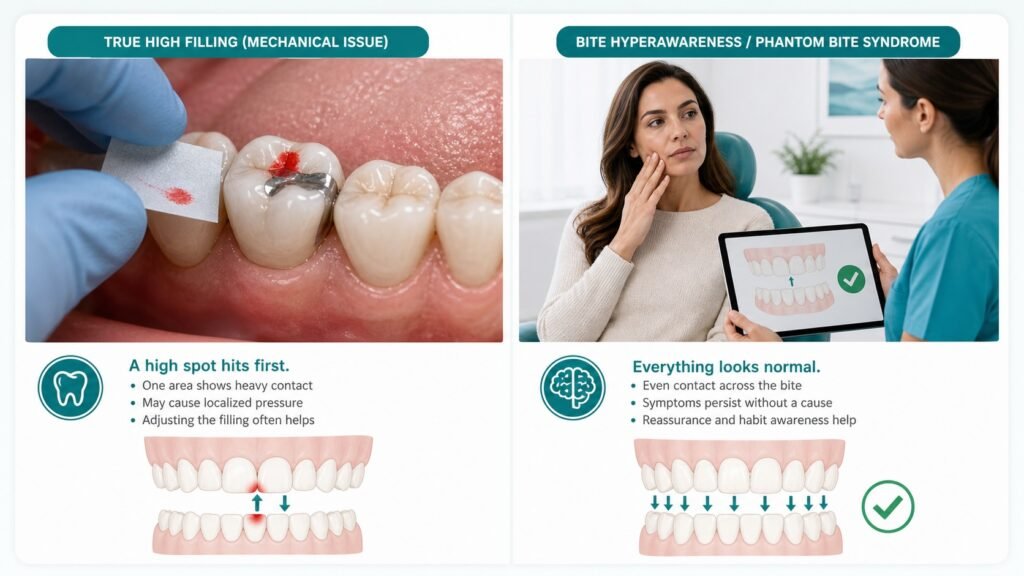
This distinction matters because the treatment approach is different. A high filling may need a minor correction. Phantom Bite Syndrome usually needs a conservative, non-destructive approach.
Can Anxiety Make Your Bite Feel Wrong?
Yes. Anxiety, stress, and poor sleep can increase awareness of body sensations, including tooth contact.
When your nervous system is on high alert, normal sensations can feel stronger, more irritating, or more threatening. You may clench more, tighten your jaw muscles, sleep poorly, and focus more on the bite.
This does not mean the symptom is “only psychological.” The mouth and brain are connected through a highly sensitive sensory system. Stress can amplify real sensations.
Related guide: If worry, repeated checking, or constant awareness of tooth contact is the main pattern, read how dental anxiety and bite hyperawareness can make teeth feel wrong.
Can TMJ Problems Make the Bite Feel Uneven?
Yes. Temporomandibular joint disorders, often called TMJ or TMD problems, can make the bite feel different.
TMJ disorders may cause:
- Jaw pain or tenderness
- Pain around the ear
- Difficulty chewing
- Clicking or grating sounds
- Jaw locking
- Headache
- Facial pain
- Tooth pain with jaw tenderness
If the jaw muscles are tight or painful, the lower jaw may not close in its usual relaxed path. This can make the teeth feel as if they are not meeting correctly.
For a general overview of TMJ symptoms, see this Mayo Clinic resource: TMJ disorders — Symptoms and causes.
Can Clenching or Grinding Make the Bite Feel Off?
Yes. Bruxism means clenching or grinding the teeth. It may happen during sleep or during the day, often without the person realizing it.
Bruxism can cause:
- Sore teeth
- Jaw muscle tenderness
- Headaches
- Tooth wear
- Tooth sensitivity
- Facial pain
- A feeling that the teeth are under pressure
- A sense that the bite feels heavy or uneven
Mayo Clinic notes that bruxism can sometimes be frequent enough to cause jaw pain, headaches, damaged teeth, and other problems. You can read more here: Bruxism — Symptoms and causes.
If your bite feels worse in the morning, during stress, or after concentrating for long periods, clenching may be contributing.
Symptoms That May Suggest Phantom Bite Syndrome
Phantom Bite Syndrome or bite hyperawareness may be considered when you notice:
- Persistent feeling that your bite is uneven
- Difficulty finding a comfortable jaw position
- Constant checking of tooth contact
- Repeated urge to ask for bite adjustment
- A feeling that previous dental work “changed everything”
- Distress that seems greater than the clinical findings
- Temporary relief after adjustment, followed by return of symptoms
- Fear that your teeth or jaw are permanently damaged
- Symptoms increasing during stress, poor sleep, or anxiety
- Multiple dental opinions with no clear explanation
You do not need every symptom to fit the pattern. The overall picture is more important.
What Should You Do If Your Bite Feels Wrong?
Use a stepwise approach.
1. Get a proper dental examination
Your dentist should first check for common dental causes, such as a high filling, high crown, tooth inflammation, cracked tooth, gum disease, jaw muscle tenderness, and TMJ problems.
2. Avoid repeatedly testing the bite
Try not to repeatedly tap, grind, slide, or clench your teeth to test the bite. This can increase sensitivity and jaw muscle tension.
3. Give your mouth time to adapt
After dental treatment, mild awareness can be normal for a short time. If there is no severe pain, swelling, or clear high spot, your dentist may advise observation.
4. Avoid irreversible treatment too quickly
Do not rush into tooth filing, crown replacement, orthodontics, or full-mouth bite reconstruction unless there is a clear diagnosis and strong clinical reason.
5. Discuss Phantom Bite Syndrome if the pattern fits
If several examinations show no clear dental problem, ask your dentist whether Phantom Bite Syndrome, Occlusal Dysesthesia, or bite hyperawareness may be contributing.
6. Consider multidisciplinary care
Some patients benefit from care involving a dentist, orofacial pain specialist, psychologist, psychiatrist, physician, or oral medicine specialist. This does not mean the symptom is imaginary. It means the condition may need more than mechanical dental correction.
More patient guides: You can explore other dental guides on The Calm Dentist Guides and Blogs.
What Not to Do If Your Bite Feels Wrong
Avoid these common mistakes:
- Do not keep asking different dentists to file different teeth.
- Do not try to adjust your own teeth.
- Do not use a nail file or sharp object on your enamel.
- Do not repeatedly tap your teeth together to check the bite.
- Do not assume every sensation means the dental work is wrong.
- Do not rush into braces, aligners, or full-mouth reconstruction without a clear diagnosis.
- Do not ignore severe pain, swelling, infection signs, or trauma.
The goal is not to dismiss your symptoms. The goal is to protect your teeth while finding the safest explanation.
How Is Phantom Bite Syndrome Treated?
Treatment usually focuses on reducing distress, reducing bite monitoring, and helping the nervous system become less focused on tooth contact.
Management may include:
- Clear explanation of the condition
- Reassurance after proper examination
- Avoidance of unnecessary irreversible dental treatment
- Defocusing strategies
- Stress management
- Sleep improvement
- Management of clenching or jaw muscle tension
- Cognitive behavioral therapy when needed
- Supportive medication in selected cases under medical supervision
- Referral to an orofacial pain or psychosomatic specialist when appropriate
A newer scoping review describes the hallmark symptom as a persistent sensation that the bite is wrong despite normal clinical and radiographic findings. You can read it here: Occlusal Dysesthesia: Phantom Bite Syndrome.
The key principle is:
If there is no clear dental disease or mechanical bite error, treatment should not be based on repeated drilling, reshaping, or replacement of teeth.
When Should You Seek Urgent Dental Care?
A wrong-bite feeling is not usually an emergency. However, you should seek urgent dental care if you have:
- Severe toothache
- Facial swelling
- Fever
- Pus or gum abscess
- Recent dental trauma
- A cracked or broken tooth
- A crown or filling that has come loose
- Sudden inability to close your teeth together
- Numbness
- Spreading pain
- Worsening jaw limitation
These signs may indicate infection, trauma, or another dental condition that needs prompt treatment.
When Should You Ask About Phantom Bite Syndrome?
You should consider discussing Phantom Bite Syndrome or Occlusal Dysesthesia with your dentist if:
- Your bite has felt wrong for weeks or months
- Several bite adjustments have not solved the problem
- Different dentists cannot find a clear cause
- The bite concern is affecting your sleep, mood, work, or daily life
- You feel unable to stop checking your bite
- You are considering major dental treatment mainly to fix a sensation
At this point, the safest approach is usually to pause irreversible treatment and reassess the diagnosis.
Frequently Asked Questions
1. Why does my bite feel wrong if my dentist says it is fine?
Your bite may feel wrong even when your dentist says it is fine because bite comfort depends on more than tooth contact. It also depends on jaw muscles, tooth-pressure receptors, habits such as clenching, emotional stress, sleep quality, and how the brain interprets bite signals.
If your dentist cannot find a high filling, high crown, cracked tooth, inflamed tooth, gum problem, or TMJ disorder, the symptom may be related to bite hyperawareness or Phantom Bite Syndrome.
2. Does this mean the problem is all in my head?
No. The sensation can be real and very distressing. However, the cause may not be a visible dental defect.
In Phantom Bite Syndrome, the brain may become unusually focused on tooth contact. This can make ordinary bite sensations feel uneven, high, uncomfortable, or abnormal.
3. Can a high filling make my bite feel wrong?
Yes. A high filling or high crown can make one tooth touch before the others. This may cause pressure, chewing discomfort, soreness, or a feeling that the bite is uneven.
A true high filling usually has a clearer clinical pattern and often improves after careful adjustment.
4. How do I know if it is a high filling or Phantom Bite Syndrome?
A high filling is more likely when the problem starts immediately after a specific restoration, one tooth clearly hits first, and the dentist can identify a consistent heavy contact.
Phantom Bite Syndrome is more likely when the bite feels wrong despite repeated checks, the discomfort shifts, several adjustments do not help, and you constantly check or test the bite.
5. Can anxiety make my bite feel off?
Yes. Anxiety and stress can make you more aware of normal tooth contact. They can also increase clenching and jaw muscle tension, which may make the bite feel strange or uneven.
6. Can TMJ problems make my bite feel uneven?
Yes. TMJ disorders and jaw muscle problems can make the jaw close differently. This may create a feeling that the teeth are not meeting correctly, even when the teeth themselves have not changed.
For more information about jaw-joint symptoms, see TMJ disorders — Symptoms and causes.
7. Can clenching or grinding make my bite feel wrong?
Yes. Clenching and grinding can make the teeth, jaw muscles, and joints sore. This may make the bite feel heavy, high, uncomfortable, or uneven.
For more information, see Bruxism — Symptoms and causes.
8. Should I ask my dentist to adjust my bite again?
If there is a clear high spot, a careful adjustment may help. But if your dentist cannot find a definite problem, repeated bite adjustments may not help and can sometimes make symptoms worse.
Repeated tooth filing can remove healthy enamel and create new sensations for the brain to monitor.
9. Should I get my teeth filed down if my bite feels high?
No tooth should be filed down unless there is a clear clinical reason. Enamel removal is irreversible.
If your bite feels high but your dentist cannot confirm a definite high spot, it is usually safer to pause, reassess, and avoid irreversible changes.
10. Can Phantom Bite Syndrome happen after dental treatment?
Yes. Some patients first notice symptoms after a filling, crown, bridge, orthodontic treatment, implant restoration, denture adjustment, extraction, or bite correction.
This does not always mean the dental treatment was wrong. Sometimes the new sensation causes the brain to monitor the bite too closely.
11. Will Phantom Bite Syndrome go away on its own?
It varies. Some people improve with reassurance, reduced bite checking, stress control, sleep improvement, and time. Others need more structured care, especially if the symptom has become persistent or is affecting daily life.
The earlier the cycle of repeated checking and repeated irreversible treatment is interrupted, the better.
12. What should I avoid if my bite feels wrong?
Avoid repeatedly tapping, grinding, or sliding your teeth to test the bite. Avoid visiting multiple dentists only to get more tooth adjustments. Do not try to file your own teeth. Avoid major dental treatment unless there is a clear diagnosis and strong clinical indication.
13. When should I seek urgent dental care?
Seek urgent dental care if you have severe toothache, swelling, fever, pus, facial swelling, dental trauma, a broken tooth, a loose crown or filling, sudden inability to close your teeth together, numbness, or worsening jaw limitation.
14. Who treats Phantom Bite Syndrome?
Management may involve a general dentist, prosthodontist, orofacial pain specialist, oral medicine specialist, psychologist, psychiatrist, or physician, depending on the severity and pattern of symptoms.
A multidisciplinary approach is often safer than repeated irreversible dental adjustments.
15. Is Phantom Bite Syndrome dangerous?
Phantom Bite Syndrome is not usually dangerous in the same way as infection or cancer. However, it can become highly distressing and may lead to unnecessary dental treatment if not recognized.
The main risk is entering a cycle of repeated bite adjustments, crown replacements, orthodontic changes, or bite reconstruction without a clear mechanical cause.
Final Thoughts
If your bite feels wrong but your dentist says it looks fine, your symptoms should still be taken seriously. But the answer is not always more drilling, more reshaping, or more dental treatment.
Sometimes there is a genuine dental reason, such as a high filling, high crown, tooth inflammation, cracked tooth, TMJ disorder, or bruxism. These should be checked first.
But if repeated examinations show no clear dental problem, the issue may involve bite hyperawareness or Phantom Bite Syndrome. In that situation, the safest path is usually conservative care, reduced bite checking, and avoidance of unnecessary irreversible treatment.
Next step: if you want the broader overview, read the main guide to why your bite feels off, including real bite problems, dental anxiety, bite hyperawareness, and phantom bite syndrome.
References
Imhoff B, Ahlers MO, Hugger A, et al. Occlusal dysesthesia — A clinical guideline. Journal of Oral Rehabilitation. 2020.
Tu TTH, Takenoshita M, Matsuoka H, et al. Phantom bite syndrome: Revelation from clinically focused review. World Journal of Psychiatry. 2021.
Pelivan I, et al. Occlusal Dysesthesia: Phantom Bite Syndrome. 2026.
Watanabe M, Hong C, Liu Z, et al. Case Report: Iatrogenic Dental Progress of Phantom Bite Syndrome. Frontiers in Psychiatry. 2021.
Mayo Clinic. TMJ disorders — Symptoms and causes.
Mayo Clinic. Bruxism — Symptoms and causes.
Medical Disclaimer
This article is for general educational purposes only and is not a substitute for diagnosis or treatment by a qualified dentist, physician, or mental health professional. If your bite has changed suddenly, or if you have pain, swelling, trauma, infection signs, fever, numbness, or difficulty closing your mouth, seek professional care promptly.

Dr. Mehmood Asghar is a Dentist and an Assistant Professor of Dental Materials, with nearly a decade of clinical experience. He holds a Ph.D. in Dental Biomaterials from Universiti Malaya and a Bachelor of Dental Surgery (BDS) from NUST. As a dedicated researcher with over 25 peer-reviewed publications and more than 310 citations in international journals, Dr. Asghar bridges the gap between clinical dentistry and advanced biomaterials research to provide patients with evidence-based, practical dental advice.
Discover more from The Calm Dentist Blog
Subscribe to get the latest posts sent to your email.