Written and clinically reviewed by Dr. Mehmood Asghar, BDS, MPhil, PhD. Last reviewed: October 16, 2026. See our editorial standards.
Quick answer
Seeing a few white or cream “sand-like” granules, a soft white-yellow film, or the edge of a membrane in the first two weeks is usually normal healing. It rarely means your whole graft has fallen out. Call your dentist or oral surgeon the same day if you notice pus, swelling that gets worse after day 3, fever, a bad taste that won’t go away, bleeding that won’t stop, or a large amount of material coming out.
Free printable: a bone graft recovery checklist with what’s normal day by day and when to call your dentist. Get the checklist ↓
Watch: what’s normal after a bone graft (77-second video)
Video summary: A few sand-like granules or a soft white film in the first two weeks is usually normal healing. The granules are a scaffold your own bone grows into, so a few at the surface can work loose. The white-yellow layer is usually fibrin, and a flat spongy sheet at the edge is often the collagen membrane. In the first week, don’t poke the site, rinse hard or use a straw. Call your dentist the same day for pus, swelling that worsens after day 3, fever, bleeding that won’t stop, or a lot of graft coming out.
Normal, or time to call? A quick check
| What you see or feel | Usually means | What to do |
|---|---|---|
| A few gritty white or cream granules, days 1–14 | Surface graft particles working loose | Normal. Mention it at your review |
| Soft white, yellow or grey film over the site | Fibrin: healthy healing tissue | Normal. Leave it alone |
| A flat, sponge-like sheet showing at the edge | Collagen membrane | Usually fine if comfortable. Tell the office within a day or two |
| The membrane has come out completely | The graft surface is less protected | Call the office the next working day |
| A lot of granules, or the gum edges have opened | Larger graft loss is possible | Call your dentist the same day |
| Pus, swelling worse after day 3, fever, a foul taste | Possible infection | Call your dentist the same day |
| Bleeding that won’t stop after 30–45 minutes of firm gauze pressure | Active bleeding | Urgent care now |
| Fluid comes out of your nose when you drink, or air whistles (upper grafts) | Possible sinus opening | Call your dentist the same day |
What is the white stuff after a dental bone graft?
Most dental bone grafts are granules of human, animal or synthetic bone packed into the socket. They feel like coarse sand. The granules work as a scaffold that your own bone cells grow into over the following months (Johns Hopkins Medicine).
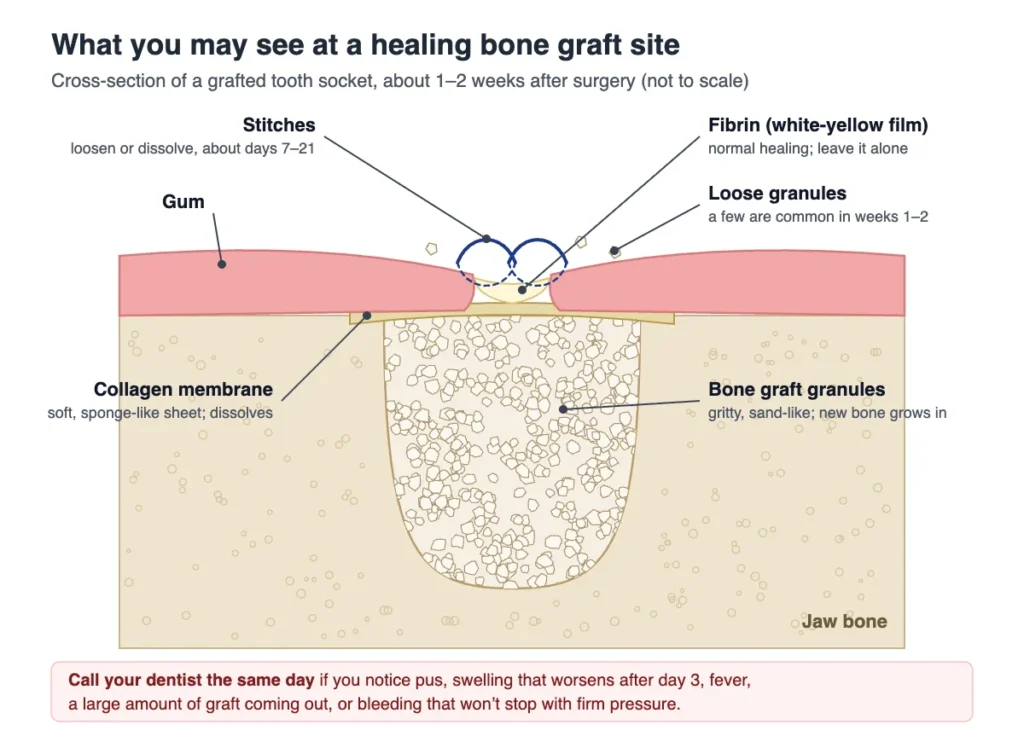
What you can see usually falls into one of four groups:
- Graft granules. Hard, gritty, white or cream, like salt or sand.
- Collagen membrane. A soft, flat, flexible sheet, sometimes looking like wet tissue paper. It dissolves over several weeks.
- Fibrin. A soft white, yellow or grey film. It is painless and odourless, and it shows the wound is sealing.
- Blood clot. Dark red, jelly-like tissue in the first few days. Protect it.
Thick yellow or green discharge, especially with worsening pain, swelling or a bad smell, is different. That may be infection: see our bone graft infection signs guide.
Why a few granules work loose
Your dentist usually overfills the socket slightly, expecting some surface particles to be lost. The gum may not fully cover the graft at first, so granules at the edge can loosen when you eat, rinse or touch the site with your tongue. Losing a few does not mean the graft has failed. The deeper graft, the part that becomes bone, cannot be judged from what you see at home.
What your graft site looks like, day by day
- Days 1–3. A dark clot, slight oozing, and swelling that peaks around day 2 or 3. A few granules in the sink are common.
- Days 4–14. A white-yellow fibrin film forms. Stitches loosen or dissolve, usually between about day 7 and day 21. The membrane edge may show. Pain should be easing each day.
- Weeks 3–8. The gum closes over and turns pink and smooth. The site feels firm.
- Months 3–6. New bone matures underneath. Many implants are placed in this window, but your dentist will confirm with an X-ray or scan. See bone graft healing stages.
Pain that suddenly gets worse around day 3 or 4, especially if it spreads to the ear, is not part of normal healing. Call your dentist.
Is my bone graft exposed?
The gum can pull back slightly and show the membrane or a few granules. Small exposures often heal. Still, tell your dentist. In bone regeneration studies, sites where the membrane became exposed gained less bone on average than sites that stayed covered (Garcia et al., 2018). That is why your dentist wants to know early. It does not mean your graft has failed.
The membrane fell out: what should I do?
Don’t push it back, pull it, cut it or rinse hard. Keep it in a clean container or take a photo, then call the office the next working day. Many sites still heal well. Your dentist will decide whether the graft needs extra protection.
Can I wash my bone graft out?
Not with gentle rinsing. Once the graft is secured with a membrane and stitches, normal water and saltwater rinses won’t wash it away. Avoid forceful rinsing, spitting and straws until your dentist says it’s safe, because suction can disturb early healing.
Can food get stuck in the graft site?
Yes. Rice, bread and egg can sit around the membrane and look like lost graft. Don’t use toothpicks or cotton buds. Rinse gently as instructed. Call if food stays trapped or the area becomes painful.
If your stitches came out too
If granules came away with a loose or dissolved stitch, see what to do when a bone graft comes out with the stitches.
What not to do
- Don’t poke the site, or pull at white tissue or the membrane.
- Don’t rinse forcefully, spit hard or use a straw in the first week.
- Don’t smoke or vape while it heals. Smoking is linked with poorer graft and implant healing.
- Don’t chew hard or sharp food on that side.
- Don’t start leftover antibiotics without your dentist’s advice.
Why your dentist cares about a stable, covered graft
Bone regenerates best when four conditions are met: the wound stays closed, a good blood supply grows in, the space under the membrane is kept open, and the graft stays still. These are known as the PASS principles (Wang & Boyapati, 2006). Preserving the socket with a graft limits the shrinkage of the jaw ridge that normally follows an extraction (Avila-Ortiz et al., 2014). That is why your dentist asks you to protect the site for a few weeks.
FAQs
What colour is a bone graft if it comes loose?
Usually white, cream or light grey granules, like coarse salt. A soft white or yellow film is more likely fibrin than graft.
Is white, jelly-like material in the gum after a bone graft normal?
Usually, yes. Soft, painless, odourless white-yellow material is typically fibrin, which is healthy healing tissue.
Can a bone graft fall out after 2 weeks?
A few surface granules can still work loose, especially if the gum hasn’t fully closed. Losing a larger amount after two weeks is uncommon and worth a call.
Does losing a few particles mean the graft failed?
No. Grafts are slightly overfilled, and most of the material stays in place. For the warning signs that do matter, see signs of a failed bone graft.
Why is there a little white thing after bone graft and implant surgery?
It is usually the membrane edge, fibrin or a granule. If it’s around an implant or healing cap, see white tissue around a dental implant.
Can I wait until my follow-up appointment?
If only a few granules appeared and pain and swelling are improving, mentioning it at your review is usually fine. Call sooner for any warning sign in the table above.
Will the graft need to be redone if some came out?
Not necessarily. Your dentist checks how much remains, and small losses rarely change the implant plan.
When to call your dentist
Call the same day for:
- pus, a bad taste or smell that won’t go away
- swelling that is increasing after day 3, or a fever
- pain getting worse instead of better
- a large amount of graft coming out, or the wound opening
- bleeding that won’t stop with 30–45 minutes of firm pressure
- fluid through your nose or whistling after an upper graft
- numbness of the lip, chin or tongue that is still there the next day
This guide is for education and does not replace advice from your own dentist or surgeon.
References
- Garcia J, Dodge A, Luepke P, Wang HL, Kapila Y, Lin GH. Effect of membrane exposure on guided bone regeneration: a systematic review and meta-analysis. Clin Oral Implants Res. 2018;29(3):328–338. doi:10.1111/clr.13121
- Avila-Ortiz G, Elangovan S, Kramer KWO, Blanchette D, Dawson DV. Effect of alveolar ridge preservation after tooth extraction: a systematic review and meta-analysis. J Dent Res. 2014;93(10):950–958. doi:10.1177/0022034514541127
- Atieh MA, Alsabeeha NHM, Payne AGT, Ali S, Faggion CM Jr, Esposito M. Interventions for replacing missing teeth: alveolar ridge preservation techniques for dental implant site development. Cochrane Database Syst Rev. 2021;CD010176.pub3. doi:10.1002/14651858.CD010176.pub3
- Wang HL, Boyapati L. “PASS” principles for predictable bone regeneration. Implant Dent. 2006;15(1):8–17.
- American Association of Oral and Maxillofacial Surgeons. Bone grafts.
- Johns Hopkins Medicine. Bone grafting.
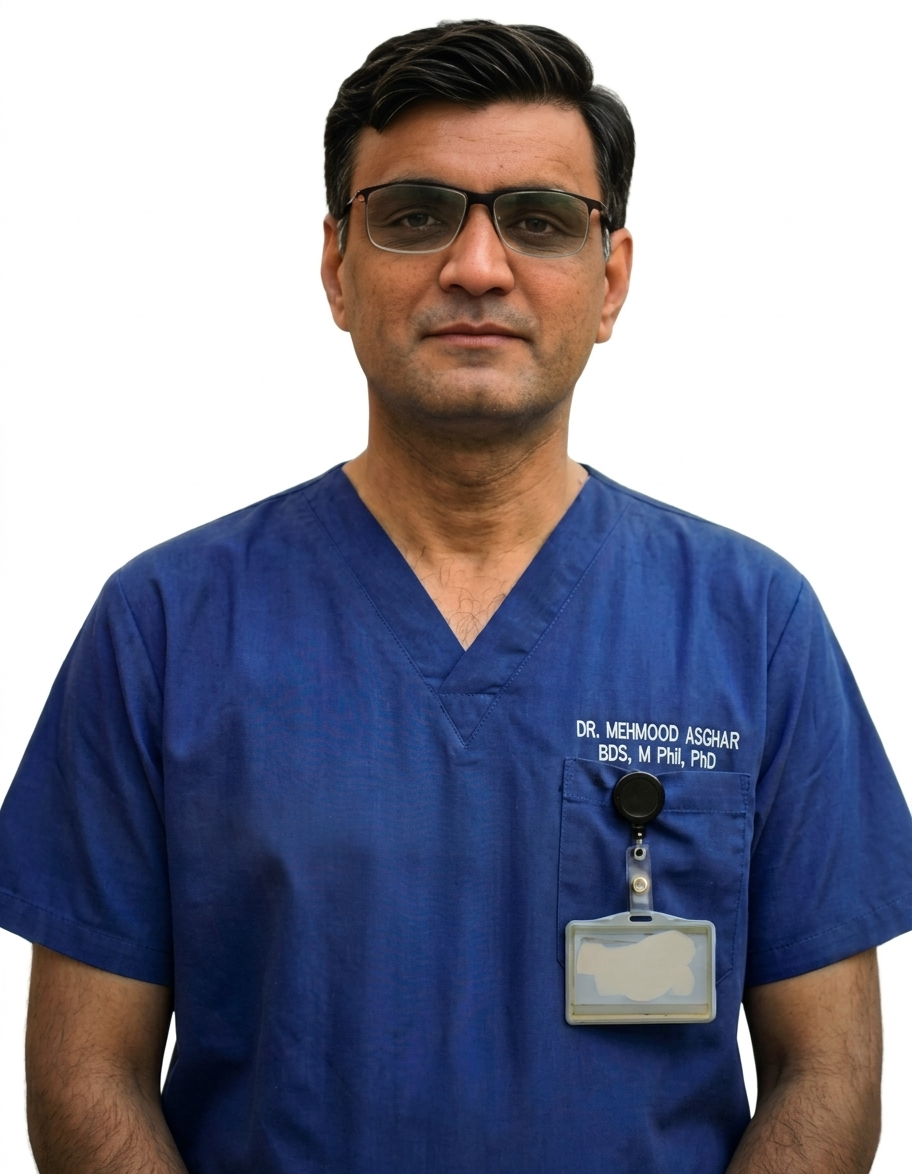
Dr. Mehmood Asghar, BDS, MPhil, PhD, is a dentist and Assistant Professor of Dental Materials at Army Medical College, National University of Medical Sciences (NUMS), Pakistan. He holds a BDS from NUST and a PhD from Universiti Malaya. His clinical, teaching and research background helps him explain dental treatments, recovery and oral health evidence in clear, practical language for patients. He writes and clinically reviews the guides at The Calm Dentist.
Have a question this guide didn’t answer? Email hello@thecalmdentist.com. Your question could become the next guide.