Quick answer: If you notice food stuck in a wisdom tooth hole, do not dig it out. During the first 24 hours, leave the extraction site undisturbed. After that, gentle warm salt-water rinses may help, unless your surgeon has given different instructions. Use a cleaning syringe only when your dental team says to start. If food will not clear, or pain or swelling is getting worse, contact your dentist.[1], [2]
You have managed your first proper meal after surgery, then notice something sitting where your wisdom tooth used to be. It is easy to worry that you have spoiled the healing process.
A small piece of food does not automatically mean an infection or dry socket. The useful questions are how long ago the tooth was removed, whether the area is becoming more comfortable, and what cleaning instructions your surgeon gave you. You do not need to make the hole look perfectly empty.
5 essential tips for food stuck in a wisdom tooth hole
- Leave a fresh socket alone. Avoid probing and routine rinsing during the first 24 hours.
- Clean gently afterward. Follow your surgeon’s rinsing instructions.
- Use a syringe only as instructed. Confirm when and how to start.
- Stop if food will not clear. Ask your dental team rather than digging deeper.
- Act on worsening symptoms. Contact your dentist for increasing pain, swelling or other warning signs.
Why do you have food stuck in a wisdom tooth hole?
The space left by a removed tooth does not close immediately. While it heals, its shape can allow small food particles to collect, especially near the back of your mouth. Stitches do not necessarily seal the whole opening.
Small grains, seeds and crumbly foods can be awkward around a healing socket. Choose textures you can manage comfortably and follow your surgeon’s advice about returning to your normal meals. There is no need to test the socket with your tongue after every bite.[3]
Food stuck in a wisdom tooth hole on the first day?
Protect the fresh wound rather than trying to retrieve the food. For the first 24 hours, routine rinsing, forceful spitting and touching the socket can disturb the blood clot. Do not use fingers, a toothpick, tweezers or a cotton swab to investigate.[1]
If something feels sharply lodged, causes significant discomfort, or leaves you unsure what to do, phone your dental team. They can advise whether it needs attention. Avoid improvising a cleaning method simply because you can see a particle.
How can you clean the area after the first day?
Once 24 hours have passed, your usual instructions may include gentle warm salt-water rinses after meals. Follow the recipe and frequency your own team provided. One hospital-recommended mixture is half a teaspoon of salt in about one cup of warm water.[2]
- Let a small mouthful gently bathe the area.
- Avoid vigorous swishing or gargling.
- Let the liquid fall from your mouth rather than spitting hard.
- Keep your other teeth clean, taking care around the surgical site.
The aim is gentle hygiene, not forcing every visible speck out. Boston University’s postoperative instructions also advise leaving stitches and healing tissue undisturbed and avoiding commercial mouthwash unless recommended.[4]
Can a syringe help with food stuck in a wisdom tooth hole?
A curved-tip irrigation syringe can help clear debris when it is part of your surgeon’s aftercare plan. There is no single starting day that suits every extraction. University of Washington instructions allow irrigation from the third day unless advised otherwise; your surgeon may use a different schedule.[5]
Use the syringe, liquid and technique your team recommends. Ask them to demonstrate where the tip should sit and how gently to press. Do not push the tip into tissue or force water under stitches.
A randomized trial found fewer inflammatory complications with a specific postoperative irrigation protocol after lower wisdom tooth surgery. That supports instructed irrigation in the right circumstances; it does not establish that everyone should flush a fresh socket immediately.[6]
If you had a bone graft, membrane or special dressing placed, check with your surgeon before irrigating. General wisdom tooth advice may not fit that procedure.
What if the food will not come out?
For food stuck in a wisdom tooth hole that will not clear with a gentle rinse, stop trying to dislodge it. Repeated probing can cause more trouble than the original particle. Small pieces may clear naturally, but persistent food trapping or discomfort is a reason to ask your dentist to check the area.[7]
Do not put peroxide, concentrated mouthwash, oils or other home remedies into the hole to dissolve food. If you cannot identify what you are seeing, leave it in place and contact your dental team.
Could it be healing tissue rather than food?
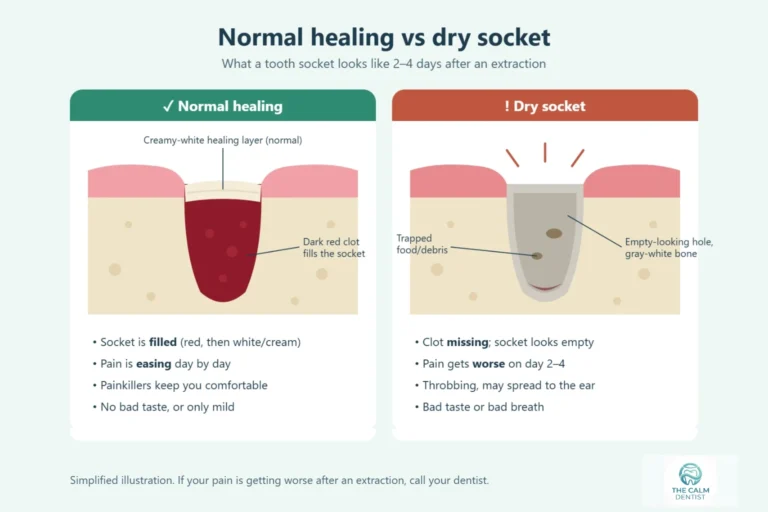
A pale or creamy layer can be part of normal socket healing. Color alone cannot reliably distinguish food, healing tissue or a complication, so do not scrape a white patch away. Our guide to dry socket versus normal healing explains the appearance and symptom differences.
Food stuck in a wisdom tooth hole 3 weeks after removal
A socket can still have a noticeable opening at this stage. Imperial College Healthcare notes that a wisdom tooth socket may take up to two months to close. This is a possible recovery course, not a deadline or a reason to ignore new symptoms.[8]
If food keeps collecting, follow the cleaning routine your surgeon recommends. Ask for a review if it repeatedly will not clear, makes eating uncomfortable, or comes with a persistent unpleasant taste. New or worsening pain and swelling need assessment even if the extraction was several weeks ago.
| Situation | Practical next step |
|---|---|
| Food noticed within the first 24 hours | Avoid probing and routine rinsing. Call your dental team if uncomfortable or unsure. |
| After 24 hours, symptoms improving | Use gentle rinses as directed; keep the surrounding teeth clean. |
| A syringe has been prescribed | Follow your surgeon’s starting day and demonstrated technique. |
| Food repeatedly trapped after two or three weeks | Ask your dentist to check the site and review your cleaning routine. |
| Severe or worsening symptoms at any stage | Seek prompt dental advice. |
When should you contact your dentist?
Contact your dentist or oral surgeon promptly for severe or increasing pain, swelling that is worsening rather than settling, pus, fever, or pain with a persistent bad taste. Bleeding that does not stop with your prescribed pressure measures also needs advice. Difficulty breathing or swallowing requires emergency care.[3], [4]
Food in the socket does not diagnose dry socket. If pain is worsening, an examination is more useful than checking the hole repeatedly. For broader aftercare, read how to reduce your risk of dry socket.
What should you tell your dental team when you call?
Have your extraction date and aftercare sheet handy. Explain whether the problem began after eating, whether the discomfort is improving or worsening, and what you have already tried. Mention any graft, dressing or stitches. Ask whether you should continue your usual rinses, pause irrigation, or come in for a check. A clear description is more helpful than repeatedly touching the socket to investigate it.
Frequently asked questions
How do I know if food is stuck in my wisdom tooth hole?
You may see a small speck in the socket, notice a bad taste or smell, or feel mild pressure. Small bits often come out with gentle rinsing. Throbbing pain that gets worse after day 2 or 3, especially pain that spreads to your ear, is more likely dry socket than food, so call your dentist.
What about food stuck in a wisdom tooth hole with stitches?
Do not pull a thread aside or pass a tool underneath it. If food stuck in a wisdom tooth hole seems caught around a stitch, follow your cleaning instructions and ask the surgical team if it persists. Let them decide whether the stitch or the site needs attention.
Can I have food stuck in a wisdom tooth hole without pain?
Yes. Not every food particle causes pain. With food stuck in a wisdom tooth hole but no discomfort, keep to your aftercare plan rather than repeatedly checking it. Ask for advice if debris persists, a bad taste develops, or symptoms change.
How do I handle food stuck in a wisdom tooth hole without a syringe?
You do not need to buy a syringe simply because you notice food stuck in a wisdom tooth hole. Use gentle rinses when permitted and ask whether your surgeon wants you to irrigate. Do not substitute a spray bottle or another improvised device.
What if I cannot see the food stuck in a wisdom tooth hole?
Do not stretch your cheek repeatedly or investigate by touch. Describe the sensation and any symptoms to your dentist. An examination can clarify what is there without making you keep inspecting the back of your mouth.
What if food is still getting stuck a month after wisdom tooth removal?
A small opening can remain at this stage. Imperial College Healthcare notes that an extraction socket can take up to two months to close.[8] That is a general recovery range, not a reason to ignore persistent discomfort. Continue the cleaning routine your surgeon recommends. Arrange a review if food repeatedly will not clear, eating is uncomfortable, or you develop new pain, swelling, discharge or a persistent unpleasant taste. Do not dig into the socket.
Will food stuck in a wisdom tooth hole dissolve?
Do not rely on every piece dissolving. Some debris may loosen or clear naturally. Use the cleaning routine you were given, and ask your dentist about anything that remains trapped or uncomfortable. Avoid trying to dissolve it with stronger products.
Can I leave a small piece of food alone?
Leaving it temporarily is often preferable to digging into a fresh wound. That does not mean ignoring persistent debris or symptoms. If gentle cleaning at the appropriate stage does not help, contact your dental team.
Can I use a Waterpik or another water flosser?
Check with your surgeon before directing a water flosser at the socket. It is not interchangeable with the curved syringe your team may prescribe, and even a familiar cleaning device may be unsuitable during early healing.[7]
If you have food stuck in a wisdom tooth hole, you do not need to keep the socket looking spotless. Give it gentle care, follow the instructions for your own surgery, and let your dentist help when a particle will not clear or symptoms change.
This article provides general education and does not replace an examination or your surgeon’s postoperative instructions.
References
- University College London Hospitals. Dental extractions: post-operative instructions.
- University Hospitals Dorset. Aftercare instructions: dental extractions. January 2026.
- NHS. Wisdom tooth removal.
- Boston University Henry M. Goldman School of Dental Medicine. Oral and Maxillofacial Surgery: post-operative instructions.
- University of Washington School of Dentistry / Northwest Center for Oral and Facial Surgery. After your oral surgery.
- Ghaeminia H, et al. Postoperative socket irrigation with drinking tap water reduces the risk of inflammatory complications following surgical removal of third molars: a multicenter randomized trial. Clin Oral Investig. 2017;21:71–83. doi:10.1007/s00784-016-1751-1.
- Healthline. 8 tips to remove food stuck in wisdom tooth hole. Medically reviewed by Christine Frank, DDS.
- Imperial College Healthcare NHS Trust. Minor oral surgery: postoperative instructions.

Dr. Mehmood Asghar, BDS, MPhil, PhD, is a dentist and Assistant Professor of Dental Materials at the National University of Medical Sciences (NUMS), Pakistan. He holds a BDS from NUST and a PhD from Universiti Malaya. His clinical, teaching and research background helps him explain dental treatments, recovery and oral health evidence in clear, practical language for patients. He writes and clinically reviews the guides at The Calm Dentist.