Quick answer: How can you prevent dry socket? Follow your dentist’s aftercare instructions, avoid smoking and vaping, and leave the socket undisturbed. Do not rinse or spit forcefully during the first 24 hours. After that, clean gently as directed. Choose soft foods, drink from a cup, and ask whether a chlorhexidine rinse is appropriate for you.[1]
If you have just had a tooth removed, the list of things to avoid can make recovery feel like a test you might fail. It does not need to be. A few practical habits can protect the healing area without making every sip or mouth movement something to worry about.
Dry socket, also called alveolar osteitis, develops when the protective blood clot in the extraction site breaks down or is lost too early. The bone underneath can become exposed and painful. Aftercare helps reduce the risk, but it cannot prevent every case. Getting dry socket does not automatically mean you did something wrong.
Here is how to prevent dry socket as far as you reasonably can, one stage at a time.
How can you lower dry socket risk during the first week?
- Follow your own dentist’s instructions. Your extraction, stitches or bone graft may need particular care.
- Leave the socket undisturbed. Avoid poking it, testing the clot or repeatedly pulling your cheek aside to inspect it.
- Avoid smoking and vaping. Plan ahead for support if stopping will be difficult.
- Do not rinse during the first 24 hours. Begin gentle rinsing afterward, unless your dentist gives different instructions.
- Choose soft foods and drink from a cup. Return to other textures gradually.
- Call if pain becomes severe or starts worsening after improving. You do not need to diagnose the socket yourself.
What should you do in the first 24 hours?
For the first day, the main task is to let the extraction site settle. Use the gauze your dental team provides in the way they show you. If bleeding restarts, follow their pressure instructions rather than repeatedly rinsing to see whether the bleeding has stopped.
Avoid vigorous mouth movements such as hard spitting, swishing mouthwash or gargling. Keep fingers, toothpicks and cotton swabs away from the socket. It can be tempting to check whether the clot is still there, but touching it will not give you a reliable answer.
Rest for the day and follow your dentist’s advice about exercise. On brushing, use the instructions you were given: keep the other teeth clean gently, but do not brush the wound itself. Postoperative guidance varies about brushing on the day of surgery.[2], [3]
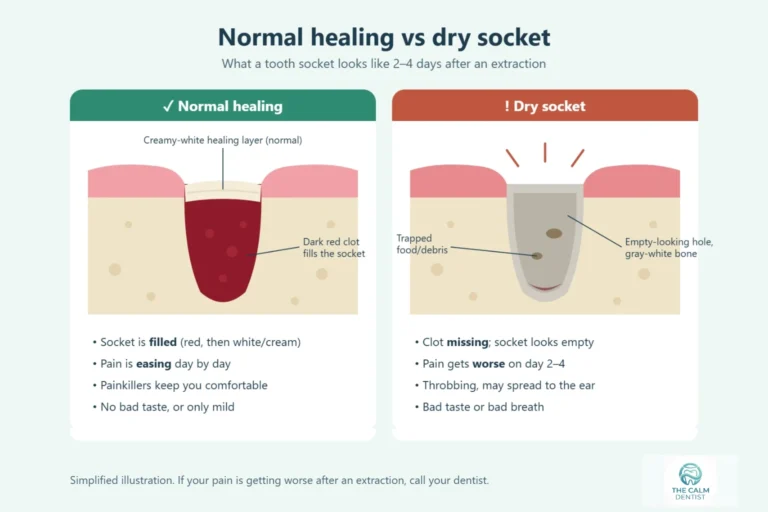
You do not need to keep looking for a dark clot. If you are worried about what you can see, our guide to what dry socket looks and feels like explains why appearance alone can be misleading.
How long should you avoid smoking and vaping?
Avoid smoking and vaping while the extraction site heals, starting before the procedure if possible. If you are trying to work out how to avoid dry socket, smoking is one of the clearest risk factors you can address.
A 2022 systematic review found dry socket in approximately 13.2% of smokers compared with 3.8% of nonsmokers across the included studies. These are pooled figures from different patient groups and extractions, not a prediction of your personal risk or the effect of one cigarette.[4]
Waiting periods in patient leaflets differ. University Hospitals Dorset advises no smoking or vaping for at least 72 hours; UCLH advises avoiding smoking for at least 48 hours.[2], [3] Neither means smoking suddenly becomes risk-free when that time is up. Plan for the first week without smoking or vaping if you can, and follow your surgeon’s advice if they recommend longer.
If cravings are likely to be difficult, ask your dentist or pharmacist beforehand about suitable support, including nicotine replacement. Do not assume vaping is a safe substitute, or that covering the socket with gauze makes smoking safe. The smoking percentages above should not be applied to vaping: they come from cigarette-smoking research.
Can using a straw cause dry socket?
Drinking from a cup is the simplest precaution while the socket heals. Many dental teams advise avoiding straws because of concern that suction could disturb the clot. Recommendations vary: AAOMS advises avoiding them for the first 24–48 hours, while Mayo Clinic recommends at least a week.[5], [6]
The direct research is less definite than those familiar warnings sometimes suggest. One small study found similar dry socket rates in patients who used straws and those who did not.[7] That does not prove every kind of straw use is harmless, but it does mean an accidental sip should not be treated as proof of damage.
As a conservative approach, use a cup during the first week unless your surgeon advises otherwise. If you forget once, put the straw aside and return to your aftercare plan. Do not poke the socket to check it.
When can you rinse and brush after an extraction?
When should salt-water rinses start?
For routine aftercare, wait until 24 hours after the extraction before starting gentle rinses. Your dentist may give different instructions for your particular procedure.
A simple recipe is ½ teaspoon of salt in 1 cup (8 oz) of warm water. Let the liquid gently bathe the area rather than swishing hard. Avoid forceful spitting afterward. Follow your dental team’s advice about how often and how many days to continue.[3]
Warm salt-water rinses are widely recommended to keep the area clean. Studies comparing them with antiseptic rinses found no clear difference, but most were small or had design weaknesses. Salt water cannot guarantee that you will avoid dry socket.[8]
How should you clean around the socket?
Continue gentle toothbrushing as your dentist advises, keeping the brush away from the fresh wound. Do not scrape away a white healing layer or dig out food with a sharp object.
If you have been given a cleaning syringe, use it only at the time and in the way your surgeon demonstrates. Gentle mouth rinsing and flushing inside a socket are different procedures. Do not start forcefully irrigating a fresh socket on your own.[2], [9]
If you notice debris after eating, our guide to food stuck in a wisdom tooth hole explains gentle cleaning, syringe timing, and when to ask your dentist for help.
When can you eat, and which foods are easiest?
Follow the eating instructions from your dental team, especially if you had sedation or general anesthesia. While your mouth is numb, you can bite your lip or tongue without realizing it, and hot food or drinks can burn you.
Once eating is permitted and you can manage it safely, begin with soft, cool or lukewarm foods. Yogurt, scrambled eggs, mashed potatoes and cooled smooth soup are useful options. Take small bites and chew away from the extraction site where possible.[2], [6]
Avoid hard, sharp or crunchy foods that scrape the wound or are uncomfortable to chew. You do not need to stay on liquids until the hole closes. Introduce more texture gradually as comfort improves, following any restrictions your surgeon gave you.
No special food seals the socket or guarantees prevention. The aim is to stay nourished while avoiding irritation.
Can chlorhexidine help prevent dry socket?
Yes. A 2022 Cochrane review found moderate-certainty evidence that chlorhexidine mouthrinse or gel placed in the socket probably reduces dry socket. Most of the research involved wisdom tooth extractions, so the size of the benefit may differ for other teeth.[1]
In one trial involving higher-risk patients, dry socket occurred in 2.69% of people using chlorhexidine and 7.26% using placebo. The rinse started 24 hours after extraction.[10] This supports asking about it; it does not mean every patient needs the same treatment.
Ask before the procedure if you have had dry socket previously, smoke, or expect a difficult extraction. If a rinse is recommended, follow its prescribed concentration, timing and duration. Chlorhexidine can cause staining, taste changes or mouth irritation. Tell your dentist about any previous reaction. In the US, chlorhexidine rinse is available by prescription, so your dentist can decide whether it is right for you.
Do not pack chlorhexidine gel or other products into the socket yourself. Gel placement in the research was a dental treatment, not a home remedy.
What should you keep doing on days 2 to 7?
After the first day, the focus shifts toward gentle cleaning and gradually returning to comfortable eating. The first week is a useful planning window, rather than a deadline when every socket is fully healed.
| Time after extraction | Main focus |
|---|---|
| First 24 hours | Leave the wound alone, avoid routine rinsing and hard spitting, and follow instructions for bleeding and rest. |
| Days 2–3 | Begin gentle rinsing as directed, keep other teeth clean and continue soft foods. |
| Days 4–7 | Continue careful hygiene and introduce more foods as comfortable. Seek advice if pain becomes severe or worsens after improving. |
Throughout this period, avoid smoking and vaping, use a cup, and follow any extra instructions for stitches or a bone graft.
When should you call your dentist?
Contact your dentist promptly if pain is severe, is not controlled by the advice you were given, or starts getting worse after initially improving. Pain spreading toward the ear, together with an unpleasant taste or odor, can occur with dry socket. An examination is needed to tell what is happening.[6]
Fever, pus, spreading facial swelling or bleeding that continues despite the pressure measures you were taught need urgent dental advice. Difficulty breathing or swallowing needs emergency care.
You do not need to wait until you can see bone. Dry socket is treatable, and your dentist can help relieve the pain. Our guide explains how dry socket is treated.
Frequently asked questions about preventing dry socket
How can I prevent dry socket while sleeping?
For the first few nights, sleep with your head raised on an extra pillow. Take out any gauze before you fall asleep so you don’t swallow or choke on it. Try to sleep on the side away from the extraction, and avoid anything that creates suction in your mouth.
How can you prevent dry socket after wisdom teeth removal?
Follow the instructions for your own extraction: leave the wound undisturbed, avoid smoking and vaping, drink from a cup, and begin gentle cleaning only when advised. Ask whether chlorhexidine is appropriate for you. Much of the prevention research involved wisdom tooth surgery, but the difficulty of the extraction and your individual circumstances affect risk.[1] If food collects near the socket, use our food-in-socket guide rather than probing the area.
Does a bone graft prevent dry socket?
Do not treat a bone graft as a guarantee against dry socket. Socket-preservation grafting is intended to limit bone loss after extraction, which is a different goal from preventing every healing complication.[12] A graft, membrane or dressing may change your cleaning instructions. Follow your surgeon’s plan, do not disturb the material, and ask before using a syringe. Severe or worsening pain still needs assessment. Our bone-graft guide explains the procedure and recovery.
Can antibiotics prevent dry socket?
A 2021 Cochrane review found low-certainty evidence that preventive antibiotics may reduce dry socket after wisdom tooth surgery. Most participants were healthy people having impacted wisdom teeth removed, so the findings do not establish that everyone having an extraction needs antibiotics.[11] Your dentist should weigh your individual risks, possible adverse effects and antibiotic resistance. Do not start leftover antibiotics or seek a prescription solely as a substitute for aftercare.
Can you get dry socket even if you follow every instruction?
Yes. Aftercare lowers risk but cannot remove every contributing factor. The tooth’s position and the difficulty of surgery also matter. If dry socket develops despite careful recovery, it does not mean you failed. Contact your dentist for assessment and pain relief.
What if you accidentally use a straw?
Stop using it and return to drinking from a cup. One accidental use does not establish that the clot has been lost. Avoid checking with your tongue or fingers, and call your dentist if severe or worsening pain develops.
Do stitches prevent dry socket?
Stitches help bring the gum edges together, but they do not guarantee protection from dry socket. Keep following your aftercare instructions even if the area is stitched. Do not pull at a loose thread or try to inspect underneath it.
Can salt water prevent dry socket?
Gentle salt-water rinsing after the first 24 hours can support postoperative care, but it is not guaranteed prevention. Research has limitations, and salt water has not been firmly established as equivalent to chlorhexidine. Follow the rinse your dentist recommends.[8]
When can you stop worrying about dry socket?
Dry socket usually develops in the first few days. If you are getting more comfortable as the week progresses, that is reassuring. There is no universal hour when risk becomes zero. Let your symptoms and your dentist’s instructions guide your recovery.
You do not need a perfect recovery routine. Protect the wound, keep things gentle, avoid smoking and vaping, and ask for help when pain changes in a concerning way. If you are wondering how to avoid dry socket, these are the steps that matter most, and you can take them without spending the week watching the socket.
For more help after an extraction, browse our tooth extraction guides.
This article provides general education and does not replace an examination or your own dentist’s postoperative instructions.
References
- Daly BJM, Sharif MO, Jones K, Worthington HV, Beattie A. Local interventions for the management of alveolar osteitis (dry socket). Cochrane Database Syst Rev. 2022;9:CD006968. doi:10.1002/14651858.CD006968.pub3.
- University College London Hospitals. Dental extractions: post-operative instructions.
- University Hospitals Dorset. Aftercare instructions: dental extractions. Patient information leaflet. January 2026.
- Kuśnierek W, Brzezińska K, Nijakowski K, Surdacka A. Smoking as a risk factor for dry socket: a systematic review. Dent J (Basel). 2022;10(7):121. doi:10.3390/dj10070121.
- American Association of Oral and Maxillofacial Surgeons. What is dry socket?
- Mayo Clinic. Dry socket: symptoms and causes.
- Bloomer CR. Straws do not cause dry sockets when third molars are extracted. Tex Dent J. 2012;129(1):25–32.
- Adekunle AA, Egbunah UP, Erinoso OA, Adeyemo WL. Effectiveness of warm saline mouth bath in preventing alveolar osteitis: a systematic review and meta-analysis. J Craniomaxillofac Surg. 2021;49(10):980–988. doi:10.1016/j.jcms.2021.09.001.
- Ghaeminia H, et al. Postoperative socket irrigation with drinking tap water reduces the risk of inflammatory complications following surgical removal of third molars: a multicenter randomized trial. Clin Oral Investig. 2017;21(1):71–83. doi:10.1007/s00784-016-1751-1.
- Halabi D, Escobar J, Alvarado C, Martinez N, Muñoz C. Chlorhexidine for prevention of alveolar osteitis: a randomised clinical trial. J Appl Oral Sci. 2018;26:e20170245. doi:10.1590/1678-7757-2017-0245.
- Lodi G, et al. Antibiotics to prevent complications following tooth extractions. Cochrane Database Syst Rev. 2021;2:CD003811. doi:10.1002/14651858.CD003811.pub3.
- Alavi SA, et al. A systematic review and meta-analysis on the use of regenerative graft materials for socket preservation in randomized clinical trials. Oral Surg Oral Med Oral Pathol Oral Radiol. 2024;138(6):702–718. doi:10.1016/j.oooo.2024.07.003.

Dr. Mehmood Asghar, BDS, MPhil, PhD, is a dentist and Assistant Professor of Dental Materials at the National University of Medical Sciences (NUMS), Pakistan. He holds a BDS from NUST and a PhD from Universiti Malaya. His clinical, teaching and research background helps him explain dental treatments, recovery and oral health evidence in clear, practical language for patients. He writes and clinically reviews the guides at The Calm Dentist.