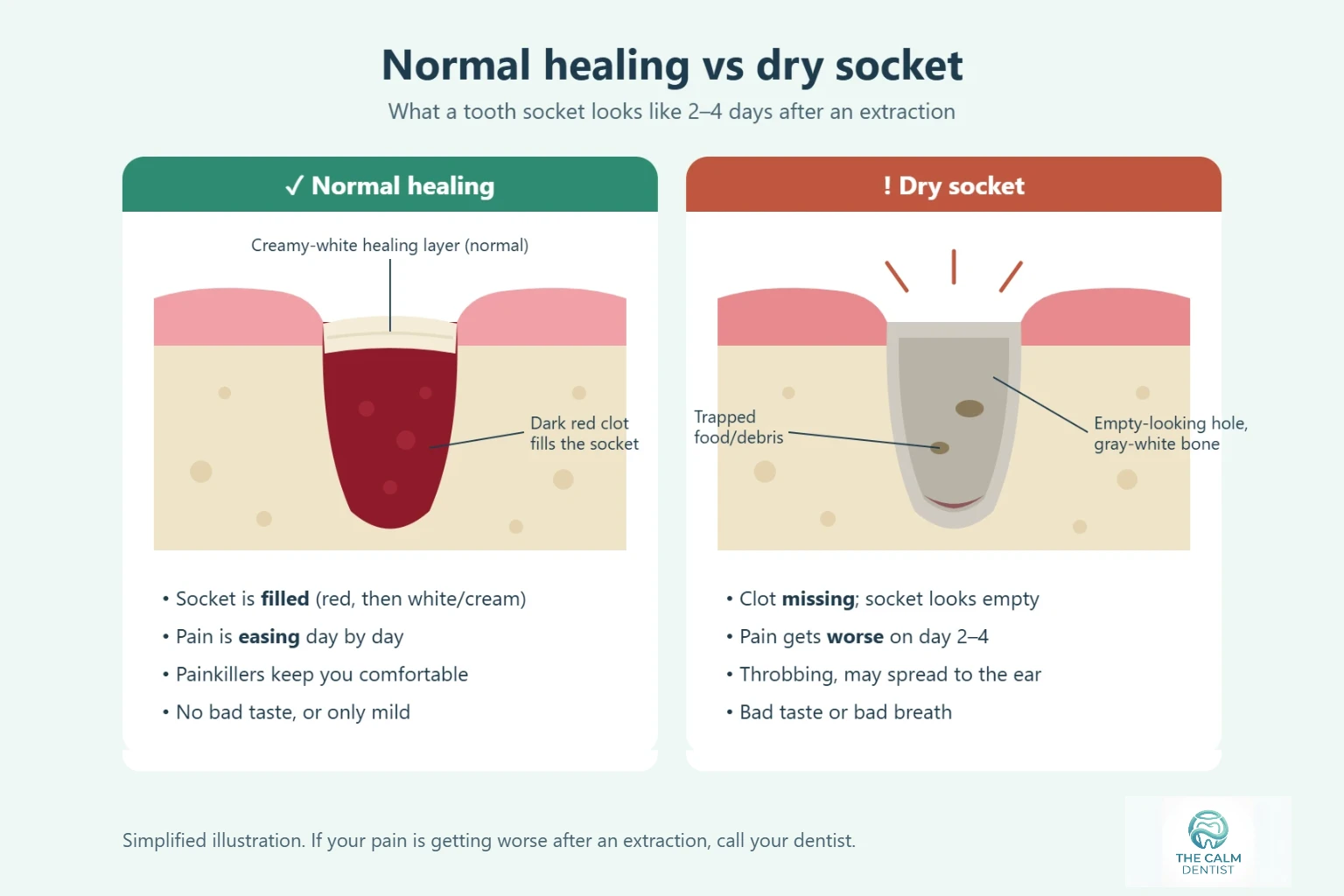
Quick answer: What does dry socket look like? A dry socket may look empty or show exposed bone after part or all of the blood clot is lost. Appearance alone cannot confirm it. Severe or worsening pain in the days after extraction, sometimes spreading toward the ear, is a reason to contact your dentist. A white healing layer by itself does not establish dry socket. Do not scrape or probe the socket.
If you’ve just had a tooth out, it’s very natural to keep checking the socket in the mirror and wonder: what does dry socket look like, and is mine one? Most of the time, what looks strange is simply healing. This guide shows what a normal socket looks like day by day, what a dry socket looks like, and how to tell the two apart, so you know when to relax and when to call.
Find your question: What does normal healing look like? · Dry socket vs normal healing · What does dry socket feel like? · How is dry socket treated? · When should I get help?
What is dry socket?
After a tooth is removed, a blood clot forms in the empty socket. The clot acts like a natural bandage: it protects the bone and nerve endings underneath and gives new gum and bone something to grow into.
Dry socket (the medical name is alveolar osteitis) happens when that clot breaks down, dissolves or comes away too early. The bone underneath is left exposed, and that’s what makes it so painful. It isn’t the same as an infection, although the two are sometimes confused (more on that below).
The good news: dry socket is uncommon after a routine extraction. A 2022 Cochrane review puts it at about 1 to 5% of routine extractions, rising to up to around 30% after surgical removal of lower wisdom teeth [1].
What does a normal healing socket look like?
A normal socket changes color quite a lot in the first week. Many people panic at the white stage, so it helps to know what to expect:
- Day 1: a dark red or maroon clot fills the socket. A little oozing is normal.
- Days 2 to 3: the top of the clot often turns white, cream or pale yellow. This is a soft healing layer, not pus. The gum around the edges may look a little red and puffy.
- Days 3 to 7: pinkish-red, slightly bumpy healing tissue starts to fill the socket from the sides and bottom. The hole gets shallower.
- Weeks 1 to 3: the gum edges draw together. A small dip can remain for a few weeks.
- Months: the bone underneath keeps filling in quietly, long after the gum looks closed.
Most importantly, with normal healing the pain is worst in the first day or two and then gradually eases.
What does a dry socket look like?
A dry socket usually looks like an empty hole where you’d expect to see a clot. Things you might notice:
- No dark clot, or only a ragged, partly broken-down clot
- A grayish-white or yellowish surface deep in the socket: this can be bare bone [5]
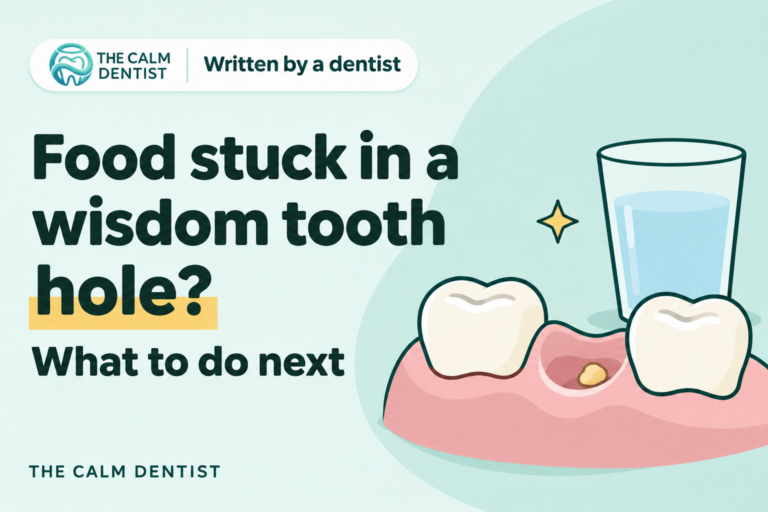
- Food or debris sitting in the wisdom tooth hole
- Occasionally, there may be a foul smell emanating from the dry socket
- Gum edges that look sore, but often not much swelling
Honestly, it can be hard to tell from a mirror, especially with back teeth. Normal healing tissue is also white-ish, and a dry socket can be hidden at the back of the mouth. That’s why dentists rely mainly on how it feels and when the pain started, not only on how it looks [2].
Dry socket vs normal healing: side by side
| Feature | Normal healing | Dry socket |
|---|---|---|
| What you see | Dark clot, then a white or creamy layer, then pink tissue | Empty-looking hole; gray-white bone or debris; clot missing |
| Pain pattern | Worst on day 1–2, then steadily easing | Eases at first, then gets worse on day 2–4 |
| Type of pain | Sore, tender, manageable | Deep, throbbing; often spreads to the ear, temple or neck |
| Painkillers | Usually enough | Often only take the edge off |
| Taste and smell | Mild, if any | Often a bad taste or bad breath |
| Swelling or fever | Mild swelling for 2–3 days, no fever | Usually little swelling and no fever |
What does dry socket feel like?
Pain is the main symptom, and its timing is the giveaway. Dry socket pain typically starts or flares 1 to 3 days after the extraction [2], and almost all cases show up within the first week [3]. People describe it as:
- A deep, throbbing ache in the socket that keeps building
- Pain that spreads to the ear, temple, eye or neck on the same side
- Pain that wakes you up or isn’t helped much by your usual painkillers
- A bad taste in your mouth or bad breath that doesn’t go away with gentle rinsing
Early-stage dry socket often feels like this: you were improving on day 1 and 2, and then on day 3 the pain turns around and gets steadily worse. You don’t need to wait until it’s unbearable. That turnaround is reason enough to call.
Who is more likely to get dry socket?
Anyone can get it, but the risk is higher with:
- Lower wisdom teeth and lower back teeth, especially surgical extractions [1, 3]
- Smoking: in a 2022 meta-analysis, about 13% of smokers developed dry socket compared with about 4% of non-smokers, a more than three-fold increase in odds [4]
- A difficult or traumatic extraction [3]
- Taking the oral contraceptive pill (linked in several studies) [3]
- A previous dry socket, or poor oral hygiene around the time of the extraction [1, 3]
Having stitches doesn’t rule it out. Dry socket can still happen in a stitched socket, although stitches may make the socket harder to see.
Can dry socket heal on its own?
Yes. Dry socket does eventually heal by itself, usually over about 5 to 10 days [2]. The problem is that those days can be very painful. Treatment doesn’t so much speed up healing as take the pain away while it heals, which is why it’s worth seeing your dentist rather than sitting it out.
How does a dentist treat dry socket?
If you’re nervous about going back, this part is usually much easier than the extraction itself. There’s no drilling and nothing is removed. A typical visit looks like this:
- A quick look: your dentist checks the socket and may take an X-ray to rule out a leftover fragment or infection [5].
- Gentle rinsing: the socket is flushed with salt water or an antiseptic rinse to remove food and debris. A little numbing can be used if it’s tender.
- A soothing dressing: a small medicated paste or pack is placed in the socket. Many people feel relief within minutes.
- Pain relief advice and, sometimes, a follow-up visit to change the dressing.
What is a dry socket medicated dressing?
It is a medicated paste or pack that a dentist may place after cleaning the socket to help manage discomfort. The product and follow-up schedule depend on the assessment; some dressings need changing.[6] Do not pack the hole with an online dressing, clove oil, cotton wool or another home remedy. If a dressing comes out or pain returns, contact the treating clinic for instructions.
Antibiotics aren’t usually needed, because dry socket isn’t mainly an infection [1]. The Cochrane review found that there isn’t yet enough high-quality research to say which dressing works best [1], so different dentists use different products. They all aim to protect the bone and calm the pain.
What can I do until I see my dentist?
- Take your usual painkillers as directed on the label (for example ibuprofen or acetaminophen/paracetamol, if they’re safe for you). Don’t go over the stated dose, and never put a tablet directly on the gum: it can burn the tissue.
- Rinse gently with warm salt water after meals (from 24 hours after the extraction). Let it fall out of your mouth rather than spitting hard.
- Avoid smoking and vaping, and chew on the other side.
- Don’t poke the socket with fingers, tongue, cotton swabs or a toothpick.
Is dry socket dangerous?
Dry socket is very painful, but it isn’t usually dangerous and it doesn’t normally cause lasting damage. Infection is a different problem and needs prompt care.
When to get help urgently (call your dentist the same day, or go to urgent care or the emergency department if you can’t reach them):
- Swelling in your face, jaw or neck that is spreading or getting worse [5]
- Fever, chills or feeling generally unwell
- Pus coming from the socket
- Difficulty swallowing, breathing or opening your mouth
- Bleeding that won’t stop with firm pressure on a gauze pad
If you had a bone graft placed in the socket, some of the same worries apply. See signs of an infected bone graft vs normal healing and what to do if bone graft granules are coming out.
Can dry socket be prevented?
You can’t control every risk, but these steps lower it:
- Don’t smoke for as long as you can before and after the extraction (ideally at least the first few days).
- Protect the clot for the first 24 hours: no rinsing, hard spitting or poking.
- Keep your mouth clean and brush the other teeth gently from the first evening.
- Ask about a chlorhexidine rinse or gel if you’re at higher risk. In the Cochrane review, chlorhexidine used around the time of the extraction reduced the risk of dry socket [1].
- Tell your dentist if you smoke, take the pill, or had dry socket before, so they can plan for it.
For the full aftercare checklist, including smoking, straws, rinsing and eating, read how to prevent dry socket after an extraction.
What does dry socket look like: Frequently asked questions
What does a partial dry socket look like?
People say “partial dry socket” when only part of the blood clot has broken down. You may see some dark clot plus a small area of grayish-white bone, often near one edge. Looks alone can mislead you. Severe, throbbing pain that starts 2 to 4 days after the extraction is the more reliable sign, so call your dentist if you have it.
Does a dry socket look like a black hole?
It can look like an empty, dark hole because the clot is missing. But a healthy socket with a dark red or nearly black clot can look similar in photos. Don’t judge by color alone. A normal socket gets less painful each day, while dry socket pain usually gets worse after day 2 or 3.
What does dry socket taste like?
An unpleasant taste or bad breath can occur with dry socket, but there is no particular taste that confirms the diagnosis. MedlinePlus lists bad taste alongside severe pain and other symptoms.[6] Taste alone cannot tell you whether there is dry socket, trapped food or another problem. Contact your dentist if the taste persists or occurs with increasing pain, swelling or discharge.
Can you have dry socket without pain?
Severe or increasing pain in the days after extraction is a characteristic feature of dry socket.[7] A white patch or an empty-looking hole without significant pain is not enough to diagnose it. Improving comfort is reassuring, but absence of pain does not rule out every healing problem. Do not probe the socket; ask your dentist if you remain concerned about its appearance or develop new symptoms.
Is a white socket after tooth extraction a dry socket?
Usually not. A soft white or creamy layer over the clot on days 2 to 4 is a normal part of healing. If the white area comes with pain that is easing, it’s very likely normal. White or gray with worsening pain, an empty-looking hole and a bad taste is more suggestive of dry socket.
How long does dry socket last?
Without treatment, symptoms typically last about 5 to 10 days [2]. With a dressing, the pain usually settles much sooner, often the same day, while the socket heals over the following week or two.
After how many days are you safe from dry socket?
Most dry sockets start within the first 3 days, and 95% or more appear within the first week [3]. If you’re past a week and your pain is steadily improving, dry socket is very unlikely.
Can you see bone in a normal socket?
Not usually in the first week, because the clot and healing tissue cover it. Seeing hard, gray-white bone, especially with increasing pain, is a reason to call your dentist.
Will treatment for dry socket hurt?
Most people find it brings quick relief. The socket is rinsed gently and a soothing dressing is placed, and your dentist can numb the area first if it’s very tender. If you’re anxious, say so at the start; it’s a short, simple visit.
The bottom line
What does dry socket look like compared to a healing socket? A socket that turns white in the first few days, with pain that is slowly getting better, is almost always healing normally. A socket that looks empty, with pain that turns around and gets worse on day 2 to 4, sounds like dry socket. It’s common enough that dentists treat it routinely, it’s quick to relieve, and calling your dentist isn’t making a fuss. It’s exactly what they want you to do.
This article is general education and doesn’t replace an examination by your own dentist or oral surgeon.
References
- Daly BJM, Sharif MO, Jones K, Worthington HV, Beattie A. Local interventions for the management of alveolar osteitis (dry socket). Cochrane Database Syst Rev. 2022;9:CD006968. PMC9511819
- Blum IR. Contemporary views on dry socket (alveolar osteitis): a clinical appraisal of standardization, aetiopathogenesis and management: a critical review. Int J Oral Maxillofac Surg. 2002;31(3):309–317. PMID 12190139
- Kolokythas A, Olech E, Miloro M. Alveolar osteitis: a comprehensive review of concepts and controversies. Int J Dent. 2010;2010:249073. PMC2905714
- Kuśnierek W, Brzezińska K, Nijakowski K, Surdacka A. Smoking as a risk factor for dry socket: a systematic review. Dent J (Basel). 2022;10(7):121. PMC9317683
- Healthdirect Australia. Dry socket. healthdirect.gov.au/dry-socket
- MedlinePlus Medical Encyclopedia. Dry socket: symptoms and treatment.
- Mayo Clinic. Dry socket: symptoms and causes.

Dr. Mehmood Asghar, BDS, MPhil, PhD, is a dentist and Assistant Professor of Dental Materials at the National University of Medical Sciences (NUMS), Pakistan. He holds a BDS from NUST and a PhD from Universiti Malaya. His clinical, teaching and research background helps him explain dental treatments, recovery and oral health evidence in clear, practical language for patients. He writes and clinically reviews the guides at The Calm Dentist.