Written and clinically reviewed by Dr. Mehmood Asghar, BDS, MPhil, PhD. Last reviewed: October 27, 2026. See our editorial standards.
Silver diamine fluoride, usually called SDF, is a liquid that a dentist paints onto a cavity to help stop it from getting worse. There is no drilling and no injection, which is why it is offered to young children, anxious patients and people who cannot easily sit through a filling.
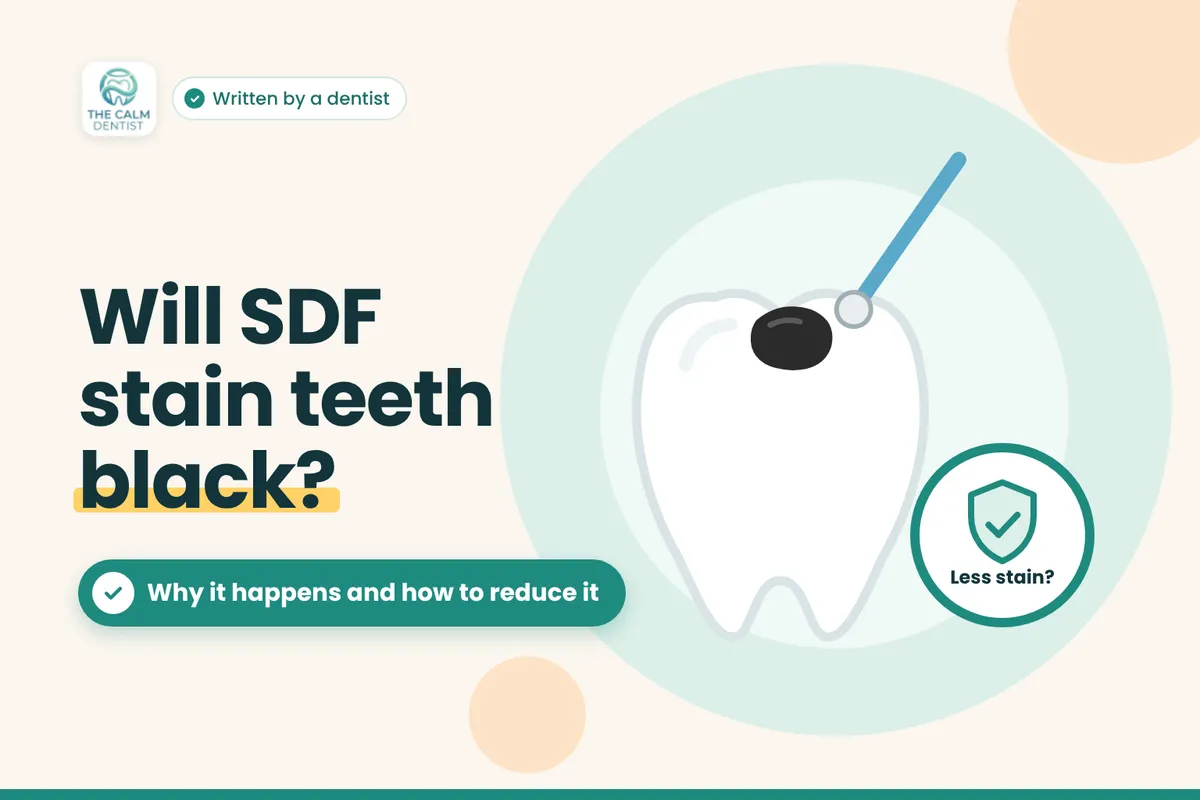
The trade-off is the color. SDF turns decayed areas of the tooth black. I have spent several years researching that staining, so this guide explains what SDF does, why the black color happens, what can and cannot be done about it, and how to decide whether SDF is right for you or your child.
Quick answer: what is silver diamine fluoride?
- What it is: a clear liquid containing silver and fluoride ions, stabilized with ammonia. Your dentist brushes it onto the decayed area for about a minute or two, following the product’s instructions.
- What it does: the silver kills decay-causing bacteria and the fluoride hardens the softened tooth, so it can stop (arrest) many cavities from progressing. It does not rebuild the tooth.
- The main downside: the decayed part of the tooth turns permanently black or dark brown. Healthy enamel around it is not usually stained.
- Who is it suitable for: young children, people with dental anxiety or special health needs, and older adults with decay on exposed roots.
How does silver diamine fluoride stop tooth decay?
Silver diamine fluoride has a two-pronged effect. The American Academy of Pediatric Dentistry (AAPD) describes it as an antimicrobial and remineralizing agent (AAPD fact sheet):
- Fluoride ions remineralize the tooth. They are taken up into the demineralized enamel (the outer layer of the tooth) and help replenish the lost minerals. Fluoride also has a limited antibacterial effect.
- Silver ions mainly act against bacteria, killing the harmful bacteria that cause cavities.
According to the AAPD, clinical studies report that SDF arrests roughly half to nine in ten treated cavities, depending on where the cavity is, how big it is and how well the area is cleaned at home. Results were better when SDF was applied twice a year. A 2024 Cochrane review found the evidence is promising but of low to moderate certainty, and more high-quality trials are needed (Cochrane, 2024).
Why does silver diamine fluoride turn teeth black?
When silver diamine fluoride is applied, the silver forms dark silver products in the decayed, softened part of the tooth, and these darken further on exposure to light. They stain the demineralized enamel or dentin black. Because the stain forms in the damaged tissue itself, it sits exactly where the cavity is, while healthy enamel nearby usually keeps its normal color.
On a back tooth this is often barely noticeable. On a front tooth it can be very visible, which is why staining is the concern parents raise most often.
Does the SDF stain fade, and can it be removed?
On the tooth, the stain is permanent. It does not fade with brushing, and you should not try to scrub or whiten it off. The Cochrane review and NHS patient information both describe the black color on treated decay as permanent (NHS Scotland: SDF for adults).
If the look bothers you later, a dentist can usually cover the stained area with a tooth-colored filling once the decay has been stopped, or mask the staining with a porcelain veneer or crown. In children, baby teeth with SDF are eventually replaced by adult teeth.
Can SDF staining be reduced? What the research shows
This is the question my own research has focused on. In a 2023 systematic review, my colleagues and I reviewed the published studies on reducing SDF staining (Asghar et al., Journal of Esthetic and Restorative Dentistry, 2023). The main findings:
- Potassium iodide (KI): applying KI straight after SDF significantly reduced staining in eight of the nine studies that tested it. Some products, such as Riva Star (SDI), come as a two-step kit: SDF followed by potassium iodide.
- Newer formulations: alternatives such as nano-silver fluoride and other modified products have also been studied, but the evidence for them is more limited.
- The limitation: most of this evidence comes from laboratory studies. Clinical trials are still needed to confirm how well these approaches work in people, and whether they affect how well SDF stops decay.
If staining worries you, ask your dentist before treatment whether they use a stain-reducing step. It is a reasonable question, and a good dentist will explain the options.
SDF stains on the skin, lips or gums
If SDF touches the lips, skin or gums, it can leave a brown or dark mark. This is a common worry for parents, but these marks are temporary. They tend to disappear in two to three weeks as the skin naturally renews. Avoid scrubbing hard, which can irritate the skin. SDF can, however, permanently stain clothes and surfaces.
Silver diamine fluoride for children and toddlers
SDF is widely used for young children because it is quick and painless, and it can stop decay in a child who is too young or too anxious for a filling. It is also helpful for children with special health care needs, for whom a long appointment or general anesthesia may be difficult.
The AAPD stresses that SDF is not a cure. Treated teeth need regular check-ups, SDF may need to be reapplied, and some teeth will still need a filling or other treatment later. A dentist should examine the tooth first, because a cavity that is deeper than it looks, especially one close to the nerve, may not be suitable for SDF.
SDF for adults: SDF or a filling?
For adults, SDF is used most often for decay on exposed tooth roots, especially in older people, and for patients who cannot easily have a filling. It is a simple treatment for root surface decay that can avoid the need for a filling in some cases.
Whether SDF or a filling is better depends on where the cavity is, how deep it is, how visible the tooth is, and how you feel about treatment. A filling restores the tooth’s shape and color, while SDF stops the decay without drilling but leaves the area dark. For a nervous adult, SDF can also be a useful first step to stabilize a tooth until you feel ready for further care. If you do choose a filling, some sensitivity afterward is common; here is our guide on what is normal after a filling.
Is silver diamine fluoride safe? Side effects
Silver diamine fluoride is used by dental teams worldwide and is generally considered safe when applied by a dental professional. In the United States, the FDA has cleared SDF for treating tooth sensitivity and has given it breakthrough therapy designation to encourage research into its use for stopping decay, according to the AAPD.
Possible side effects include:
- Permanent black staining of the treated decay
- Temporary brown marks on the gums, lips or skin
- A short-lived metallic taste
- Mild, temporary irritation of the gums
SDF is not suitable for everyone. People with a silver allergy should not have it, and teeth with deep decay reaching the nerve are not good candidates. Tell your dentist about any allergies before treatment.
How often is SDF applied, and how long does it last?
There is no single schedule. The AAPD recommends basing it on each person’s risk, and the best results in studies came from applying SDF twice a year. NHS guidance says it can be repeated every six months. Your dentist will check the treated teeth at each visit to see whether the decay has stayed hard and inactive.
Cost varies widely by country, clinic and insurance. SDF is usually quicker and less expensive than a filling, but ask your dental office for the exact fee and whether your plan covers it.
FAQs
Does silver diamine fluoride hurt?
No injection or drilling is needed. The liquid is simply brushed onto the tooth. Some people notice a brief metallic taste.
Will SDF stain healthy teeth?
The black color forms mainly in decayed, softened tooth tissue. Healthy enamel nearby usually stays its normal color, although SDF can discolor some tooth-colored fillings. NHS guidance notes that this can usually be polished away.
Is the black stain a sign that SDF is working?
The darkening shows the silver has reacted with the decayed area, and a hard, dark surface is often a sign the decay has been arrested. Your dentist will confirm this by checking the tooth at follow-up visits.
Can SDF replace a filling?
Sometimes. SDF can stop decay without a filling, particularly in baby teeth and on root surfaces. But it does not rebuild the tooth, so some teeth will still need a filling, a crown or other treatment later.
Does SDF work on adult teeth?
Yes. It is used in adults, especially for root decay in older people. Whether it is the right choice depends on the cavity and how visible the tooth is.
Final thoughts
Silver diamine fluoride is a quick, painless way to stop many cavities, especially for young children, anxious patients and older adults with root decay. Its one big drawback is permanent black staining of the treated decay. Knowing that in advance, and asking your dentist whether a stain-reducing step is an option, will help you make a calm, informed choice.
Medical Disclaimer: This article is for general educational purposes only and is not a substitute for diagnosis or treatment from your own dentist, physician, or qualified healthcare professional. If you have severe pain, swelling, fever, trauma, pus, difficulty opening your mouth, or symptoms that are getting worse, seek professional care promptly.

Dr. Mehmood Asghar, BDS, MPhil, PhD, is a dentist and Assistant Professor of Dental Materials at Army Medical College, National University of Medical Sciences (NUMS), Pakistan. He holds a BDS from NUST and a PhD from Universiti Malaya. His clinical, teaching and research background helps him explain dental treatments, recovery and oral health evidence in clear, practical language for patients. He writes and clinically reviews the guides at The Calm Dentist.