Quick answer: What are All-on-4 dental implants? All-on-4 replaces a full upper or lower arch of teeth with a fixed bridge supported by four implants. The two rear implants are tilted to use available bone. Same-day temporary teeth are possible only when clinical conditions and implant stability allow. The final bridge is fitted later. Suitability, healing time and cost depend on your individual treatment plan.
Find your question: Am I suitable? · How does it compare with dentures? · What happens during treatment? · What is recovery like? · How long does it last? · How much does it cost?
What Are All-on-4 Dental Implants?
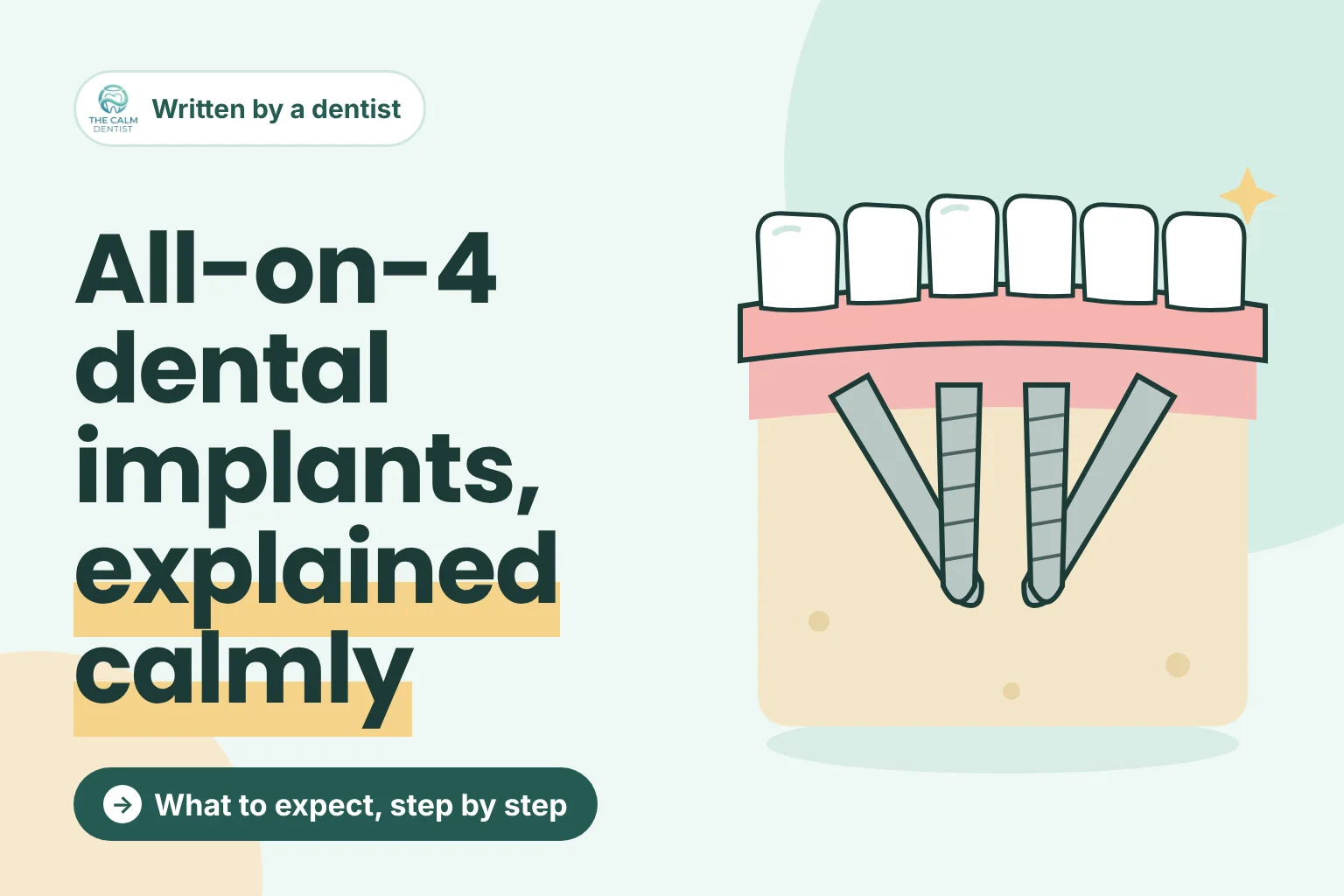
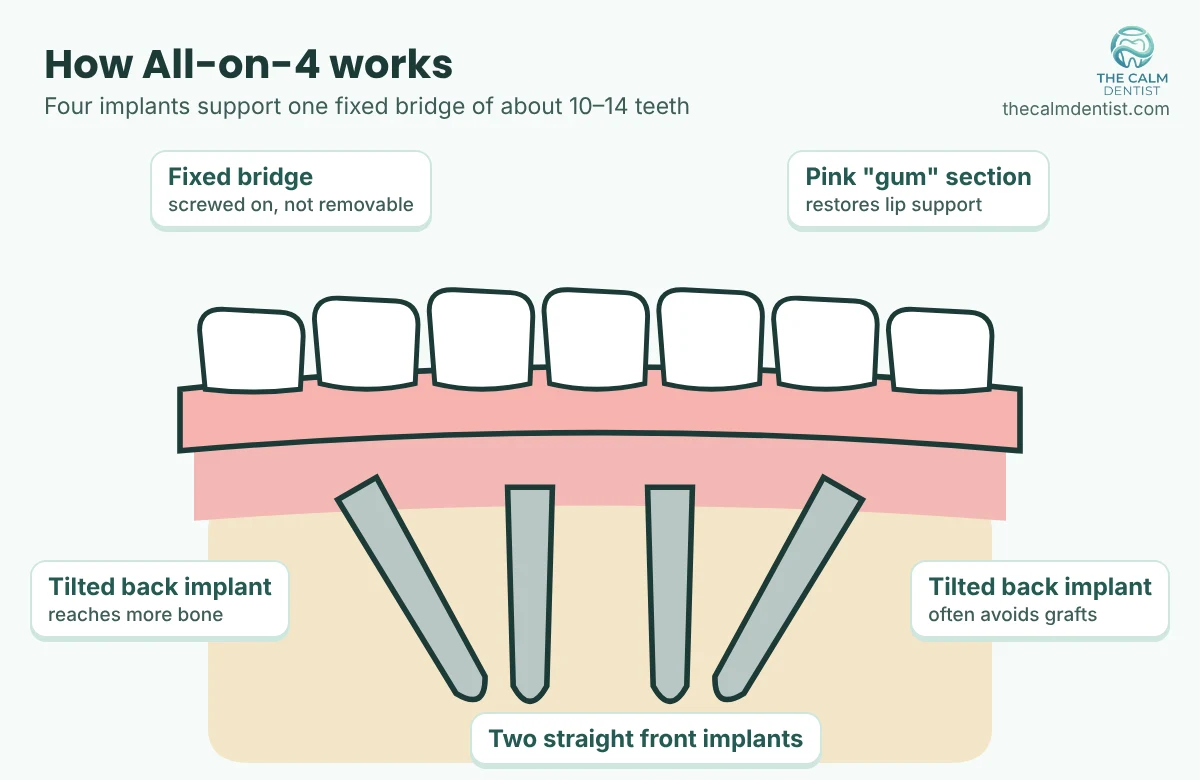
All-on-4 dental implants are a way of replacing all the teeth in your upper or lower jaw with a fixed bridge supported by four implants. Two implants go straight in at the front of the jaw, and two go in at an angle farther back. The bridge is screwed onto all four, so it stays in your mouth. Only your dentist can remove it.
The angled back implants are the clever part. Tilting them lets them reach longer into the bone and spread the bridge’s support further back. Often that avoids the sinus in the upper jaw and the nerve in the lower jaw, which can mean fewer bone grafts than placing implants straight.
You’ll also hear it called “full-arch implants,” “teeth in a day” or “All-on-X.” Strictly speaking, All-on-4® is Nobel Biocare’s trademarked treatment concept, and many clinics use similar techniques with other implant brands or with five or six implants.
Who Is a Good Candidate for All-on-4 Dental Implants?
All-on-4 is usually considered when most or all of the teeth in one jaw are missing or can’t be saved. Tooth loss is common: in the US, about 17% of adults aged 65 and over have lost all their natural teeth.⁴ You may be a good candidate if:
- Most of your teeth in one jaw are failing, loose or already gone
- You’re tired of a loose or uncomfortable denture
- You have enough bone in the front of the jaw for four implants (a 3D scan will show this)
- Your general health allows minor oral surgery
- Any gum disease has been treated, and you’re ready to clean your new teeth daily
What if I have bone loss?
Bone loss doesn’t automatically rule you out. Tilting the back implants is designed to work with reduced bone. If there still isn’t enough, your dentist may suggest a dental bone graft or a sinus lift first, or, in severe cases, zygomatic implants anchored in the cheekbone.
Smoking and diabetes
Smoking is one of the biggest risks to any implant. A 2021 meta-analysis of 292 studies found implants in smokers had about 2.4 times the odds of failing compared with non-smokers.⁵ If you smoke, stopping (even temporarily around surgery) gives your implants a much better start. Diabetes is not usually a barrier if it’s well controlled, so tell your dentist about your latest blood sugar results.
All-on-4 vs All-on-6, Dentures and Snap-In Dentures
| Feature | All-on-4 | All-on-6 | Snap-in denture (overdenture) | Conventional denture |
|---|---|---|---|---|
| Implants per arch | 4 | 6 | Usually 2–4 | None |
| Fixed or removable? | Fixed (only your dentist removes it) | Fixed | Removable; clips onto implants | Removable |
| Covers the roof of the mouth? | No | No | Often not (upper may need a palate) | Upper usually does |
| Bone needed | Moderate (tilted implants help) | More | Less | None |
| Relative cost | High | Higher | Moderate | Lowest |
| Daily cleaning | Around and under a fixed bridge | Around and under a fixed bridge | Remove and clean | Remove and clean |
All-on-6 spreads the load over two more implants, which some dentists prefer for heavy biters or softer bone, but it needs more bone and costs more. A snap-in denture is a good middle ground if you want much better stability than a normal denture without the cost of a fixed bridge.
The All-on-4 Dental Implants Procedure, Step by Step
- Consultation and 3D scan. Your dentist examines your mouth, takes a CBCT (3D) scan and photos, and plans exactly where the implants will go. Ask to see the plan; a good clinic will happily explain it.
- Surgery day. Any remaining failing teeth are removed, the four implants are placed, and the gums are stitched. This is usually done in one appointment under local anaesthetic, often with sedation.
- Temporary teeth. When the implants are firm enough, a fixed temporary bridge is attached, usually the same day or the next. This is what “teeth in a day” means.
- Healing (about 3–6 months). The implants fuse with your jawbone (osseointegration). You’ll eat a softer diet and have check-ups so your dentist can adjust the bridge.
- Final bridge. New scans or impressions are taken, and your final, stronger bridge is made and fitted.
- Long-term care. Regular check-ups and professional cleans, with the bridge removed by your dentist when needed.
How Many Teeth Do You Get, and What Are They Made Of?
An All-on-4 bridge usually carries 10 to 14 teeth per arch. Because a lot of gum and bone shrinks after teeth are lost, the bridge often includes a pink, gum-coloured section to restore your lip support and smile.
Temporary bridge vs final bridge
Most patients get two bridges. The temporary bridge is fitted soon after surgery, usually within a day or so, and is made of acrylic (a hard plastic). It’s designed to be light and kind to the healing implants. After a few months of healing, the final bridge is made, usually stronger and more natural-looking.
Acrylic, zirconia or hybrid: a dental materials view
- Acrylic teeth on a metal or titanium frame: lighter and easier to repair, and usually cheaper. The trade-off is that acrylic wears and can chip or crack over the years. In a large review, fracture of all-acrylic bridges was the most common complication.¹
- Zirconia: a very strong, tooth-coloured ceramic. It resists wear and staining well, but it’s harder and heavier to repair if it does break, and usually costs more.
- Hybrid designs: combine a strong frame with porcelain or composite teeth, trying to balance strength, looks and repairability.
There’s no single best material for everyone. It depends on your bite force, whether you grind your teeth, your budget and how the opposite jaw is restored. Ask your dentist why they recommend one material over another.
Does All-on-4 Hurt? Sedation and Comfort for Anxious Patients
This is the question I’m asked most, and it’s completely understandable. The surgery itself shouldn’t be painful. Your mouth is fully numbed with local anaesthetic, and you’ll feel pressure and vibration rather than sharp pain. If you’d like to understand the numbness itself, see how long dental numbing lasts.
Because the appointment can be long, many clinics offer extra help:
- Oral sedation: a tablet that makes you calm and drowsy.
- IV sedation: medicine through a vein that keeps you deeply relaxed; many patients remember very little afterwards.
- General anaesthetic: you’re fully asleep, usually in a hospital or specialist setting.
Afterwards, expect soreness, swelling and some bruising, which usually peak around day 2–3 and settle over one to two weeks. Most people manage with the pain relief their dentist recommends. Tell your dentist upfront that you’re anxious. It isn’t an inconvenience; it helps them plan your care.
Questions to ask about comfort
- What sedation do you offer, and who monitors me during it?
- How long will the appointment take?
- Can I have breaks, and how do I signal if I need one?
- What pain relief should I have ready at home?
- Who do I call if I’m worried after hours?
All-on-4 Recovery: What to Expect Week by Week
- Days 1–3: swelling, bruising and tenderness are normal. Rest, keep your head raised, use cold packs and stick to liquids and very soft foods.
- Week 1–2: swelling and bruising fade. Stitches dissolve or are removed. Many people return to desk work within a few days to a week.
- Weeks 2–8: a soft “fork-mashable” diet protects the healing implants. Avoid biting into hard or chewy food with the temporary teeth.
- Months 3–6: the implants integrate with the bone, and you move on to your final bridge.
Call your dentist if you have bleeding that won’t stop with pressure, swelling that keeps increasing after day 3, fever, a bad taste with pus, or if the temporary bridge feels loose or cracked.
Is bruising normal after All-on-4 dental implants?
Some facial bruising and swelling can follow implant surgery. Leeds Teaching Hospitals notes that these effects vary with the extent of surgery and the individual response, and may be worse during the first 24–48 hours.11 Full-arch treatment can also involve extractions or grafting, so use your surgeon’s recovery instructions rather than another patient’s photograph as your timetable.
Contact your dental team if pain or swelling is worsening rather than settling, or if you develop fever, discharge, persistent bleeding or a loose temporary bridge. Difficulty breathing or swallowing requires emergency help.
Getting Used to Your New Teeth
Something nobody warns you about: a new full-arch bridge can feel strange at first. Many patients notice:
- Bulkiness: your tongue and lips are used to a different shape.
- Speech changes: a slight lisp or whistle on “s” sounds is common for the first few weeks.
- A different bite: chewing feels different without natural tooth roots to give feedback.
- Heightened awareness: you may keep noticing the teeth with your tongue.
For most people, this settles over several weeks as your mouth and brain adapt. Reading aloud helps speech. If you’re still struggling after a couple of months, or the bite feels genuinely uneven, tell your dentist: small adjustments to the bridge shape can make a big difference. If you tend to notice every small change, why anxiety can make your teeth feel weird may help too.
How Long Do All-on-4 Implants Last? What the Research Says
The research is encouraging, especially for the implants themselves:
- A systematic review of 13 studies and 4,804 implants found that 74 implants failed (about 1.5%), most of them in the first year.¹
- In a study of 245 patients followed for up to 10 years, 94.8% of lower-jaw implants survived, and 99.2% of the bridges were still in use.²
- In the upper jaw, a study of 1,072 patients followed for 5–13 years reported 94.7% implant survival.³
- A 2021 review of long-term studies reported implant survival of roughly 94–98% over 6–11 years, with no meaningful difference between the tilted and straight implants.⁶
Two important caveats. First, much of the long-term data comes from experienced clinics, and some studies lost track of a portion of their patients, so real-world results may vary. Second, the implants usually outlast the teeth on top. Bridges, especially acrylic ones, can need repairs or replacement after some years, so ask what’s covered and what maintenance costs to expect.
What problems can occur with All-on-4 dental implants?
- It’s a big, largely irreversible decision. Remaining teeth are usually removed. Make sure any teeth that could be saved have been considered.
- Bridge chips and fractures: the most common problem, especially with acrylic bridges.¹
- Peri-implantitis: gum inflammation with bone loss around implants. A review estimated it affects about 22% of implant patients, while milder gum inflammation (mucositis) affects about 43%.⁷ Good cleaning and regular check-ups lower the risk.
- Food trapping under the bridge, which needs a water flosser or special floss to clear.
- If one implant fails, the bridge may need temporary changes while it’s replaced. Four implants leave less “spare” support than six.
- Cost and follow-up: it’s a significant investment, and treatment far from home (including abroad) makes follow-up harder if something goes wrong.
| Pros | Cons |
|---|---|
| Fixed teeth, so no loose denture | Surgery, with a few months of healing |
| Temporary teeth usually within a day or so | Remaining teeth are usually removed |
| Tilted implants often avoid bone grafts | Bridge chips or fractures can happen |
| High long-term implant survival in studies | Higher upfront cost than dentures |
| No plate covering the roof of the mouth | Needs careful daily cleaning and regular check-ups |
How to Clean and Care for All-on-4 Implants
- Brush twice a day with a soft brush, paying attention to where the bridge meets the gum.
- Use a water flosser once a day to rinse under the bridge.
- Superfloss or interdental brushes help clean around each implant.
- See your dentist for check-ups, usually every 3–6 months at first. From time to time, they may remove the bridge to clean thoroughly and check the implants.
- Wear a night guard if you grind your teeth, to protect the bridge.
If you notice white or swollen tissue around an implant, our guide to white tissue around a dental implant explains what’s normal and when to call.
How Much Does All-on-4 Cost?
All-on-4 dental implant costs vary widely by location, materials, and what’s included. According to CareCredit’s cost data, the national average for All-on-4 in the US is about $15,176, with prices ranging from about $11,640 to $27,500. CareCredit lists full-mouth treatment (both arches) separately, so treating both jaws costs more.⁸ Always ask whether a quote includes extractions, the temporary and final bridges, scans, sedation and follow-up visits. For a full breakdown, read why dental implants are so expensive.
How much do All-on-4 dental implants cost with insurance?
There is no single insured price for All-on-4. Some dental plans contribute toward implants, but coverage depends on the specific plan and the services being billed. Delta Dental advises requesting a pre-treatment estimate before implant treatment. An estimate helps you compare the proposed fee, the expected benefit and your remaining share; it is not a guarantee of payment.9
Ask the dental office for an itemized plan covering extractions, implants, abutments, temporary and final bridges, scans, sedation and follow-up. Ask your insurer which items are covered, whether exclusions or waiting periods apply, and how deductibles, network rules and the remaining annual maximum affect your benefit. An annual maximum limits what the plan pays during its benefit year, so a percentage benefit does not necessarily mean that percentage of the whole All-on-4 bill will be paid.10 Get the answers in writing before committing to treatment.
What patients often wish they’d known
- The temporary teeth are not the final result. They’re lighter and simpler on purpose.
- The soft-food weeks are real, so plan meals before surgery.
- Speech and the “bulky” feeling usually improve with time.
- Ask exactly what happens, and what it costs, if a bridge chips or an implant fails.
- A second opinion is normal for treatment this big.
Questions to Ask Your Dentist Before All-on-4
- Can any of my teeth be saved instead?
- Why All-on-4 for me, rather than All-on-6 or a snap-in denture?
- Do I need a bone graft or sinus lift?
- Which implant system and which bridge material will you use, and why?
- How many full-arch cases have you done?
- What sedation options do you offer?
- What does the quote include, and what could change it?
- What happens, and what does it cost, if the bridge breaks or an implant fails?
- How often will I need check-ups and professional cleans?
The Bottom Line
All-on-4 dental implants can give you fixed, natural-looking teeth with fewer implants and often without bone grafts, and long-term studies are reassuring. But it’s a major, mostly irreversible treatment with real trade-offs: healing time, possible bridge repairs and ongoing care. Take your time, ask questions, get a second opinion if you need one, and choose a dentist who makes you feel heard. Feeling nervous is normal; feeling rushed is not.
Frequently Asked Questions
How do I care for All-on-4 implants?
Brush the bridge twice a day with a soft brush, and clean underneath it every day with a water flosser, floss threaders, or small interdental brushes. Eat soft foods while you heal, as your surgeon advises, and keep your regular checkups. Your dental team may remove the bridge from time to time for a deeper cleaning. Avoid smoking, which raises the risk of problems around implants.
Do people regret getting All-on-4?
Many people are happy with All-on-4, but some do have regrets. Common ones are a longer adjustment period than expected, changes in speech at first, the cost, food getting trapped under the bridge, or how the teeth look. You can reduce these risks by asking questions first: see photos of the dentist’s past cases, ask about maintenance, and ask what happens if something breaks.
Do you get permanent teeth on the same day?
Same-day teeth usually refer to a temporary fixed bridge, rather than the final restoration. Not everyone is suitable for immediate loading. Nobel Biocare specifies that patient criteria and adequate implant stability must be met. Ask what temporary teeth you will receive, what happens if immediate loading is unsuitable, and when the final bridge is planned.
Are All-on-4 implants permanent?
The bridge is fixed, so you can’t take it out yourself. Only your dentist can remove it for cleaning or repairs. The implants are designed to last many years, but the teeth on top may need repair or replacement over time.
How many teeth do All-on-4 implants have?
Usually 10 to 14 teeth per arch, depending on your mouth and the design of the bridge.
Do All-on-4 implants look natural?
A well-designed bridge can look very natural, including the gum section. Zirconia and porcelain usually look the most lifelike. Ask to see before-and-after photos of the clinic’s own patients.
Can I get All-on-4 if I have gum disease?
Often yes, because the affected teeth are usually removed during treatment. But gum disease must be brought under control first, and you’ll need excellent cleaning afterwards to protect the implants.
How long after All-on-4 can I eat normally?
You’ll start on liquids and very soft foods, then a soft diet for the first couple of months while the implants heal. Most people return to a normal diet once the final bridge is fitted, usually 3–6 months after surgery. Follow your own dentist’s instructions.
Can I have an MRI with All-on-4 implants?
Titanium implants are generally considered safe for MRI, though they can affect image quality near the jaw. Always tell the MRI team you have dental implants.
Is All-on-4 worth it?
For many people with failing teeth or a denture they can’t tolerate, fixed teeth make a big difference to eating, confidence and comfort. It’s worth it when the plan suits your mouth, your budget and your willingness to look after it, and when you’ve weighed the alternatives.
References
- Patzelt SBM, Bahat O, Reynolds MA, Strub JR. The all-on-four treatment concept: a systematic review. Clin Implant Dent Relat Res. 2014;16(6):836–855. PMID: 23560986.
- Maló P, de Araújo Nobre M, Lopes A, Moss SM, Molina GJ. A longitudinal study of the survival of All-on-4 implants in the mandible with up to 10 years of follow-up. J Am Dent Assoc. 2011;142(3):310–320. PMID: 21357865.
- Maló P, de Araújo Nobre M, Lopes A, Ferro A, Nunes M. The All-on-4 concept for full-arch rehabilitation of the edentulous maxillae: a longitudinal study with 5–13 years of follow-up. Clin Implant Dent Relat Res. 2019;21(4):538–549. PMID: 30924250.
- Centers for Disease Control and Prevention. Oral Health Surveillance Report 2019, Table 35: Adults 65+ who have lost all their natural teeth.
- Mustapha AD, Salame Z, Chrcanovic BR. Smoking and dental implants: a systematic review and meta-analysis. Medicina (Kaunas). 2021;58(1):39. PMC8780868.
- Gaonkar SH, Aras MA, Chitre V, et al. Survival rates of axial and tilted implants in the rehabilitation of edentulous jaws using the All-on-four concept: a systematic review. J Indian Prosthodont Soc. 2021;21(1):3–10. PMC8061444.
- Derks J, Tomasi C. Peri-implant health and disease. A systematic review of current epidemiology. J Clin Periodontol. 2015;42 Suppl 16:S158–S171. PMID: 25495683.
- CareCredit. All-on-4 dental implant cost and procedure guide. Accessed November 2026.
- Delta Dental. Dental implants cost and insurance; Pre-treatment estimates.
- Delta Dental. What is a dental insurance annual maximum?
- Leeds Teaching Hospitals NHS Trust. Dental implants: swelling and bruising after surgery.
This guide is general information, not a personal treatment plan. Always follow the advice of the dentist who examines you. Last reviewed: November 2026.
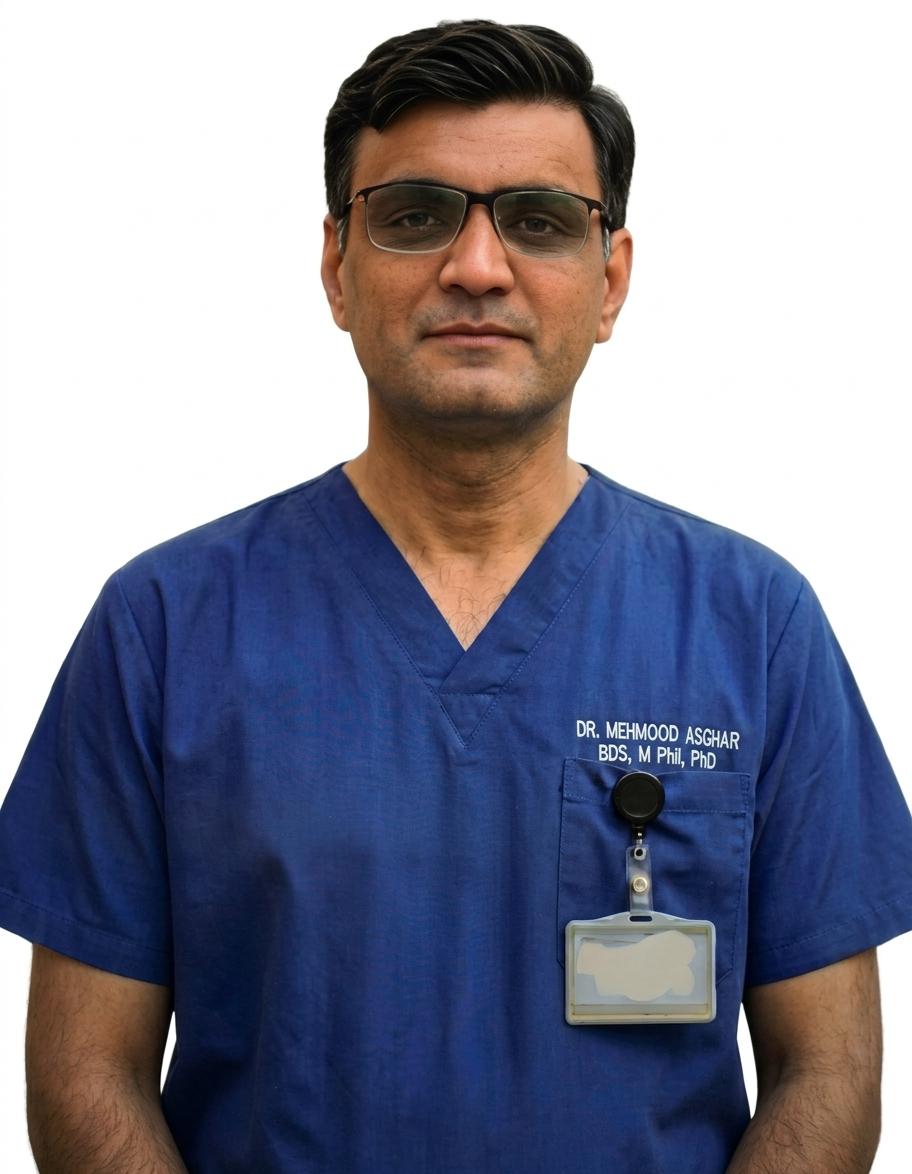
Dr. Mehmood Asghar, BDS, MPhil, PhD, is a dentist and Assistant Professor of Dental Materials at the National University of Medical Sciences (NUMS), Pakistan. He holds a BDS from NUST and a PhD from Universiti Malaya. His clinical, teaching and research background helps him explain dental treatments, recovery and oral health evidence in clear, practical language for patients. He writes and clinically reviews the guides at The Calm Dentist.